





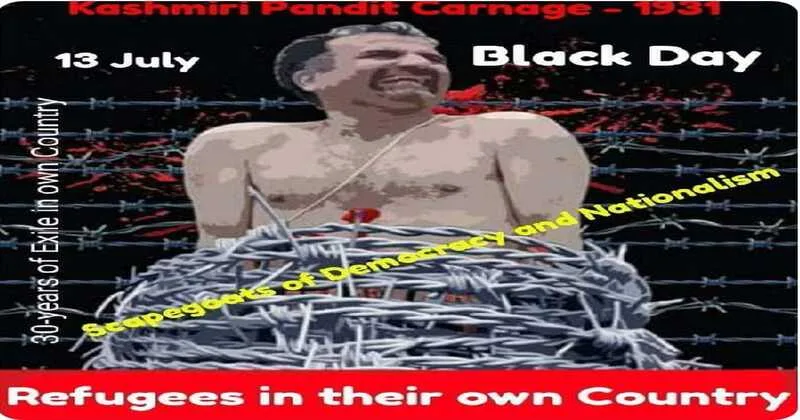
New Delhi: Consequent upon the controversy being raised by the Kashmir centric political class in context of 13 July, Ashwani Kumar Chrungoo, senior BJP & Kashmiri Pandit leader and Human Rights Defender issues the following statement:
“Maharaja Hari Singh represented the Association of the Princely Ruled States of India in the Round Table Conference in London in 1930 wherein he pleaded the cause of Independence from the British occupancy. With this got initiated the conspiracy against the Dogra Maharaja by the British and the Muslim elite in the State and were thereupon used by the British against the Maharaja and the Dogra rule.
The Muslim students who were sent by the Maharaja to Aligarh Muslim University for higher education on the State scholarships became the pioneers of the resentment against the Maharaja in Kashmir. Sheikh Mohammad Abdullah was one of the leading figures who raised the banner of revolt and organised a movement against the Dogra regime. He constituted Srinagar Study Circle which later on took the shape of J&K Muslim Conference in Srinagar.
It was the same Muslim Conference that spearheaded the revolt against the Maharaja in 1931 and generated hatred towards the Hindu minorities of Kashmir. With this were founded the concepts of Muslim fundamentalism and Muslim majoritarianism in the Saffron Valley of Kashmir that later on took the political shape in the 1931 carnage against the Hindu minorities.
The Kashmiri Pandits have been observing 13th July as BLACK DAY every year. It is the day when the minority Hindu community became victim of the first attempt of genocidal acts of the 20th century in Kashmir against them. There were many players who contributed to the mayhem – some acted consciously, some sub-consciously and some without any conscience. All these actors did not act in tandem, but all their actions were aimed in one direction.
The British government, after the Round Table Conference in London, decided to weaken the position of Maharaja of Kashmir, Hari Singh. The Maharaja, as the representative of the Princely Ruled States of India in the Conference, took a very strong position against the British Raj in India. The British propped up an agent (who was already in their circuit) Abdul Qadeer, a non-state subject from Peshawar, and assigned him the un-coveted job to incite the Muslim population of Jammu and Kashmir against the Maharaja. He did his job meticulously on various fronts.
On the other hand, the Muslim Conference (now J&K National Conference) spearheaded the campaign against the Maharaja and got involved in a number of intrigues in this connection. The focus of the campaign was that the Maharaja was a Hindu King and belonged to Jammu; as such he should ‘Quit Kashmir’.
There were other communal forces also active in the Valley who believed that Kashmir was deprived of the ‘Muslim rule’ because of the Kashmiri Pandits, and therefore they ought to pay a price for being the nationalists. Since Kashmiri Pandits belonged to the Hindu fraternity and the Maharaja was also a Hindu, therefore, it was assumed that the Hindu community should be held responsible for continuance of the Maharaja’s rule in Kashmir.
A conspiracy was hatched to loot and burn the Hindu houses and property in Srinagar city on Aashad Chaturdashi (the Birthday of Mata Shri Jwala Devi Ji of Khrew). This day fell on 29th July in 1931. People in the Srinagar city would usually go in large numbers to the sacred shrine of Shri Jwala ji at Khrew (now in Pulwama district) on this occasion. It was decided by the conspirators to take advantage of their (KPs’) absence and loot and burn their properties on Har-Chodah (Aashad Shukla Chaturdashi), the Isht-Devi’s day. However, the conspiracy got leaked well before the ‘doomsday’ but the chalked out plan remained in the storehouses of the minds of the conspirators and their followers.
Around the same time, a ‘rebellion’ was orchestrated in the Central Jail at Hariparbat, Srinagar on 12-13 July 1931 which was supported and incited by Abdul Qadeer from within and outside the Jail premises. Thousands of Muslim conference workers and other activists joined the prisoners who broke out of the jail and went berserk and off the rocker.
In accordance with the earlier chalked out plan, the mobs under the supervision and leadership of social, religious and political activists, looted Hindu properties and houses at Vicharnag, Maharaj Ganj (the hub of business activity), Amirakadal, Hari Singh High Street and parts of Bohrikadal. In Kanikoot Village (now in Badgam district) Hindus were mercilessly beaten, their properties vandalized and the members of one family were thrown out from the windows of their three-storey house and brutally killed. The Hindu community of all hues in the valley was taken aback; this carnage shook its confidence because of the fact that it did not become victim of any riots but had to face a ONE SIDED RAID, for no fault of theirs.
Prof. Ram Nath Kaul, educationist and Principal (Retd.) of Government Degree College, Bemina, Srinagar in his book on Sheikh Mohd. Abdullah gives an account of the happenings of 13th July 1931. Prof Kaul had developed proximity with National Conference and Sheikh Abdullah. His book titled “Sheikh Mohammad Abdullah: A Political Phoenix” was released in 1985 and it is believed that the Sheikh had seen its manuscript. The writer, while describing the incident says that when the prisoners broke out of the jail and joined the rampaging mobs, looted and burnt the Hindu properties, the police (though in small numbers) in order to control the situation, fired gun shots. Some people in the mob were injured. The mobs, with their injured fellows and some seriously injured ones, reached Mujahid Manzil. the headquarters of Muslim Conference. They were greeted by Sheikh Abdullah. One of the seriously injured fell into the lap of the Sheikh and said, “Sheikh Sahib, Aap ney hamen jaisa kaha tha, humney vaisa kar diya” (whatever you had told us, we did the same), and with this he breathed his last in the lap of the Sheikh.
The dead marauders were designated as ‘martyrs’ by the Muslim political structures of Kashmir in due course of time. The Kashmiri Pandits used to call this fateful day as “Bata-loot” with effect from 1932. Some would call the ‘martyrs day fanfare’ as ‘Lootus-Vorus’. There was also a slogan carved out like:“Har Chodah:Batan Seit Dagah”. This day, historically, was observed by the Hindus of Kashmir at Sheetalnath -Srinagar as BLACK DAY. In exile, for the last 35 years, the Pandits observe this day every year and register their rejection of the so-called “martyrs’ day theory”.
The July 13 as BLACK DAY reveals how genocide was planned against the Kashmiri Pandits by the local fundamentalist, seperatist elements and dogmatic forces, when there was no existence of Pakistan. It was the beginning of the process the climax of which was seen in 1989-90. In fact there was always a historical intent to ethnically cleanse Kashmir of Kashmiri Hindus and the so-called movement for separatism and later terrorism had their ideological and political roots in the July 13, 1931 political and communal upheaval and carnage.












Comments