
Operation Sindoor exemplified Bharat’s strategic strength and technological prowess. By targeting terror camps and enemy infrastructure swiftly and precisely using indigenously developed drones and missile defence systems, the operation highlighted the nation’s ability to protect its sovereignty through Swadeshi technologies. This successful military initiative showcased not only the bravery of our armed forces but also the scientific excellence of our indigenous defence ecosystem. As stated by our Honourable Prime Minister, Operation Sindoor is not over—it continues, not just at the borders but now within our homes and markets through our economic decisions.
At this juncture, assessing the role of foreign MNCs and their influence on our markets is a long-overdue exercise. It is essential to decipher the forces beyond economies—those that hold sway over nations and their sovereignty to the extent that suits their interests. However, Operation Sindoor presents an opportunity to explore this economic domain, where the real battle is being waged under the smokescreen of international trade.
Swadeshi Beyond Borders: A Citizen’s Responsibility
Just as soldiers protect the nation at borders, the citizens have responsibility to protect its economy by adopting Swadeshi in their day to day lives. A truly self-reliant nation is one where its people manufacture, use, and invest in their own products, create employment for their people, and reinvest capital within the country.
‘Swadeshi’ is not merely a preference for indigenous products; it is a comprehensive and profound national philosophy that aims to achieve true self-reliance, cultural integrity, and economic sovereignty. As Dattopant Thengadi, aptly described, “Swadeshi is the practical manifestation of patriotism.” It reflects a spirit of national determination to attain self-sufficiency, uphold sovereignty, and promote global cooperation based on equality and mutual respect.
The use of foreign multinational (MNC) products drains national wealth and strengthens foreign economies. For instance, foreign FMCG giants such as Hindustan Unilever (UK/Netherlands), Nestlé India (Switzerland), Colgate Palmolive, PepsiCo, and Johnson & Johnson (USA) collectively earn over Rs1 lakh crore annually from markets of Bharat. These profits are largely repatriated to their home countries, many of which, directly or indirectly, maintain strategic partnerships with Pakistan—Bharat’s hostile neighbour.
Table-1: Economic Size of Foreign MNCs in FMCG Sector in Bharat
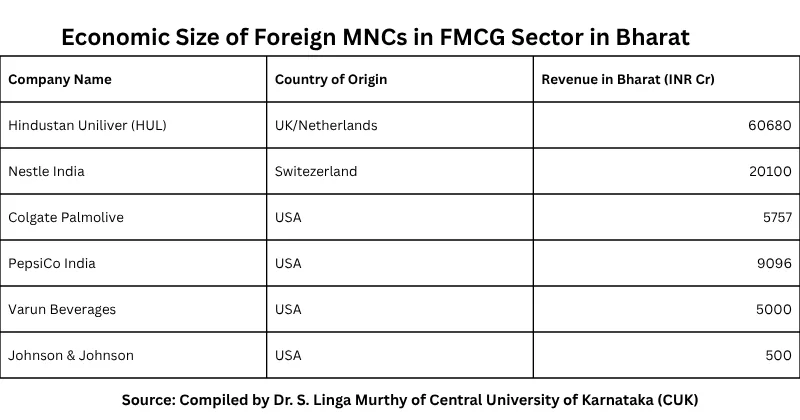
Table-1: Economic Size of Foreign MNCs in FMCG Sector in BharatEconomic Dependence Equals Strategic Vulnerability
Foreign control over critical sectors like electronics and FMCG is not merely an economic concern; it is a strategic vulnerability. Data from FY 2024–25 shows that selected foreign electronics companies earned over Rs 3.29 lakh crore in revenue from Bharat, with profits exceeding Rs 31,000 crore. In contrast, selected Bharatiya electronics firms collectively earned only Rs 1.01 lakh crore in revenue and Rs 2,824 crore in profits. Companies like Haier (China) reported profit margins as high as 55.2%, while Bharatiya brands like Godrej and Micromax operated on razor-thin margins below 1%.
Table-2: Bharatiya Market with Foreign Companies in Electronic Products in FY 2024-25
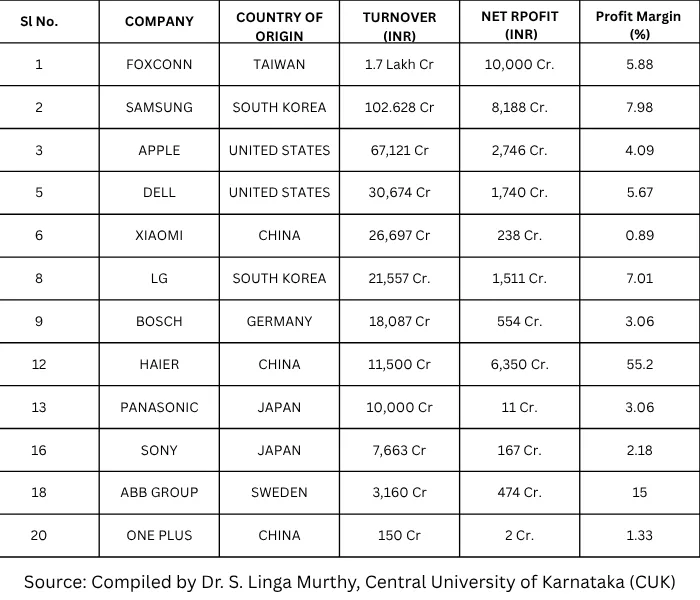
Table-3: Bharatiya Market with Bharatiya Companies in Electronic Products in FY2024-25
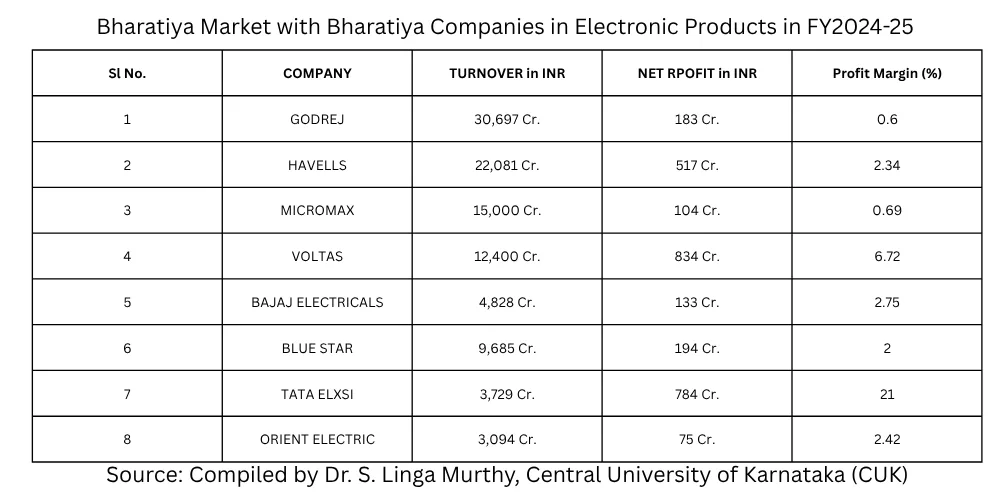
Data from a representative sample of 11 major foreign electronics firms show a combined turnover of Rs3.29 lakh crore and a net profit of Rs 31,029 crore. In contrast, eight Bharatiya companies together account for only Rs 1.01 lakh crore in turnover and Rs 2,824 crore in profits. This means foreign firms enjoy approximately 76.5% of the market revenue and a staggering 91.7% of the sector’s total profits.
The electronics sector is not just an economic domain—it is a foundation for national security, data sovereignty, and technological autonomy. Foreign control over hardware infrastructure opens Bharat to risks such as digital surveillance, backdoor access, and compromised supply chains.
Moreover, the dependency on imported semiconductors, routers, and communication hardware has a direct impact on Bharat’s strategic preparedness in an era of cyber warfare and AI dominance. This situation reflects a new kind of colonisation—technological and economic rather than military. As the data shows, Bharat is not just buying foreign products—it is funding foreign profits, importing dependency, and surrendering strategic control. Reclaiming our electronics market is not a question of protectionism, but of national survival and sovereignty. The path ahead must be guided by Swadeshi principles—not as isolationism, but as intelligent and culturally rooted self-reliance. The time has come to transform Bharat from a passive consumer of global tech to a proactive creator of indigenous innovation to the globe.
This dominance in foreign companies’ profit share means Bharatiya consumers are directly funding foreign technological advancement and strategic capacity. The United States and China—both of whom have provided military and economic aid to Pakistan—benefit enormously from the Bharatiya market. Their companies’ profits are used to develop defence technologies, support their own strategic agendas, and, in cases, indirectly empower Pakistan’s military apparatus.
The Unseen Cost: Funding Our Own Enemy
By purchasing foreign products, Bharatiya consumers inadvertently contribute to a disturbing cycle in a way that the earned profits from Bharat go to U.S.A. and Chinese companies and these companies pay taxes and dividends to their home countries. A portion of these funds and profits from Bharatiya soil is used by the U.S. and China to support Pakistan strategically or militarily, in turn, Pakistan uses that support to target Bharat and Bharatiya civilians and soldiers. In essence, we are indirectly funding threats to our own national security by patronising foreign MNCs. This makes the use of Swadeshi products not just an economic choice, but a patriotic responsibility.
Swadeshi as a Strategic Doctrine
True economic independence can only be achieved when citizens consciously adopt Swadeshi practices. Choosing Bharatiya brands in electronics, clothing, food, and daily-use items. Supporting Bharatiya entrepreneurs and industries in building capacity and innovation. Shifting public procurement policies to favour domestic companies with high local content. This is not about isolationism. It is about restoring balance, rebuilding internal strength, and ensuring that our consumption habits do not compromise our national interests. By using swadeshi, we can strengthen our domestic industry, exports, create employment opportunities to our young folks, we can empower our farmers and our mothers economically.
Conclusion
The call for Swadeshi is a call for strategic and economic awakening. Just as Operation Sindoor demonstrated the military might of Bharat, the economic battle must be won by its citizens. Swadeshi is no longer an ideological aspiration—it is a practical necessity. In this mission, every Bharatiya consumer is a soldier. Every rupee spent on Bharatiya products is a bullet in favour of Bharat’s sovereignty, security, and future.
Let us pledge to strengthen our nation not just with arms, but with economic wisdom. Let Swadeshi guide our wallets, our choices, and our vision for a strong and self-reliant Bharat.