





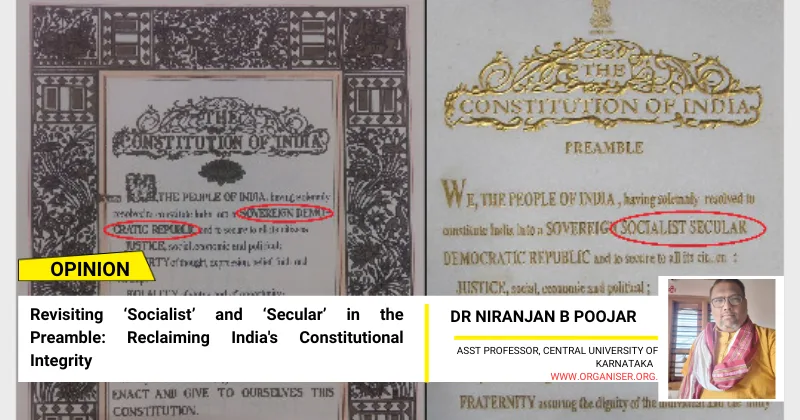
On June 25, 1975, the Indian Republic entered a political blackout — Emergency. Democracy was throttled, media gagged, opponents jailed, and the Constitution mutilated. Among the most insidious changes made by Indira Gandhi’s authoritarian regime was the insertion of the words “Socialist” and “Secular” into the Preamble of the Indian Constitution via the 42nd Amendment — without public debate or Constituent Assembly discussion. These words were not mere cosmetic additions; they were ideological impositions that contradict the very spirit of Bharat’s civilisational identity and constitutional democracy.
Why Were These Words Not in the Original Preamble?
Dr. B.R. Ambedkar, the chief architect of the Indian Constitution, categorically opposed the inclusion of “socialist” and “secular” in the Preamble. During the Constituent Assembly debates, he argued that the Constitution should be a mechanism of governance, not a manifesto of ideology. “What should be the policy of the State, how the society should be organized in its economic side, are matters which must be decided by the people themselves according to time and circumstances,” Ambedkar said (CAD, Vol. VII, p. 43). In other words, let elected governments decide policies, not an eternal ideological stamp.
Ambedkar was not alone. All founding members, including Rajendra Prasad, and Patel, avoided doctrinal rigidity in the Preamble, precisely because Bharat’s strength lies in its pluralism, not in ideological straitjackets.
Socialism: The Death of Economic Liberty
Socialism, a globalist agenda, is not just an economic model — it is a political weapon. It kills individual enterprise, promotes bureaucratic control, and fosters a nanny state where citizens become dependents, not creators. The inclusion of “Socialist” in the Preamble has allowed successive governments to justify State overreach, nationalize resources, and suffocate private innovation — all in the name of public good.
Moreover, this socialism has only deepened inequality rather than solving it. As economist B.R. Shenoy warned as early as 1955, Nehruvian socialism would lead Bharat to a “bureaucratic raj and economic stagnation.” Decades later, that is precisely what happened. The collapse of the license-permit-quota raj in the early 1990s exposed the moral and economic bankruptcy of socialist policies. So why should this outdated, failed ideology continue to stain our Constitution?
Secularism: A Mask for Political Appeasement
After insertion of secularism into Preamble, the Indian version of interpretation lost the neutrality — but has become a smokescreen for state-sponsored discrimination against Hindus in the name of “minority rights.” Far from separating religion from the State where it was conceptualised in Europe, Indian secularism has led to the State’s intervention in Hindu temples, control over religious education, and denial of equal rights to Hindus in matters like education (Article 30). At the same time, minorities enjoy unquestioned privileges — from running their institutions without interference to receiving targeted subsidies.
This distorted secularism has become a vote-bank strategy, not a principle of governance. As Sardar Vallabhbhai Patel warned, “To make religion a matter of State would be to reverse the process of centuries of Bharat evolution.”
Furthermore, secularism is not a neutral word in real essence— it carries Jewish, Protestant and Enlightenment roots, developed specifically to undermine the authority of the Catholic Church in Europe. However, in the Indian context, it has been systematically designed and pushed to defame Hindutva its dharmic nature and holistic worldview. It’s no coincidence that Marxist historians, leftist politicians, and Westernized intellectuals have all aggressively pushed secularism as the defining feature of Indian modernity to suit their agenda.
Secularism is Itself a Religious Doctrine
Here lies the grand irony: while secularism claims to oppose religion in public life, it is itself a dogma — with doctrines, prophets (like Voltaire and Rousseau), and evangelists (like Nehruvian intellectuals). As philosopher Alasdair MacIntyre wrote in After Virtue, “Secular liberalism is just another theology — minus God but full of commandments.”
In this light, forcing “secularism” into the Constitution is equivalent to enforcing a Western atheist theology on a deeply spiritual civilisation like Bharat. This is colonialism in the name of modernity, and it must be rejected.
Emergency Insertion = Undemocratic and Unconstitutional
Let us be clear: no Constituent Assembly ever approved these words. The 42nd Amendment was passed during Emergency, when Parliament functioned under duress, with Opposition leaders in jail and the media gagged. It was an act of constitutional fraud — akin to forging someone’s will when they are unconscious.
The Supreme Court in the Kesavananda Bharati case (1973) ruled that the basic structure of the Constitution cannot be altered. If so, how did a draconian government insert two words that fundamentally alter the spirit of constitutional governance? This contradiction must be corrected.
Time to Reclaim the Original Preamble
Bharat must revert to the original Preamble, as envisioned by the founding fathers. The words “socialist” and “secular” are not Indian in spirit, not constitutional in procedure, and not democratic in intent. They are ideological landmines, designed to subvert dharmic values, justify State overreach, and serve political appeasement.
We are not a socialist country. We are not a secular-atheist state. We are a dharmic civilisation rooted in pluralism, swaraj and spiritual autonomy. Let us have the courage to say so in our Constitution.
A Constitutional Clean-Up Is Due
Removing “socialist” and “secular” is not about ideology — it is about restoring constitutional honesty, reclaiming national dignity, and ending political hypocrisy. If we truly respect Ambedkar, respect democracy, and believe in Bharat, then we must act.
Let us undo the Emergency’s constitutional sins — and reclaim the Preamble for the people of Bharat.














Comments