





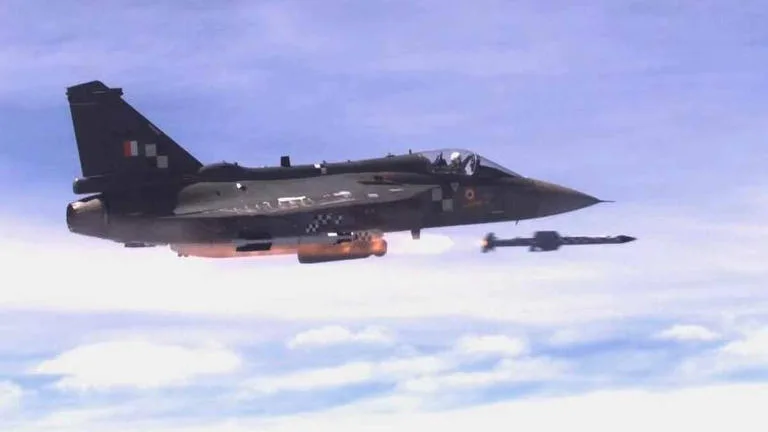
From the roaring skies above Odisha to the dust-laden terrains where artillery wheels now roll with pride, India has taken another firm step toward its dream of self-reliance. No longer just a consumer of global defence technology, the nation is now shaping its own destiny, designing, building, and firing its own weapons of deterrence and defence.
India successfully test-fired its domestic beyond-visual-range air-to-air missile, Astra, with a domestically built radio frequency seeker, on Friday (July 11). Organised by the Defence Research and Development Organisation (DRDO) along with the Indian Air Force (IAF), the test was a defining moment for the nation’s increasing technological autonomy in strategic weapon systems.
In keeping with this advance in air warfare, DRDO also launched its indigenously designed 155mm/52 calibre Mounted Gun System (MGS), a mobile artillery platform that can deploy rapidly, imparting tremendous mobility and firepower to the Indian Army.
In concert, these double-barreled developments mark India’s increasing resolve towards self-reliance under the Make in India defence programme and highlight its changing battlefield preparedness across air and land spheres.
Astra Missile Targets Clean
In a demonstration of indigenous strength, two Astra missiles were fired from a Su-30 MKI fighter jet over the Bay of Bengal, off Odisha’s coast on July 11, 2025. The trials, performed under different combat conditions, targeted high-speed unmanned aerial targets representing enemy aircraft. Both missiles hit their targets with accuracy, confirming the indigenous radio frequency seeker missile’s strength.
The Chandipur Integrated Test Range tracked the trials and recorded the flight data, confirming the missile’s seamless performance. All the subsystems, including the homegrown RF seeker, functioned as predicted as per the Ministry of Defence.
The Astra missile, the first indigenous beyond-visual-range air-to-air missile of India, has a range of more than 100 kilometers and comes equipped with an upgraded guidance and navigation system. The most important factor about this trial is the indigenously developed RF seeker, an important piece of equipment that allows the missile to engage its target from a distance. This is a breakthrough that lessens India’s dependence on foreign nations for advanced combat technology.
Network of Indian Industry Behind the Success of the Missile
Not only is the Astra programme a success for the DRDO and the IAF, but it is also an example of the synergy of the Indian public and private sectors. Over 50 indigenous companies, including the government-owned Hindustan Aeronautics Limited (HAL), have been involved in the development, design, and manufacture of the missile system. The indigenous achievement is in consonance with the overall government vision of lowering the dependence on foreign imports for critical defence components.
Defence Minister Rajnath Singh welcomed the test as a significant milestone in key defence technology. He congratulated DRDO, IAF, and the Indian defence sector, saying that successful testing of the missile with a domestic seeker is a landmark in India’s journey toward becoming self-reliant in defence.
Dr. Samir V. Kamat, Chairman of DRDO and Secretary to the Department of Defence R&D, also appreciated the team involved in conducting the successful test. He pointed out that the test reflects the increasing maturity and dependability of India’s indigenous missile development capability.
Strategic Edge for the Indian Air Force
The addition of Astra to the Indian Air Force armory greatly increases the nation’s air warfare capabilities. The longer range enables pilots to attack threats at a greater distance, effectively incapacitating enemy planes without risking themselves to the return fire. Even more significant is the indigenous seeker technology, which cuts down on exposure to possible supply chain outages, a lesson India has learned well in the face of international geopolitical changes.
The missile is now integrated with the Su-30 MKI platform but could also be used on other aircraft like the indigenous Tejas Mk-2 and the Rafale. Its success also heralds the possibility of exports, making India a competitive entry in the international missile market.
Mobile Gun System Debuts
As India’s air defence went to new levels with Astra, DRDO also developed ground artillery with the launch of a new 155mm/52 calibre Mounted Gun System (MGS). The system has been designed by DRDO’s Vehicle Research and Development Establishment (VRDE) and it has rapid deployment as well as high mobility in difficult terrain.
The MGS, which is installed on a heavy-duty wheeled chassis, can be deployed in 80 seconds and redeployed in 85 seconds, an enormous leap from conventional towed guns that require much, much longer to deploy and shift. This shoot-and-scoot nature is critical in contemporary warfare, as counter-battery fire from the enemy can react within minutes.
“This system addresses a long-standing operational gap. Unlike conventional towed guns, our MGS enables swift movement and immediate firepower, all with a made-in-India backbone,” said VRDE Director G. Ramamohana Rao in a statement to ANI.
The MGS is a part of a Technology Demonstrator Project on the Advanced Towed Artillery Gun System (ATAGS). It has been built to fulfill the Army’s need for mobile guns that can function effectively across the varied terrain of India, ranging from deserts to mountains.
The MGS system provides the Army with not only agility but strategic flexibility. Its rapid deployment enables artillery batteries to redeploy very quickly between missions, making it difficult for enemy targeting platforms to track them. The system is fully developed at home, providing for strategic autonomy and minimizing reliance on foreign vendors.
VRDE officials stated that the MGS is export-ready as well. It is in line with India’s aspirations to emerge as a major defence exporter and should find buyers among nations looking for dependable, affordable mobile artillery for use in various kinds of operational terrain.
A Paradigm Shift in Indian Defence Doctrine
The Mounted Gun System and the Astra missile collectively depict a wider paradigm shift in Indian defence policy. The accent is now squarely placed on indigenous platform development with high operational effectiveness and strategic autonomy. The Ministry of Defence is promoting the establishment of systems that are on par with international standards yet fully developed within the nation.
These advances are timed when regional security issues and international uncertainties are on the rise. India’s explicit move towards indigenous military technology is a strong message about its desire to build up its military on its own terms.
From Laboratories to Frontline Capability
From the missile tests across the skies of Odisha to DRDO’s artillery test beds, India is gradually converting its defence research into combat capability. The successful test of the Astra with a domestic seeker and the induction of the MGS indicate a fresh assurance of India’s capability to conceptualise, manufacture, and deploy complex defence systems.
The successful test of the indigenous Astra missile, guided by a homegrown seeker, and the unveiling of the DRDO’s mobile Mounted Gun System, are not just technological milestones, they are proud symbols of India’s resolve to stand on her own feet. Behind these metal machines lie the beating hearts of Indian scientists, engineers, and soldiers, who together are scripting a new chapter of Atmanirbhar Bharat.
In a world fraught with uncertainty, India is sending a powerful message: our strength is made at home, by our own hands, for our own protection.













Comments