





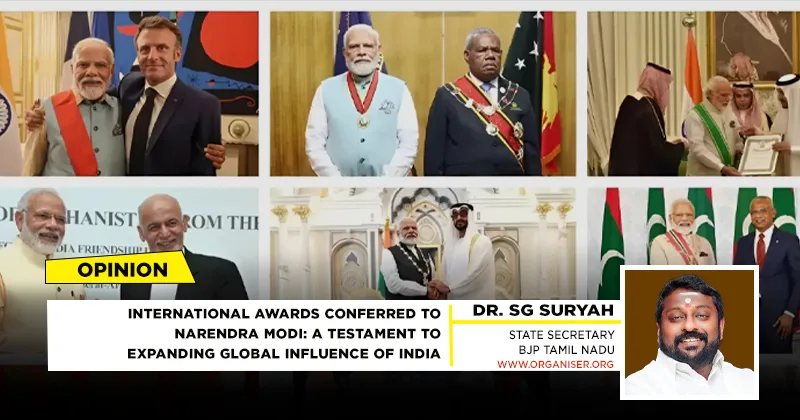
Since assuming office as the 14th Prime Minister of India in 2014, Narendra Modi has emerged as one of the most globally decorated Indian leaders. As of July 2025, he has received 25 prestigious international awards—an unprecedented tally that surpasses those earned collectively by his most prominent predecessors. This remarkable collection of honours, bestowed by countries across continents, is a reflection not only of Modi’s assertive and strategic diplomacy but also of India’s rising profile as a global power under his leadership.
Each of these honors carries its own significance and reflects a broader geopolitical narrative. In 2016, Saudi Arabia awarded Modi the Order of King Abdulaziz, its highest civilian honor, recognizing his pivotal role in strengthening India-Saudi relations. Two years later, the Grand Collar of the State of Palestine was conferred upon him by President Mahmoud Abbas for fostering India-Palestine ties, showcasing Modi’s diplomatic balance in the Middle East. In 2019, the United Arab Emirates honored him with the Order of Zayed, the nation’s highest civilian award, for deepening strategic partnerships with the Gulf nation.
The global reach of these recognitions was further demonstrated when the United States awarded him the Legion of Merit in 2020, underlining his role in advancing India-US strategic cooperation. That same trajectory of diplomatic goodwill continued with Bhutan presenting him the Order of the Druk Gyalpo in 2021, and France conferring its highest award—the Grand Cross of the Legion of Honour—in 2023. As Modi’s 20th international honor, the Order of Mubarak Al-Kabeer was bestowed by Kuwait in 2024, further affirming India’s increasing goodwill in West Asia. More recently, in 2025, Ghana honored Modi with the Officer of the Order of the Star for his statesmanship, while Trinidad and Tobago conferred the Order of the Republic for his outreach to the Indian diaspora and philanthropic initiatives. Cyprus, too, added to this growing list by awarding the Grand Cross of the Order of Makarios III, recognizing the depth of India-Cyprus bilateral ties.
Beyond these high-profile accolades, Modi has also been recognized by nations such as Egypt, Nigeria, Mauritius, Sri Lanka, Papua New Guinea, Fiji, and the Maldives. The breadth of this appreciation—from large strategic players to small island nations—illustrates the inclusive and far-reaching scope of India’s foreign policy. In addition to these state-conferred honors, Modi has been the recipient of globally prestigious non-governmental awards. The United Nations presented him with the Champions of the Earth Award in 2018 for his leadership in environmental protection, while the Bill and Melinda Gates Foundation conferred the Global Goalkeeper Award in 2019 for the Swachh Bharat Abhiyan, a sanitation campaign that significantly improved public health outcomes in India.
These awards are not merely decorative acknowledgments but are emblematic of India’s evolving role in global affairs. Each award sheds light on a unique dimension of Modi’s leadership and how it aligns with India’s strategic goals and international responsibilities. His foreign policy, often characterized as “India First,” has successfully prioritized robust bilateral and multilateral relationships. Honors from countries like Russia, which presented him the Order of St. Andrew in 2019, and France emphasize India’s enhanced standing with both Eastern and Western powers. This positions India as a bridge between competing geopolitical blocs, granting it a voice in shaping major global decisions.
Equally important is Modi’s advocacy for the Global South. During India’s G20 presidency in 2023, he championed the cause of developing nations, a stance that resonated across continents. Recognition from African countries such as Nigeria, which conferred the Grand Commander of the Order of the Niger in 2024, and Ghana in 2025 highlights how India is now regarded as a leading voice for the aspirations and challenges of the developing world.
Modi’s leadership in environmental diplomacy has also drawn global acclaim. Initiatives like the International Solar Alliance and Swachh Bharat are not only celebrated within India but are also viewed as scalable solutions to global sustainability challenges. The Champions of the Earth Award and the Global Energy and Environment Leadership Award from CERAWeek in 2021 serve as testament to India’s proactive role in climate action and renewable energy advocacy.
Further adding to Modi’s international appeal is his focus on cultural diplomacy and diaspora engagement. Nations with significant populations of Indian origin, such as Mauritius and Trinidad and Tobago, have honored Modi for reconnecting them with their heritage and for promoting people-to-people ties that go beyond statecraft. Such engagements have amplified India’s soft power, leveraging shared culture, tradition, and language to deepen international bonds.
In an era marked by geopolitical tensions, Modi’s foreign policy has sought to navigate challenges with a measured and principled approach. His balanced stance on international conflicts and emphasis on dialogue and peace has won recognition from countries like Palestine and the Maldives. His receipt of the Seoul Peace Prize in 2018 further emphasizes his image as a statesman committed to global stability and inclusive growth.
The scale and variety of these honors paint a compelling picture when compared with those received by past Indian leaders. Jawaharlal Nehru, Indira Gandhi, and Manmohan Singh were each honored internationally, but their combined total amounts to just six recognitions—far fewer than Modi’s 25. Unlike his predecessors, whose awards primarily came from a select group of nations, Modi’s accolades span a vast geographical and political spectrum, reflecting India’s expanded diplomatic footprint.
This extensive global appreciation also serves a domestic political purpose. In particular, honors from Muslim-majority countries like Saudi Arabia, UAE, Palestine, and Kuwait challenge the often-circulated domestic criticisms about Modi’s alleged religious bias. These awards act as diplomatic endorsements of India’s pluralistic engagement and nuanced foreign policy, even within regions of sensitive political and religious contexts.
As the world becomes increasingly multipolar and complex, India under Modi has emerged as a confident, assertive, and dependable partner in the global order. Whether through trade, security, climate action, or cultural outreach, India’s diplomacy has matured into a proactive instrument of statecraft. Modi’s international recognition is not merely a personal milestone—it reflects India’s ascent as a nation that not only demands but commands respect.
In conclusion, the 25 international honours conferred on Prime Minister Narendra Modi represent far more than symbolic gestures. They mark a new chapter in India’s diplomatic history—one where the country is seen not only as a regional player, but as a global leader with the capacity to influence, inspire, and intervene constructively on the world stage. The challenge ahead lies in translating this recognition into long-term strategic gains and ensuring that India’s elevated global stature endures beyond individual leadership.












Comments