VP Dhankhar addresses inaugural IKS conference
June 18, 2026
  • Read Ecopy
  • Circulation
  • Advertise
  • Careers
  • About Us
  • Contact Us
Android AppiPhone AppArattai
Organiser
  • ‌
  • Bharat
    • Assam
    • Bihar
    • Chhattisgarh
    • Jharkhand
    • Maharashtra
    • View All States
  • World
    • Asia
    • Europe
    • North America
    • South America
    • Africa
    • Australia
  • Editorial
  • International
  • Opinion
  • RSS @ 100
  • More
    • Op Sindoor
    • Analysis
    • Sports
    • Defence
    • Politics
    • Business
    • Economy
    • Culture
    • Special Report
    • Sci & Tech
    • Entertainment
    • G20
    • Azadi Ka Amrit Mahotsav
    • Vocal4Local
    • Web Stories
    • Education
    • Employment
    • Books
    • Interviews
    • Travel
    • Law
    • Health
    • Obituary
  • Subscribe
    • Subscribe Print Edition
    • Subscribe Ecopy
    • Read Ecopy
  • ‌
  • Bharat
    • Assam
    • Bihar
    • Chhattisgarh
    • Jharkhand
    • Maharashtra
    • View All States
  • World
    • Asia
    • Europe
    • North America
    • South America
    • Africa
    • Australia
  • Editorial
  • International
  • Opinion
  • RSS @ 100
  • More
    • Op Sindoor
    • Analysis
    • Sports
    • Defence
    • Politics
    • Business
    • Economy
    • Culture
    • Special Report
    • Sci & Tech
    • Entertainment
    • G20
    • Azadi Ka Amrit Mahotsav
    • Vocal4Local
    • Web Stories
    • Education
    • Employment
    • Books
    • Interviews
    • Travel
    • Law
    • Health
    • Obituary
  • Subscribe
    • Subscribe Print Edition
    • Subscribe Ecopy
    • Read Ecopy
Organiser
  • Home
  • Bharat
  • World
  • Operation Sindoor
  • Editorial
  • Analysis
  • Opinion
  • Culture
  • Defence
  • International Edition
  • RSS @ 100
  • Magazine
  • Read Ecopy
Home Bharat

Western constructs were paraded as universal truths, there was an achitecture of erasure and decimation: VP Dhankhar

At the inaugural Annual Conference on the Indian Knowledge System (IKS), Vice-President Jagdeep Dhankhar called for restoring India’s intellectual heritage, emphasising the need to honour both ancient wisdom and lived experience. He urged a decisive shift from colonial constructs to a truly indigenous research ecosystem

WEBDESKWEBDESK
Jul 10, 2025, 05:20 pm IST
in Bharat, Delhi
Follow on Google News
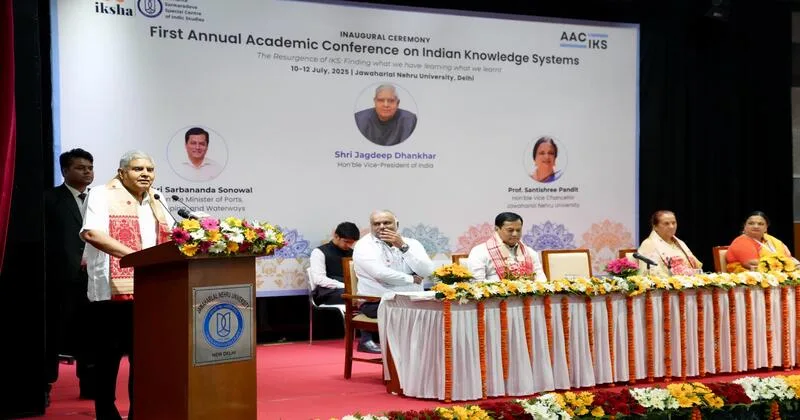
Vice-President Jagdeep Dhankhar addressing the inaugural Annual Conference on the Indian Knowledge Systems in New Delhi

Vice-President Jagdeep Dhankhar addressing the inaugural Annual Conference on the Indian Knowledge Systems in New Delhi

FacebookTwitterWhatsAppTelegramEmail

The Vice-President of India, Jagdeep Dhankhar, today said, “India’s rise as a global power must be accompanied by the rise of its intellectual and cultural gravitas. This is very significant as the rise without this is not lasting, and the rise without this is not in harmony with our traditions. The strength of a nation lies in the originality of its thought, the timelessness of its values, and the resilience of its intellectual traditions. That is the kind of soft power that endures, and soft power is potent in the world we live in”, he said.

Reaffirming India’s identity beyond the confines of post-colonial constructs, the Vice-President observed, “India is not just a political construct formed in the mid-20th century. It is a civilisational continuum—a flowing river of consciousness, inquiry, and learning that has endured.”

Also Read: From Palm Leaves to Pixels: Gyan Bharatam Mission set to digitise 50 crore pages of Indian manuscript treasure

Critiquing the historical sidelining of indigenous wisdom, he said, “While indigenous insights were dismissed as relics of the primitive past, it was not an error of interpretation. It was an architecture of erasure, destruction, and decimation. What is more tragic is that the selective remembrance continued even after independence. Western constructs were paraded as universal truths. To put it more bluntly, untruth was camouflaged as truth.”

“What should have been our fundamental priority was not even on the radar. How can you not be cognizant of your core values?” he questioned.

Reflecting on the historical ruptures in India’s intellectual journey, the Vice-President remarked, “The Islamic invasion of India caused the first interlude in the glorious journey of Bharatiya Vidya Parampara (भारतीय विद्या परंपरा). Instead of embrace and assimilation, there was contempt and destruction. The British colonisation brought forth the second interlude, when the Indian Knowledge System was stunted, stymied, and subverted. Centers of learning changed their motives. The compass was moderated. The North Star was changed. From bearing Sages and Savants, it started producing clerks and yeomen. The needs of the East India Company to have brown babus replaced the need of the nation to have thinkers.”

“We stopped thinking, contemplating, writing, and philosophising. We started cramming, regurgitating, and swallowing. Grades, unfortunately, replaced critical thinking. The great Bharatiya Vidya Parampara (भारतीय विद्या परंपरा) and its allied institutions were systematically drained, destroyed, and decimated.”, he mentioned.

Addressing the inaugural Annual Conference on the Indian Knowledge Systems in New Delhi as the Chief Guest today, Dhankhar said, “Long before the Universities of Europe came into being, Bharat’s universities had already established themselves as thriving centers of learning. Our ancient land was home to luminous centres of intellectual life, Takshashila, Nalanda, Vikramashila, Vallabhi, and Odantapuri. These were the towering citadels of knowledge. Their libraries were vast oceans of wisdom, housing tens of thousands of manuscripts.”

He added, “These were global universities, where seekers came from lands near and far, such as Korea, China, Tibet, and Persia. These were the spaces where the intellect of the world embraced the spirit of Bharat.”

Calling for a more holistic understanding of knowledge, the Vice-President said, “Knowledge resides beyond manuscripts. It lives in communities, in embodied practices, in the intergenerational transmission of wisdom.”

He emphasised that, “A genuine Indian Knowledge Systems research ecosystem must honour both the written word and the lived experience—recognising that insight emerges as much from context as it does from text.”

Calling for focused action to strengthen Indian Knowledge Systems, the Vice-President remarked, “Let us therefore turn our attention to tangible action because that is the need of the hour. The creation of digitised repositories of classical Indian texts is an urgent priority covering all classical languages such as Sanskrit, Tamil, Pali, and Prakrit, to name just a few.”

He added, “These repositories should be made widely accessible, enabling scholars in India and researchers around the world to engage meaningfully with these sources. Equally essential is the development of training programs that empower young scholars with robust methodological tools, blending philosophy, computational analysis, ethnography, and comparative inquiry to deepen their engagement with the Indian knowledge system.”

Quoting renowned scholar Max Müller, the Vice-President said, “If I were asked under what sky the human mind has most fully developed some of its choicest gifts, has most deeply pondered on the greatest problems of life, and has found solutions of some of them which well deserve the attention even of those who have studied Plato and Kant—I should point to India.”

“Friends, it was nothing but the articulation of eternal truth,” the Vice-President said.

Touching upon the dynamic relationship between tradition and innovation, the Vice-President stated, “The wisdom of the past does not obstruct innovation, rather it inspires it. The metaphysical can speak to the material. Spiritual insight can coexist with scientific precision, but then you have to know what spiritual insight is.”

He continued, “The Rigveda’s hymns to the cosmos can find new relevance in the age of astrophysics. The Charaka Samhita can be read alongside global debates on public health ethics.”

“As we navigate a fractured world, we are stunned by global conflagration. So we are faced with a fractured world. Knowledge systems that have long reflected on the interplay between mind and matter, the individual and the cosmos, duty and consequence, become relevant and vital to shaping thoughtful, enduring responses.”, he concluded.

Sarbananda Sonowal, Minister of Ports, Shipping and Waterways, Govt. of India, Prof. Santishree Dhulipudi Pandit, Vice Chancellor, Jawaharlal Nehru University, Prof. M. S. Chaitra, Director- IKSHA, Akhil Bharatiye Toli Sadasya, Prajna Pravah, and other dignitaries were also present on the occasion.



Topics: Jagdeep DhankharIndian Knowledge SystemPost- colonial IndiaBharatiya VidyaIntellectual HeritageIKS Conference
ShareTweetSendShareSend
✮ Subscribe Organiser YouTube Channel. ✮
✮ Join Organiser's WhatsApp channel for Nationalist views beyond the news. ✮
Previous News

Tamil Nadu: DMK, Church leaders unveil statue of Stan Swamy; attempt to portray Maoist as human rights activist

Next News

Love Jihad Racket: ATS squad of Uttar Pradesh Police obtains seven-day remand for Chhangur Baba

Related News

Representative Image

Rudraksha: The sacred bead and the scientific reality

Vedantha Makethon & Dakshinasya Darshini: The Confluence of Science, Innovation & Indian Knowledge System in Bengaluru

Representative Image

In what manner did Macaulay demonstrate a toxic mentality and an anti-humanitarian attitude?

Ancient Indian Knowledge System: A tool to accomplish modern diplomacy

Ancient Indian Knowledge System: A tool to accomplish the goals of modern diplomacy

Prime Minister Narendra Modi addresses the G20 Summit in Johannesburg, South Africa

G20: PM Modi pitches 4 proposals; Countering terrorism, calibrating healthcare, harnessing skill & knowledge ecosystem

Representative image

Environmental consciousness in ancient traditions: Western model of development versus Indian model

Load More

Latest News

The Genius of Guru Arjan Sahib: The sovereign scripture, the four doored temple, and the music of oneness

Rani Lakshmibai, the Queen of Jhansi

Remembering Rani Lakshmibai on her death anniversary: Warrior queen who defied the British empire & inspired a nation

Maharana Pratap

How Maharana Pratap turned Haldighati into a symbol of eternal resistance

Sarvam joins the unicorn club with $234 million in fresh capital to advance agentic AI & cybersecurity technologies

Winners of the Devrishi Narad Patrakar Samman 2026 at Speaker Hall, Constitution Club

Journalism of future will use AI but AI will not replace journalists: Rahul Kanwal at Devrishi Narad Patrakar Samman

Victim Ram Phool Meena and Dr Riyazuddin who worked at Jamia Islamia

Exclusive | Assaulted, called Kafir, posted as ‘punishment’: Jamia employee reaches NCST against administration

Shiv Sena (UBT) faces a fresh rebellion scare, prompting an emergency whip and a crucial Delhi showdown

Son with Uddhav, father with Shinde? Ashtikar family emerges as new flashpoint in Shiv Sena (UBT) crisis

Guru Arjan Dev Ji Martyrdom Day: Sant, nation-builder and defender of dharma

Kakoli Ghosh Dastidar and Sagarika Ghose

TMC internal rift: Kakoli Ghosh Dastidar hits back at Sagarika Ghose saying, ‘What about team of thieves you belong?’

Reports say, six Shiv Sena (UBT) MPs have merged with the Shiv Sena faction led by Maharashtra Deputy Chief Minister Eknath Shinde

What is Operation Tiger: How reports of 6 rebel MPs triggered fresh fears of another split in Uddhav Thackeray’s sena

Load More
  • Privacy
  • Terms
  • Cookie Policy
  • Refund and Cancellation
  • Delivery and Shipping

© Bharat Prakashan (Delhi) Limited.
Tech-enabled by Ananthapuri Technologies

  • Home
  • Search Organiser
  • Bharat
    • Assam
    • Bihar
    • Chhattisgarh
    • Jharkhand
    • Maharashtra
    • View All States
  • World
    • Asia
    • Africa
    • North America
    • South America
    • Europe
    • Australia
  • Editorial
  • Operation Sindoor
  • Opinion
  • Analysis
  • Defence
  • Culture
  • Sports
  • Business
  • RSS @ 100
  • Entertainment
  • More ..
    • Sci & Tech
    • Vocal4Local
    • Special Report
    • Education
    • Employment
    • Books
    • Interviews
    • Travel
    • Health
    • Politics
    • Law
    • Economy
    • Obituary
  • Subscribe Magazine
  • Read Ecopy
  • Advertise
  • Circulation
  • Careers
  • About Us
  • Contact Us
  • Policies & Terms
    • Privacy Policy
    • Cookie Policy
    • Refund and Cancellation
    • Terms of Use

© Bharat Prakashan (Delhi) Limited.
Tech-enabled by Ananthapuri Technologies