





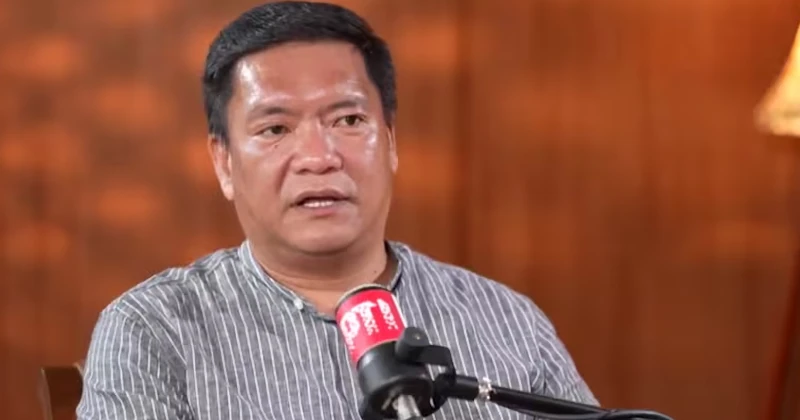
Arunachal Pradesh Chief Minister Pema Khandu has reignited the long-standing debate over China’s illegal occupation of Tibet with a rare and bold political statement that directly challenges Beijing’s expansionist narrative. Speaking in an exclusive interview with PTI Editor-in-Chief Vijay Joshi, Khandu delivered a historic blow to China’s propaganda by stating unequivocally that his state shares a border with Tibet — not China.
This statement, made on record and on camera, carries immense geopolitical weight. It challenges not only the cartographic aggression that China routinely practices by renaming Indian towns and publishing distorted maps, but also takes direct aim at the core lie underpinning Beijing’s claims over Arunachal Pradesh that Tibet is and always was a part of China.
VIDEO | EXCLUSIVE: China's mega dam being built near the Arunachal Pradesh border will be a ticking "water bomb," an existential threat more dangerous than its military, the state's chief minister Pema Khandu (@PemaKhanduBJP) has said.
Speaking to PTI Editor-in-Chief Vijay… pic.twitter.com/0LhctGNnIN
— Press Trust of India (@PTI_News) July 9, 2025
“Let me correct you here. We share a border with Tibet, not China,” Khandu said in response to a PTI question referencing a “1,200-kilometre-long border with China.”
The Chief Minister, who hails from the frontier district of Tawang — a region deeply connected to Tibetan Buddhism and history — did not stop there. “Officially, yes, Tibet is under China now. That can’t be ruled out. But originally, we shared a border with Tibet. And in Arunachal Pradesh, we share only three international boundaries — with Bhutan (about 150 km), with Myanmar (around 550 km), and with Tibet (about 1,200 km), which is one of the longest in the country.”
This seemingly simple but powerful assertion strikes at the heart of China’s geopolitical manipulations and has the potential to reshape global perceptions of the India-China-Tibet tri-junction conflict zone.
Khandu’s remarks come against the backdrop of increasing Chinese belligerence, both military and ideological, along the Line of Actual Control (LAC). Beijing refers to Arunachal Pradesh as “Zangnan” or “Southern Tibet” and has tried to usurp the region through semantic subterfuge by renaming dozens of Indian villages and mountains with Mandarin nomenclature.
This tactic is part of China’s broader “lawfare” strategy — the use of domestic laws and propaganda to justify extraterritorial claims. However, Khandu’s historical framing challenges this premise entirely. By drawing attention to the fact that India’s border has always been with Tibet, not with China, the Arunachal Chief Minister reaffirms the historical status of Tibet as a sovereign, independent nation prior to its forceful annexation by Maoist China in the 1950s.
VIDEO | In an exclusive interview with PTI Editor-in-Chief Vijay Joshi, Arunachal Pradesh Chief Minister Pema Khandu (@PemaKhanduBJP) said that originally his state shares border with Tibet and not China.
"If you look at the map… none of the Indian states directly share border… pic.twitter.com/bik919zwuk
— Press Trust of India (@PTI_News) July 9, 2025
“If you look at the map,” Khandu emphasised, “none of the Indian states directly share border with China. We share a border with Tibet only.”
This argument is both factually accurate and diplomatically explosive. For decades, India — bound by the Panchsheel Agreement of 1954 and the One China policy — avoided publicly referring to Tibet’s independent status. But Khandu’s statement revives that truth in the public domain, reminding the world that Tibet was a buffer state between India and China — until China forcefully ended that arrangement.
In recent years, China has escalated its cartographic hostilities. In May 2025, Beijing released a list of 30 renamed places in Arunachal Pradesh — the fifth such attempt since 2017. These illegal “renaming” efforts have been met with stern rebuttals from India’s Ministry of External Affairs.
“Creative naming won’t alter the undeniable reality… Arunachal Pradesh was, is, and will always remain an integral and inalienable part of India,” said the MEA in a strongly worded response.
China had previously tried similar tactics in 2021, 2023, and 2024, including the release of a so-called “standard map” that audaciously claimed Arunachal Pradesh and Ladakh’s Aksai Chin region as part of its territory. That map was released just days before India hosted the G20 Summit in New Delhi — an attempt to diplomatically provoke India on the global stage.
India’s External Affairs Minister Dr S Jaishankar had swiftly condemned the map as baseless, stating, “Just by putting out maps, you don’t become the owner of territory. Making absurd claims doesn’t make other people’s territories yours.”
VIDEO | EXCLUSIVE: Arunachal Pradesh Chief Minister Pema Khandu (@PemaKhanduBJP) said China's repeated attempts to rename places in the state is a "habit" and not surprising.
"This is a habit of China. Not just once, I think the last time when Arunachal Pradesh was renamed, this… pic.twitter.com/96cS0kP6Io
— Press Trust of India (@PTI_News) July 9, 2025
CM Khandu echoed the same sentiment, “We know China’s habit, and I think the External Affairs Ministry has given them a fitting reply. This is not the first time. It’s their fifth attempt at renaming places in Arunachal. We are not surprised. We know this is routine for China.”
Unlike routine diplomatic rebuttals, Khandu’s statements resonate with deeper civilizational and historical truths. Tawang, his hometown and a sacred site in Tibetan Buddhism, was the birthplace of the 6th Dalai Lama and a prominent monastic center long before the People’s Republic of China existed.
By emphasising Arunachal’s cultural and spiritual connection with Tibet, not with China, Khandu re-centers the discourse around India’s shared heritage with the Tibetan people — one rooted in centuries of religious, trade, and social exchange. This stands in sharp contrast to China’s narrative, which is rooted in conquest, suppression, and redefinition of history through state propaganda.
In doing so, Khandu has also amplified the long-muted voice of the Tibetan struggle. While official Indian policy has tiptoed around the issue, the Arunachal Chief Minister’s framing sends a strong message — that Tibet’s past independence is not forgotten, and China’s illegal occupation is not legitimized by maps or force.
Apart from addressing border issues and China’s narrative aggression, CM Pema Khandu also spoke about linguistic diversity in Arunachal Pradesh and the practical need for a common language to foster unity.
Highlighting the uniqueness of his state home to 26 major tribal groups and hundreds of sub-tribes, each with its own language Khandu emphasized that Hindi serves as a functional and unifying medium of communication.
“In the Northeast, if you go to other states, there are also tribal groups, but everyone has a common language. In Assam, there is Assamese; in Mizoram, there is Mizobasha; in Nagaland, there is Nagal. But in Arunachal, we don’t have a common language called ‘Arunachali’,” he explained.
VIDEO | EXCLUSIVE: Arunachal Chief minister Pema Khandu (@PemaKhanduBJP) said it is important to preserve regional languages but there is no harm in learning Hindi as it acts as a "binding language."
In an interview to PTI Editor-in-Chief Vijay Joshi, the chief minister said his… pic.twitter.com/H0PsPdnTPH
— Press Trust of India (@PTI_News) July 9, 2025
“Every tribe has its own language and diversity. If I speak in my own language, other tribes won’t understand it. So, everyone speaks Hindi.”
The Chief Minister stressed that there is no contradiction between preserving indigenous languages and using Hindi as a bridge, calling it a “binding language” for daily life and inter-tribal interaction. In a state as diverse as Arunachal Pradesh, the use of Hindi has emerged not as imposition but as necessity — a fact that strengthens social cohesion and communication in one of India’s most culturally complex regions.













Comments