






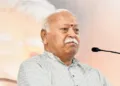
Rashtriya Swayamsevak Sangh (RSS) Sarsanghchalak Mohan Bhagwat on July 9, described senior Sangh ideologue and organisational pillar, the late Moropant Pinglay, as the “embodiment of complete selflessness” who dedicated his life to the cause of nation-building and Hindu resurgence without ever seeking personal recognition.
Dr Bhagwat was speaking at the release of the book Moropant Pinglay: The Architect of Hindu Resurgence in Nagpur, an event that brought together RSS swayamsevaks, intellectuals, and admirers of Pinglay’s life and work. Dr Bhagwat recalled Pinglay’s rare ability to communicate profound ideas in the simplest language, his unwavering commitment to national causes, and his distinctive humility that kept him away from the limelight.
“Moropant was the embodiment of complete selflessness. Whatever he did, he did with the sole vision of how it would contribute to nation-building,” Dr Bhagwat said while unveiling the book chronicling Pinglay’s life and contributions.
Dr Bhagwat fondly remembered how Pinglay, even after making remarkably accurate political predictions during the post-Emergency political upheaval, chose to stay away from any attention.
Referring to the 1977 general elections after the Emergency, Dr Bhagwat recalled how Pinglay predicted that the opposition alliance could win around 276 seats, a prediction that came true.
“When the results were announced, Moropant was at Sajjangad fort in Maharashtra, far removed from the political buzz. He never sought credit, never basked in applause,” Dr Bhagwat said.
Referring to Pinglay’s significant contribution to the historic Ekatmata Rathyatra from Gangasagar to Somnath, an event aimed at promoting national integration, Dr Bhagwat shared how a newspaper had once described Pinglay’s work as having “military precision.”
“Wherever he spoke, people felt free from tension,” Dr Bhagwat observed. “Even when faced with tough questions from RSS volunteers, Moropant would smile and say, ‘Come to the RSS shakha, play games, and it will automatically contribute to building the Hindu Rashtra.’ That was his unique way of diffusing tension and inspiring action.”
Dr Bhagwat emphasised that Pinglay was not only a master of organisational work but also someone deeply engaged in both scientific and spiritual pursuits.
Highlighting lesser-known facets of Pinglay’s life, Dr Bhagwat noted how he actively participated in the Saraswati river revival project alongside scientists. His ability to connect with people from diverse backgrounds, including those outside the formal RSS structure, stood out as a hallmark of his inclusive leadership.
“Many people who were not even part of the Sangh joined constructive nation-building work because of Moropant ji. He had that rare ability to touch lives without preaching,” Bhagwat added.
The RSS Sarsanghchalak also remembered Pinglay’s humility, stating that he always deflected any praise using gentle humour. “He never spoke about his achievements. If someone praised him, he would smile, crack a joke, and move on. He consciously avoided any kind of public felicitation,” Bhagwat shared.
The book Moropant Pinglay: The Architect of Hindu Resurgence aims to document not just the events of Pinglay’s life but also his philosophy of service, selflessness, and silent dedication to the larger cause of Hindu unity and national rejuvenation.
Dr Bhagwat’s remarks show the Sangh’s continued emphasis on nurturing leadership that combines intellectual depth, grassroots activism, and a self-effacing commitment to society.











Comments