





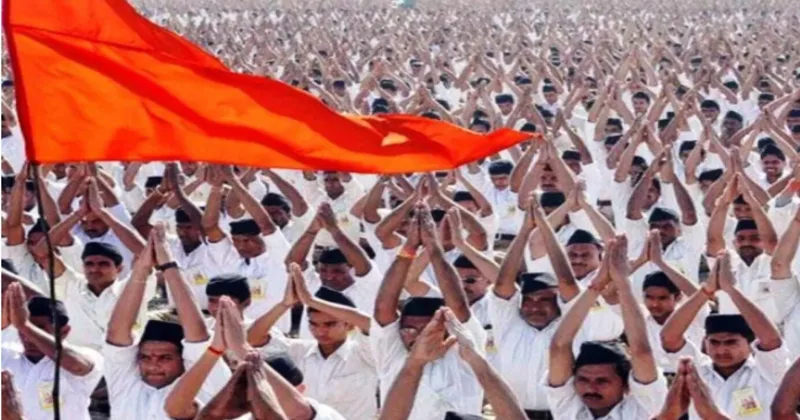
New Delhi: For the millions of karyakartas of the Rashtriya Swayamsevak Sangh (RSS), their guide and guru isn’t a person or a holy book, but the Bhagwa Dhwaj (Saffron Flag). This unique tradition, established by the RSS’s founder Dr Keshav Baliram Hedgewar, stands in stark contrast to the common practice in many spiritual and social organisations of venerating their founders or living gurus.
Every year, on Vyas Purnima (Guru Purnima) as per the Hindu calendar, RSS swayamsevaks gather at their shakhas (branches) to formally worship the Bhagwa Dhwaj, an event that holds paramount importance among the six annual festivals celebrated by the Sangh.
The tradition of Guru Puja was first observed by the RSS in 1928, just three years after its inception. Since then, it has continued uninterrupted, with the saffron flag retaining its supreme position within the organisation, even above the Sar Sanghchalak (RSS Chief).
The decision to elevate the saffron flag to this supreme status has often puzzled observers. In India and many other countries, it’s customary for religious and spiritual organisations to revere their founders. The rich tradition of the Bhakti movement, for instance, has always embraced the concept of a personal guru. Dr Hedgewar’s choice to deviate from this prevalent custom, by installing the Bhagwa Dhwaj as the guru instead of himself, is considered a unique initiative in contemporary global history. For an organisation that has grown to be the world’s largest voluntary body, its highest position being held by a flag is indeed a subject worthy of serious contemplation. Several senior RSS swayamsevaks have attempted to shed light on this intriguing aspect.
According to HV Seshadri, a former Sarkaryawah (General Secretary) of the RSS, “The Bhagwa Dhwaj has been a revered symbol of Indian culture and tradition for centuries. When Dr Hedgewar started the Sangh, he presented this flag to the swayamsevaks as the supreme symbol of all national ideals and later initiated the tradition of worshipping the Bhagwa Dhwaj as the Guru on Vyas Purnima.”
NH Palkar, an RSS swayamsevak and author, penned an insightful book on the Bhagwa Dhwaj, originally published in Marathi in 1958 and later in Hindi. This 74-page work suggests that the tradition of hoisting the saffron flag dates back to the Vedic period in Sanatana Dharma.
Palkar states, “Described as ‘Arunketu’ in Vedic literature, this Bhagwa Dhwaj has always held a place of reverence in the Hindu way of life. This flag has consistently inspired Hindus to fight and emerge victorious against foreign invasions throughout history. Its deliberate use has served to awaken the spirit of struggle for national defense among Hindus.”
To substantiate the national character of the Bhagwa Dhwaj, Palkar cites several historical instances:
Guru Gobind Singh, the tenth Sikh Guru, utilized the saffron flag when leading thousands of Sikh warriors to defend Hindu Dharma, symbolizing the resurgence of Hindutva. Inspired by this flag, Sikh soldiers under Maharaja Ranjit Singh’s rule, led by General Hari Singh Nalwa, conquered territories up to Kabul-Kandahar in Afghanistan.
During Mughal invasions of Rajasthan, Rajput warriors, under the leadership of Ranachief and Maharana Pratap, drew inspiration from the Bhagwa Dhwaj to fight historic battles against the invaders.
Chhatrapati Shivaji and his associates fought decisive battles under the banner of the Bhagwa Dhwaj to liberate themselves from Mughal rule and establish a Hindu Swaraj (self-rule).
Palkar also mentions the armies of the South Indian Vijayanagara kingdom, which valiantly resisted Mughal invasions, hoisting the Bhagwa Dhwaj as a symbol of valor and sacrifice. The saffron or renunciate color also played an inspiring role in the medieval Bhakti movement and the contemporaneous revival and reform of Hindu Dharma.
Many Hindu monasteries and temples still hoist the saffron flag, considering its color a symbol of valor and sacrifice.
During India’s First War of Independence in 1857 against British rule, revolutionaries united under the केसरिया (saffron) flag.
Palkar concludes that a study of the entire history of the Bhagwa Dhwaj clearly indicates its inseparable connection to Hindu society. He asserts that the flag is a natural and inherent symbol of Hindu society and the Hindu Nation. During intellectual discussions on the importance of the Bhagwa Dhwaj at RSS shakhas and training camps, essentially the same points highlighted in Palkar’s book are conveyed to the swayamsevaks. The author concisely links Hindu Nation, Hindu Society, Hindu Culture, Hindu Way of Life, and philosophy inextricably to the Bhagwa Dhwaj. He believes that this flag has always been capable of inspiring Hindus with qualities like sacrifice, valor, and patriotism.
According to Shri Guruji (M.S. Golwalkar), “In the Sangh, there is no place for individual ego, nor an opportunity for institutional pride. The Sangh is only proud of its whole Bharat. Then, how can it show reverence to any other symbol, abandoning its divine flag? We do not wish to disrespect any other flag, but our reverence is dedicated to the ancient history of Bharat and the traditional Bhagwa Dhwaj.”
The Bhagwa Dhwaj has been a witness to the continuous struggles and victories of Hindu society. Without the Bhagwa Dhwaj, Hindu culture and the Hindu Nation cannot be imagined. (The term ‘Dharma’ here is used as understood by scholars of Hindutva, meaning a way of life, not limited to rigid rituals or ceremonies). Culture is the lifeline of any nation, and Hindu culture is the lifeline of our country, with the Bhagwa Dhwaj symbolizing Hindu culture.
Palkar’s significant statement emphasizes that the existence of the Bhagwa Dhwaj is not affected by whether it has received official government recognition or not. This is why the saffron flag remains revered by many social, political organizations, castes, and sub-castes even today.
Three Core Reasons for Accepting the Bhagwa Dhwaj as Guru:
The RSS primarily adopted the Bhagwa Dhwaj as its Guru for three key reasons:
Historical Connection and Unity: The flag is steeped in history and plays a crucial role in uniting an organization and aiding its development.
Cultural Nationalism: The Bhagwa Dhwaj most vividly reflects the ideology of cultural nationalism, which is the strong foundation upon which the RSS was established.
Preventing Personality Cults: By giving the supreme position to the Bhagwa Dhwaj, a symbol of cultural nationalism, instead of an individual, the RSS successfully ensured it would not become a personality-centric organization. This foresight proved highly successful, leading to the widespread growth of the organization across various sectors of life over many years, and notably, preventing any disputes over succession to the highest position within the Sangh. The absence of leadership struggles in such a large organization is remarkable and can largely be credited to Dr. Hedgewar’s decision to accept the Bhagwa Dhwaj as Guru.
Guru Dakshina: A Spiritual Offering to the Bhagwa Dhwaj
Guru Purnima is one of the six main festivals officially celebrated by the RSS through its various shakhas (along with Varsh Pratipada, Vijayadashami, Makar Sankranti, Hindu Samrajya Diwas, and Raksha Bandhan). This tradition was instituted by Dr. Keshav Baliram Hedgewar, the revolutionary freedom fighter and pioneer of Hindu renaissance who founded the RSS in 1925.
On Guru Purnima, the RSS also observes the Guru Dakshina program. In this ceremony, all swayamsevaks salute their Guru – the Bhagwa Dhwaj, offer flowers, and, in an unmarked envelope, discreetly submit their best annual contribution to the organization along with a single flower.
According to Shri Guruji (M.S. Golwalkar), “Guru Dakshina is not a fixed amount or a regular collection of donations. It is purely voluntary. One should not avoid this puja (worship) due to financial hardship, inability to support one’s family, or fear of what others might say if a small amount is offered. It is enough to come here, salute the Dhwaj with heartfelt devotion, and offer just one flower. Even a single paisa offered with such sentiment is worth more than thousands of rupees given by a rich person.”
Each RSS shakha begins organizing Guru Dakshina programs from Guru Purnima, with these events continuing for approximately a month. The two main objectives are: firstly, to perpetuate the ancient Indian Guru-Shishya (teacher-disciple) tradition, where disciples, upon completing their education, offered dakshina to their guru as a sign of respect and gratitude, with the emphasis on gratitude rather than the amount of money. Secondly, the Guru Puja program is conducted with great simplicity. Swayamsevaks attend this event not in their uniform, but in traditional Indian attire (dhoti-kurta or pajama-kurta).
The Guru Puja program begins similarly to a shakha session, with the hoisting of the Bhagwa Dhwaj in a room or hall. However, on this day, only the flag worship and an intellectual discourse (boudhik) take place. Near the flagstaff, incense and lamps are lit, and large portraits of RSS founder Dr. Hedgewar and his successor M.S. Golwalkar (revered as ‘Guruji’ by swayamsevaks) are placed. Flowers are also kept nearby for the flag worship.
Information about the program is widely disseminated, with efforts made to ensure that even those who have attended a shakha just once are encouraged to participate in Guru Puja. This effort is considered important for keeping new swayamsevaks connected to the organization.
The Guru Dakshina program, though simple, creates a profound spiritual atmosphere of reverence and gratitude towards the Guru, leaving a special impression on new swayamsevaks. On this occasion, swayamsevaks also engage in group singing of patriotic songs.
The program includes an intellectual address by a specially invited dignitary or a senior RSS official. The RSS encourages shakhas to invite respected doctors, lawyers, professors, retired army officers, or well-known personalities from their local area as chief speakers for the Guru Dakshina program. This helps the organization involve members from outside the traditional RSS circles. Experience shows that distinguished individuals attending the RSS Guru Dakshina program for the first time are often so impressed that they become lifelong admirers and friends of the Sangh, even if they are not swayamsevaks themselves.
Like daily shakha sessions, the program concludes with the Sangh’s flag prayer.
Over time, the Guru Dakshina program has also become a powerful means for connecting with swayamsevaks who cannot attend regular shakhas, allowing them to meet everyone at least once a year. As many swayamsevaks dispersed across the country working in various fields and in prominent RSS-affiliated organizations, separate Guru Dakshina programs began to be held at RSS offices or in halls for them. These too mostly include swayamsevaks who do not regularly attend shakhas. Convenient separate programs are also held for swayamsevaks involved in professions like administration, journalism, and medicine.
Guru Dakshina is offered once a year. Generally, one or two dates are set in a month for Guru Dakshina. RSS shakhas and other affiliated organizations are required to organize this program on these fixed dates. This tradition has never been broken in the RSS and is considered the most revered and sacred program.














Comments