





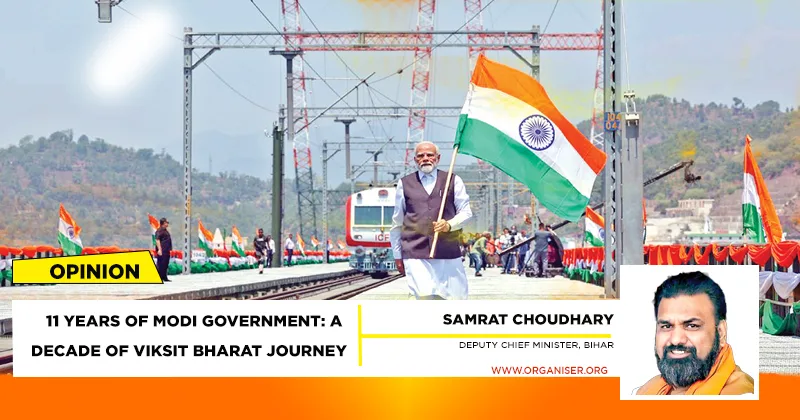
At the dawn of Bharat’s 100 years of its Independence in 2047, the country aims to leapfrog into developed countries league as envisioned by the Prime Minister (PM) Narendra Modi. In order to achieve the agenda of Viksit Bharat 2047, Prime Minister is working tirelessly to fulfil the dream of 140 crore Bharatiyas.
This dream of developed India is based on the solid foundation of transformation that India has witnessed in its last 11 years of golden period under the dynamic leadership of Narendra Modi. The transformation uplifted Indian economy from the group of fragile five in 2014 to the remarkable achievement of becoming fourth largest economy after overtaking Japan in terms of Gross Domestic Product (GDP) at the time when Narendra Modi has completed 11 years of his Government.
From a Government known for policy paralysis under PM Manmohan Singh to a Government known for working round the clock for Indians, India as a nation has truly arrived to claim the leadership role in world polity.
PM started this transformational journey with a historic mandate where the nation handed a single party majority after 1984 General Election. PM used this majority to run an inclusive Government which worked for Sabka Sath Sabka Vikas. To have inclusive growth, he launched PM Jan-Dhan Yojna in which every Indian got an opportunity to open bank account, even if he/she had no balance to maintain. The success of this scheme can be measured from the fact that 55.48 crore Indians opened their bank accounts under this scheme and has deposited Rs 256,757.68 crore balance. Additionally, this Jan-Dhan scheme along with another Modi government’s initiative JAM accounts enabled the beneficiaries of various Government schemes or subsidies to receive Direct Benefit Transfer (DBT) amount in their bank accounts. This was an inflexion point in Indian policy making as the technology and political intent of the Prime Minister eliminated intermediaries between Government and citizens, and helped prevent leakage in taxpayers’ money, which has resulted in an approximate saving of Rs 3.48 lakh crore between 2014 and 2024.
PM Modi impetus on reform was not only economic, but also social. It took nearly 70 years for an Independent India to recognise toilet as a means to basic dignity, especially for female population. Due to lack of hygienic toilets, female child used to drop out from school, which deprived them from exercising their Fundamental Right of Education. For adult females, lack of toilets created security concern and deprived them the working opportunity, which were easily available for their better half’s. Narendra Modi changed this from the premises of Red Fort when he announced “Swachha Bharat Abhiyan”. Today, its success is being taught in various countries as India built approximately 11 crore individual toilets and 2.23 Community Sanitary Complex in last 10 years that has contributed to India’s GDP by approximately 2.7 per cent, as per the UNICEF (United Nations International Children’s Emergency Fund) report.
On women empowerment, Prime Minister Modi has set a very high benchmark that has unleashed full potential of women workforce. Government allowed women officers in a combative role, a feat which was on full display during the recently launched counter offensive operation named as “Operation Sindoor”, when two women officers, one each from Army and Airforce, briefed the entire nation during the testing times. Beti Padhao Beti Bachao, a social reform initiative addressed the issue of female foeticide and as a result, Indian sex ratio at birth has improved to 933 in 2022-23 from 918 in 2014. Today, Government is running various schemes to provide entrepreneurship opportunities to our mothers, sisters and daughters.
India has already arrived globally in terms of infrastructure. Road quality is at par with developed nations. National Highway length has seen a growth of 60 per cent in last decade. Rail links have been established to North-Eastern States and Jammu and Kashmir. Airports have doubled in the Modi’s era and the UDAN scheme has given wings to millions of citizens by connecting small towns and cities to India’s metropolitan centres. All the improved means of connectivity has reduced the travel time, improved the efficiency in trade of goods and services and created new employment opportunities, especially for locals through higher trades and tourism.
In this journey, the PM has worked on upgrading the health facility for ordinary citizen. The AIIMS, a reliable, affordable and trusted brand of medical treatment, has been increased from seven to 23 in just 10 years, with Bihar having two AIIMS to cater to health facility requirements. Aayushman Bharat schemes enables poor as well as senior citizens to avail private care health services that helped them to save their money and time. PM is working on his vision to develop one world class medical college and hospital in each district so that common citizens don’t have to travel to State or country’s capital to avail medical treatments.
The way PM handled Covid–19 pandemic was also transformational. India not only developed its own vaccine, but donated it to many friendly countries prioritising well-being of global earth. For own citizens, Government continue’s to provide free ration to almost 80 crore people, a scheme started at the time of Covid–19. The impact is recognised by World Bank when it concluded in its recent study that India reduced its multidimensional absolute poverty from more than 26 per cent in 2014 to less than three per cent in 2024.
For manufacturing, PM started various schemes such as Start Up India Stand Up India, Make in India, Production Linked Incentive (PLI) scheme, Aatmnirbhar Bharat Abhiyan, Mudra Yojna, and many more so that India can become an alternate to China in terms of world factory. As a result, Apple has shifted its production line that has been a talking point among global industrialist about Indian manufacturing ecosystem. The efforts of the Indian Government to set-up semi-conductor industry have started yielding results and soon, India will dominate the production capability in semi-conductor space, a critical capability for fast technological growth in the era of Artificial Intelligence (AI) and Machine Learning (ML). Recently concluded “Operation Sindoor” drew focus on defence manufacturing in which India has substantially improved its capacity and is now targeting a defence production value of Rs. 3 lakh crores by financial year 2029. The PLI driven electronics industrial growth resulted in making India second largest mobile exporter from an importer of mobile phones just in a decade. Unsatisfied with this growth, Prime Minister continuously works towards economic reforms required to transform India into world manufacturing hub.
Without any iota of doubt, Prime Minster has delivered the solid foundation in last 11 years of his transformative governance, as a result of which, the Indian growth story is being discussed across the globe. Adversaries are worried that India under the able leadership of PM Modi will leapfrog into developed nation category sooner than later.














Comments