





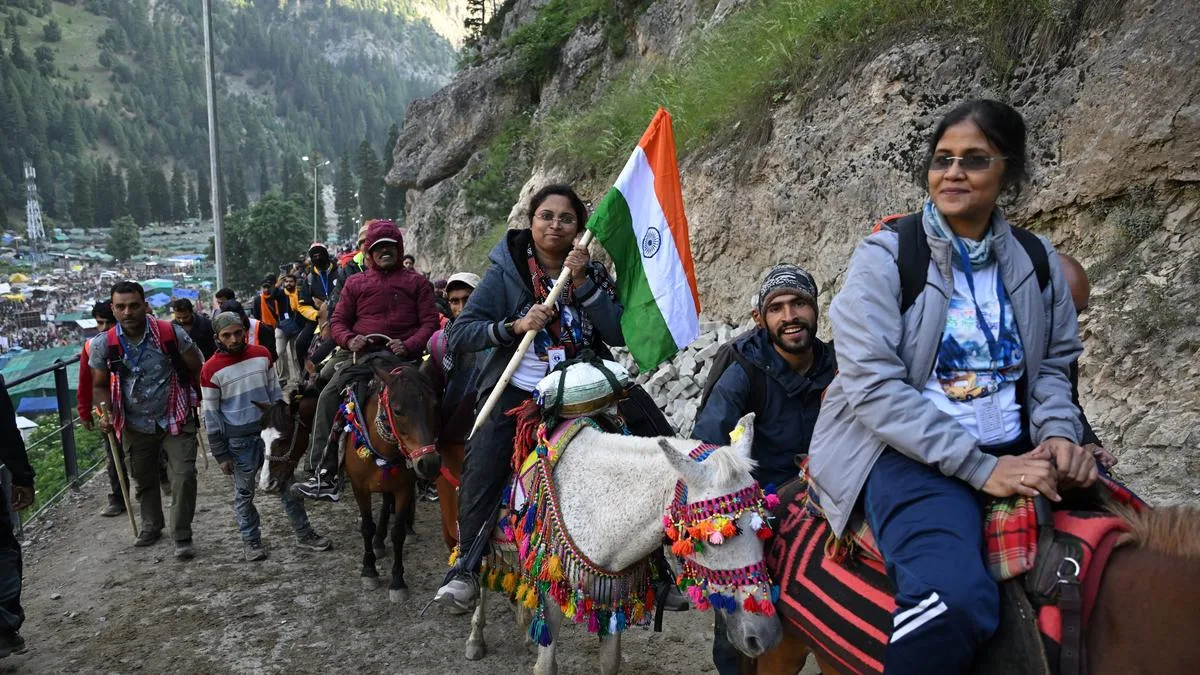
In the heart of the Kashmir Valley, where the snow-capped peaks of the Himalayas touch the heavens, the annual Amarnath Yatra unfolds as a testament to faith, resilience, and unity. The year 2025 marked a significant chapter in this sacred pilgrimage, as over 90,000 devotees completed their darshan at the holy Amarnath cave shrine within the first five days, commencing on July 3.
Despite the shadow of a tragic terror attack in Pahalgam earlier that year, the Yatra proceeded with unparalleled devotion, meticulous organisation, and the unwavering support of security forces and local communities.
The Dawn of the Yatra
On July 2, 2025, Jammu buzzed with anticipation. The Bhagwati Nagar Yatri Niwas, a sprawling complex in the heart of the city, was a sea of saffron-clad pilgrims, their faces radiant with devotion and determination. The air was thick with the chants of “Bam Bam Bhole” and the scent of incense, as thousands gathered for the official flag-off of the Amarnath Yatra by Jammu and Kashmir’s Lieutenant Governor, Manoj Sinha. The ceremony was a blend of solemnity and celebration, with prayers for a safe and successful pilgrimage resonating through the crowd.
The Yatra, a 38-day odyssey concluding on August 9, coinciding with Shravan Purnima and Raksha Bandhan, is one of Hinduism’s most revered pilgrimages. Devotees undertake the arduous yatra to the Amarnath cave shrine, perched at an altitude of 3,888 meters in a narrow gorge at the end of the Lidder Valley. The cave houses a naturally forming ice stalagmite (Lingam), Bhagwan Shiva, which waxes and wanes with the lunar cycle, a divine phenomenon that draws millions to its sacred embrace.
As the first rays of dawn broke on July 3, two escorted convoys departed from Bhagwati Nagar. The first, comprising 148 vehicles and carrying 3,321 pilgrims, set off at 2:55 a.m. for the Baltal base camp in north Kashmir. The second, with 161 vehicles and 4,220 pilgrims, left at 4:03 a.m. for the Nunwan base camp in Pahalgam. These convoys, flanked by security personnel, symbolised the meticulous planning that underpinned the Yatra, especially in the wake of heightened security concerns following the April 22 terror attack in Pahalgam, which claimed 26 Hindu lives.
The Shadow of Tragedy
The Pahalgam attack, orchestrated by Pakistan-backed terrorists, had cast a pall over the preparations for the Yatra. The tragedy, which struck just months before the pilgrimage, highlights the vulnerability of this sacred journey in a region long plagued by unrest.
Yet, it also galvanised the resolve of the authorities, security forces, and local communities to ensure the Yatra’s success. The Shri Amarnathji Shrine Board (SASB), tasked with overseeing the pilgrimage, worked in tandem with the Indian Army, Central Armed Police Forces (CAPFs), Border Security Force (BSF), Central Reserve Police Force (CRPF), Sashastra Seema Bal (SSB), and Jammu and Kashmir Police to create a fortress-like security apparatus.
An additional 180 companies of CAPFs were deployed, supplementing the existing forces stationed along the entire route from Jammu to the holy cave. Transit camps, base camps, and the treacherous mountain paths were placed under a multi-layered security cover. Surveillance drones buzzed overhead, checkpoints dotted the routes, and armed personnel patrolled tirelessly. Pilgrims were strictly advised to travel only in escorted convoys, and helicopter services, a popular option in previous years, were suspended due to security concerns, making the Yatra a wholly ground-based endeavour.
Despite the heightened security, the spirit of the Yatra remained unbroken. The pilgrims, undeterred by the challenges, saw their journey as an act of surrender to Lord Shiva. For many, the absence of helicopter services only deepened the spiritual significance of the trek, as they embraced the physical rigour as part of their penance.
The Routes to Divinity
The Amarnath Yatra offers two distinct routes to the holy cave, each with its own challenges and allure. The traditional Pahalgam route, stretching 46 kilometres, begins at Nunwan base camp in Anantnag district, about 90 kilometres from Srinagar. Pilgrims traverse through Chandanwari, Sheshnag, and Panchtarni, navigating rugged terrain, steep inclines, and breathtaking vistas of snow-clad peaks and gushing streams. The journey typically takes five days, with overnight halts at designated camps where basic facilities like food, shelter, and medical aid are provided.
The Baltal route, shorter at 14 kilometres, is a steeper and more strenuous path that allows pilgrims to complete their darshan and return on the same day. Located near Sonamarg in Ganderbal district, roughly 95 kilometres from Srinagar, Baltal attracts those seeking a quicker, albeit more physically demanding, pilgrimage.
Both routes converge at the holy cave, where the ice lingam, revered as “Baba Barfani,” awaits the devotees. For those unable to trek on foot, horse and pony services, operated by local handlers, provided a vital lifeline. The sight of pilgrims atop sturdy ponies, winding through narrow mountain trails, became a hallmark of the Yatra. These services, managed by local J&K people, not only facilitated the journey but also fostered a sense of camaraderie between the pilgrims and the local community.
A Warm Welcome in the Valley
As the convoys rolled into the Kashmir Valley through the Navyug Tunnel at Qazigund, a heartwarming scene unfolded. Residents, deeply affected by the Pahalgam attack, lined the roads to welcome the pilgrims. Holding garlands and placards, they expressed solidarity and sorrow, their gestures a powerful rebuke to the forces of division. “We stand with you,” read one placard, while another simply said, “Welcome to Kashmir.”
The pilgrims, many of whom had travelled from distant corners of India, were visibly moved by this outpouring of affection.
In Baltal, locals offered cold drinks and drinking water to weary pilgrims returning from the cave, a gesture that spoke volumes about the region’s tradition of hospitality. “The love and support from the people here make this journey even more special,” said Anil Sharma, a pilgrim from Uttar Pradesh, his voice choked with emotion. “We feel safe, welcomed, and blessed.”
From providing food and shelter to guiding pilgrims through treacherous paths, the local community’s contributions were indispensable. Their resilience in the face of adversity, particularly after the April attack, inspired the pilgrims and reinforced the Yatra’s message of peace.
Voices of the Pilgrims
The pilgrims themselves were a diverse tapestry of India’s cultural and spiritual fabric. Among them was Sunita Devi, a 45-year-old homemaker from Bihar, who had been visiting the Amarnath cave since 2019. “Every time I come here, I feel Baba Barfani calling me,” she said, her eyes gleaming with devotion. “The arrangements this year are exceptional, food, medical camps, and security are all top-notch. The Army’s presence makes us feel like we’re in safe hands.”
Ravi Kumar, a first-time pilgrim from Delhi, was struck by the sheer scale of the Yatra. “I had heard stories about the ice lingam and the cave’s divine energy, but seeing it with my own eyes was overwhelming,” he shared. “The trek was tough, but the support from the administration and locals made it manageable. I’ll carry this experience in my heart forever.”
For many, the Yatra was not just a physical journey but a spiritual transformation. “Comfort is not the priority when you’re on a pilgrimage,” said Meena Rathore, a devotee from Rajasthan. “But the facilities this year are far better than I expected. The security forces and locals have gone out of their way to make us feel at home.”
The Indian Army, in particular, earned widespread praise. Stationed at every critical juncture, from transit camps to the cave itself, their vigilance and warmth reassured the pilgrims. “The Army is our guardian angel,” said Sanjay Patel, a pilgrim from Gujarat. “Their efforts, combined with the administration’s planning, have made this Yatra a truly divine experience.”
The Sacred Cave and its Mystique
At the heart of the Yatra lies the Amarnath cave, a natural wonder steeped in history and reverence. Puranas reference the site, cementing its status as one of Hinduism’s holiest shrines. The ice stalagmite, which forms naturally inside the cave, is the focal point of the pilgrimage. Embodied as Bhagwan Shiva, it is said to grow and shrink with the lunar cycle, a phenomenon that devotees interpret as a divine sign.
For the 90,000 pilgrims who had darshan in the first five days, standing before the lingam was a moment of profound spiritual fulfilment.
On Sunday, July 6, alone, 21,512 devotees completed their darshan, a testament to the Yatra’s growing popularity. The SASB reported that thousands more were registering on the spot at Baltal and Nunwan, bypassing the traditional route from Jammu.
Challenges and Triumphs
The Yatra was not without its challenges. Two pilgrims succumbed to natural causes during the first few days, a sombre reminder of the physical toll of the high-altitude trek. Medical camps, staffed by doctors and paramedics, were set up at regular intervals to address emergencies, offering everything from oxygen cylinders to basic first aid.
The SASB and local administration ensured that these facilities were accessible to all, minimising risks and providing reassurance to the pilgrims. The suspension of helicopter services, while a logistical challenge, did little to dampen the pilgrims’ spirits.
Many embraced the opportunity to undertake the full trek, viewing it as an act of devotion. “Walking to the cave feels like a true pilgrimage,” said Priya Sharma, a young devotee from Mumbai. “It’s not just about reaching the destination, it’s about the journey and the sacrifices we make along the way.”
A Journey of Unity and Faith
As the Yatra progressed, it became more than a religious pilgrimage, it became a symbol of resilience, unity, and shared humanity. The collaboration between the administration, security forces, and local communities created an ecosystem where faith could flourish despite adversity.
The pilgrims gratitude was palpable, their voices echoing through the valleys as they chanted praises to Bhagwan Shiva and thanked those who made their journey possible.
By Tuesday, July 8, the Yatra had already seen over 90,000 devotees complete their darshan, with thousands more joining each day. The numbers were a testament to the enduring allure of the Amarnath cave and the unwavering faith of its devotees.
As the pilgrimage continued toward its culmination on August 9, it carried with it a message of hope, harmony, and the triumph of the human spirit. In the shadow of the Himalayas, amidst the chants of “Har Har Mahadev,” the Amarnath Yatra of 2025 stands as a beacon of devotion, a reminder that even in the face of challenges, the call of the divine could unite hearts and transcend boundaries.
For the pilgrims, the locals, and the guardians of the Yatra, it is a journey not just to a cave, but to the very heart of faith itself.
















Comments