





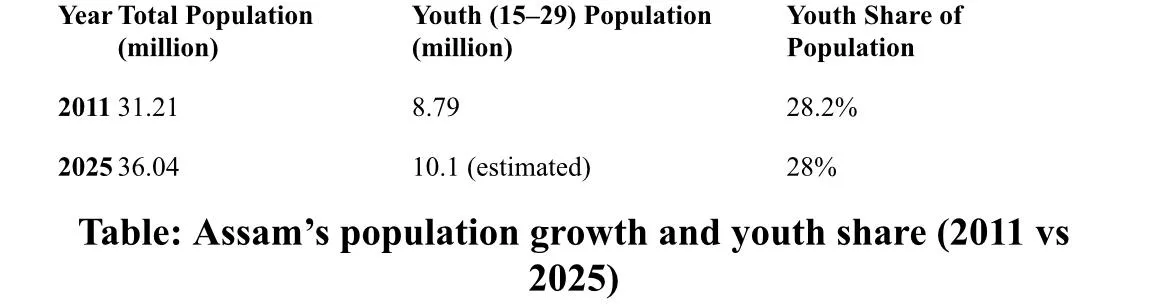
Assam is blessed with a rich mix of indigenous customs, dialects, and civilisations. There are more than two and a half dozen prominent ethnic groups, including Scheduled Tribes, which account for around 12 per cent of the population of Assam (3.88 million as of 2011) among our youth. Each of them, Bodo, Mishing, Karbi, Rabha, Kachari, Dimasa, and half a dozen others, has its own history and dreams. Around 28 per cent or 10 million of Assam’s estimated 36.04 million population in 2025 will comprise young people aged 15-29 years. This is a growth of a kind from the 8.79 million young people counted in the 2011 Census. There can’t be only one solution to our policies. Rather, it must enable community leaders, tribal student unions, and local youth groups to adapt programs to their own contexts. We must balance tradition and modernity. The cultural landscape in Assam is evolving under the pressures of migration and globalisation. Young people are blending traditional Bihu with rock music, celebrating both Rangali Bihu and global events, creating a hybrid identity. A State Youth Policy to encourage this positive hybridity while ensuring the continuity of distinctive community identities is the need of the hour.
Clearly, any Assam youth policy will be a supplement to India’s overall youth development plan. A ten-year plan (2023–2033) on five broad themes: education, employment, young leadership, health, and social justice, with special emphasis on social inclusion, is presented in the draft National Youth Policy 2024. These priorities echo Assam’s needs
Education & Skill Development: Enhancing life and professional skills is a key component of the national policy, which is in line with NEP 2020. Assam must do the same, boosting school quality and vocational training. Our Gross Enrolment Ratio in higher education is only 51.3 per cent. We need strategies to raise this from more colleges in underserved areas to scholarships for girls and marginalised youth.
Employment & Entrepreneurship: The national vision commits to economic opportunities for youth. Assam’s policy will dovetail with this by focusing on job creation, skill training, and entrepreneurial support (more on this later). With youth unemployment a pressing issue, we must leverage central programs and ensure our youth are job-ready.
Youth Leadership & Civic Participation: The National Youth Policy highlights leadership, volunteering, and the use of technology for empowerment. In Assam, we can align by strengthening NSS, Nehru Yuva Kendra, and other volunteer networks. We should create avenues for youth to engage in governance, e.g. youth parliaments, municipal youth councils, echoing the national National Young Leaders Program, which fosters youth voice in development.
Health & Wellbeing: Following the national lead, Assam’s youth policy must address physical and mental health. This includes sports promotion (in line with Fit India) as well as tackling mental health issues (more on that in Challenges section). The policy will integrate efforts with the National Adolescent Health Mission and other central schemes to reach youth in schools and colleges.
Social Justice & Inclusion: The draft NYP 2024 commits to safety, justice, and support for marginalised youth. Assam will align by focusing on equity, whether for indigenous communities, tea tribe youth, differently-abled youth, or young women facing social barriers. The policy can incorporate provisions from national schemes for Scheduled Tribes and OBC youth, ensuring no section is left behind.
In short, our state policy will complement and localise the National Youth Policy, it means our youth in Dibrugarh or Dima Hasao can benefit from both Guwahati’s initiatives and Delhi’s vision, in a seamless mission of youth-centric governance.
Learning from Global Youth Policy Models
Youth-centric governance is not just an Indian concern, countries across the world have devised innovative policies to empower their young citizens. Here, we highlight a few countries known for progressive youth policies, and what Assam can learn from them
Finland: This Nordic country is globally renowned for its holistic approach to the well-being of young people. Even Finland has a Youth Act to protect youth rights and require cross-ministerial youth work. The law provides consistency and periodic refreshing of youth policies by compelling the Finnish government to adopt a National Youth Work and Policy Program every four years. The Youth Act encourages inter-ministerial coordination as well as between municipalities, social cohesion, and youth involvement in decision-making. One of its core principles is that youth policy has to be horizontal, i.e., sectors like health, work, education, and others join hands to contribute to improving youth outcomes. Assam’s lesson: One such institutional coordination mechanism is a cross-departmental Youth Development Council that can be established by a state youth policy. It could also mandate that youth voices are included in policymaking, perhaps by creating youth advisory boards at state and district levels (similar to Finland’s national and local youth councils). Embedding the values of cultural diversity, sustainability, and healthy lifestyles in youth programs as Finland’s Youth Act does would resonate well in Assam’s context too.
Australia has launched an ambitious youth engagement strategy, called “Engage!” (2024), aimed at including young people in governance. The strategy outlines clear priority areas: the government will recognise and listen to young people, empower them to advocate and engage, and support government agencies in working more effectively with youth. To put this into action, Australia has established structures such as a National Youth Steering Committee, Youth Advisory Groups, and an annual National Youth Week to celebrate and amplify youth voices. Special emphasis is given to Indigenous (First Nations) youth and marginalised rural youth, ensuring their voices are not lost. Lesson for Assam: The idea of institutionalised youth consultation is powerful. Assam could establish a State Youth Advisory Council comprising dynamic young achievers from different fields and regions, who meet regularly with policymakers. Likewise, organising Youth Parliaments or Youth Assemblies can give youngsters a platform to debate issues and offer solutions. Australia’s model of directly involving youth in designing the policies that affect them can help make Assam’s youth policy more relevant and legitimise it in the eyes of young citizens.
South Korea: The nation has invested extensively in youthful development, namely entrepreneurship and skills acquisition, in reaction to challenges such as intense competition in the labour market and pressure to study. One such example is the Young Entrepreneurs Academy (YEA), a government-sponsored program managed by the Ministry of SMEs and businesses that provides end-to-end support to youth businesses. Since its launch in 2011, the YEA has established 18 centres nationwide and assisted over 7,600 young entrepreneurs by providing them with financial assistance, technical training, and mentorship. Two start-up “unicorn” businesses, billion-dollar firms that began as youth ventures, are good examples of successful programs. The government views young entrepreneurs as key to Korea’s economic vitality and backs them with an entire ecosystem of incubators, accelerators, and networking opportunities. Laws like the Youth Activity Promotion Act and the Framework Act on Youth also exist in South Korea that encourage civic education, volunteering, and other youth activities. Assam’s lesson: Focusing on skill development and young entrepreneurship can transform employment. Assam can emulate South Korea by creating local incubation centres or “Youth Startup Parks” in collaboration with universities and industry. Providing modest seed funding, training, and mentorship (for example, through programs like the recently revamped Swami Vivekananda Youth Empowerment scheme) can unleash a wave of startups in sectors like agri-business, handloom, IT services, and tourism areas where Assam’s youth have talent. Additionally, formulating statutes or regulations that institutionalise youth volunteer programs (akin to Korea’s encouragement of youth volunteering) could strengthen civic sense and leadership skills among Assamese youth.
Singapore: The city-state of Singapore offers a great model of structured youth development and civic engagement. Singapore established a National Youth Council (NYC) in 1989, which today is an autonomous agency under the government dedicated to youth affairs. The NYC’s mission is to “hear youth, empower youth and be here for youth”, ensuring young Singaporeans have opportunities to develop self-awareness, resilience, and community spirit, and to be future-ready. It runs a plethora of programs: from grants for youth-led ground-up initiatives, to leadership expeditions like Outward Bound Singapore, to a Youth Corps for volunteering, to Youth Action Challenge hackathons for policy ideas. Significantly, Singapore involves youth in policy co-creation through “Youth Panels” that work with government agencies on specific issues, contributing ideas to drive change. The whole approach is one of partnership between youth and government, treating youth not as beneficiaries but as stakeholders. Lesson for Assam: Investing in a robust youth institutional framework pays off. Assam can consider setting up a dedicated Youth Development Council or Directorate, learning from the NYC model, which collaborates with NGOs, educational institutions and the private sector to run youth programs. The concept of youth-led policy innovation (for example, youths coming up with solutions for local problems like flood management or drug abuse, which the government can implement) is directly applicable. Also, Singapore’s focus on making youth “future-ready” through leadership training, digital skill programs, and international exposure is something Assam can adopt by partnering with organisations to run youth exchange programs and skill bootcamps. In essence, treating youth as partners in governance, not just targets of welfare, can dramatically increase their engagement.
These international cases, Finland, Australia, South Korea, and Singapore, despite their different contexts, share a common thread: they place youth at the centre of policy, and they create dedicated mechanisms to serve youth interests. Whether it’s legal mandates, advisory bodies, entrepreneurial ecosystems, or youth-run initiatives, these are tools Assam can customise.
Major Youth Challenges in Assam
While the outlook for Assamese youth is hopeful, we must confront some stark challenges that our young generation faces today. A frank assessment of these issues is the first step to addressing them in our policy
Unemployment and Underemployment: Assam has seen a steep increase in the number of educated youths actively looking for jobs in the recent past. According to the recent Economic Survey, more than 21 lakh youths job seekers are registered in the state, a clear increase from the previous years. The rising number is a testimony to our youths’ growing aspirations as much as to the expansion of education. It is also a timely reminder that to meet these aspirations, we need to further step up our efforts in the areas of job creation, entrepreneurship, and skill development. Assam’s overall unemployment rate in 2023-24 was only 6.1 per cent, thanks to agrarian and informal employment absorbing many. But that statistic masks the reality of urban and educated youth unemployment. In urban Assam, unemployment among urban youth reached 27.5 per cent by late 2024.
Skill Gaps and Education Quality: The employability challenge is tied to gaps in our education system. While literacy has improved (from 72% in 2011 to an estimated 80 per cent today) and more youth are finishing school, there remains a skill deficit. Many graduates lack the practical skills demanded by industries. Those who do often pursue general streams with limited job market linkage. The problem is two-fold: one, quality, i.e., better teaching, computer literacy, English literacy, etc., and two, alignment, i.e., courses created aligned with Assamese economic requirements (e.g., skilling for new industry clusters such as food processing, tourism, IT, and green jobs). School dropouts continue to be a problem in some rural and remote enclaves, particularly among girls and lower-income students. We need to keep our youth engaged in learning or skilling pathways, otherwise, they fall into the unemployment pool.
Mental Health and Substance Abuse: Perhaps one of the most under-acknowledged issues is the mental health crisis among youth. Modern pressures, unemployment stress, and social media have taken a toll on young minds. A UNICEF-supported survey in 2022 revealed a shocking finding – approximately 95 per cent of youth in Assam reported having faced mental health issues related to cyberbullying or corporal punishment. Many reported that online bullying impacted their relationships and led to anxiety, fear, and even self-harming tendencies. This points to a silent epidemic of depression, anxiety, and trauma among our youth. Unfortunately, stigma and a lack of services mean most suffer in silence. In addition, substance abuse is on the rise in some pockets, and cheap drugs and alcohol have ensnared a section of disillusioned youth. The Assam Police’s drive against drugs has had successes, but the demand side remains; many young people turn to substances as an escape from idleness or emotional distress. We must treat mental health as seriously as physical health in our youth policy by expanding counselling, peer support networks, and awareness to remove stigma.
Climate Vulnerability and Instability: Assam’s youth also face some social and environmental issues to deal with. Livelihood and education of rural youths are disproportionately impacted by climate change and floods. School schedules are disrupted every year, and adolescents are required to help families get back on track after disasters. Adolescent minds take a huge psychological toll due to climate catastrophes. Furthermore, although Assam is a relatively peaceful state now, its history of insurgencies can instil a feeling of insecurity. Youth in some regions have grown up amidst political bandhs or protests, affecting their outlook. In order to safeguard young individuals from being affected by those circumstances that lie beyond their control, social and climatic resilience is required.
Our aim is to turn each challenge into an opportunity: unemployment into entrepreneurship, skill gaps into skill development drives, migration into brain-gain by attracting investment, mental health struggles into stronger support systems, and climate threats into youth-led climate action. The next section outlines how we plan to do exactly that.
The Way Ahead and Empowerment
Despite the obstacles, the youth of Assam have demonstrated incredible determination, inventiveness, and perseverance. The government responsibility is to empower them to build an ecosystem where their ambitions can take flight. The State Youth Policy will be a blueprint for such empowerment, anchored in several key strategies:
1. Job Creation through Entrepreneurship and Skill Development: The solution to unemployment lies not just in seeking jobs, but in creating jobs. Assam has taken steps to empower young entrepreneurs with funds and dreams. The SVAYEM scheme has empowered two lakh youth with their aspirations through money and entrepreneurship training, including local industries, services, and agriculture. Based on this, the government has initiated the CMAAA to empower another two lakh youth to become self-reliant. Eligible youth can initiate or grow a business with finance assistance ranging from Rs 2 to Rs 5 lakh, a combination of grants and interest-free loans. SVAYEM and CMAAA collectively promise new hope to young Assamese who want to make their futures here. This injection of capital at the grassroots is fostering thousands of micro-enterprises from agri-processing units to local tourism services. The Youth Policy will reinforce such efforts by streamlining credit access, incubation, and mentorship for startups.
Complementing entrepreneurship is skills training. The construction of the Assam Skill University (ASU) at Mangaldoi is a game-changer. Spread over 80+ acres, ASU will train over 10,000 students in industry-aligned courses, ranging from data science and AI to solar technology and advanced welding. With a Rs 1000 crore investment and Asian Development Bank support, this is India’s first skill university in the Northeast. By 2025, ASU will be fully functional, producing a pipeline of skilled youth ready for both local industries and global job markets. Youth Policy will support such institutions by updating curriculums as per market demand and ensuring even rural youths (through ITIs and skill centres) can access world-class training. We envision “skill on wheels” mobile units to bring short-term vocational courses to flood-affected char areas and tea gardens, so that no willing youngster is left unskilled due to location.
2. Bridging Education to Employment: The youth policy can tackle the education-employment disconnect through focused interventions. Firstly, career counselling and internship programs can be expanded statewide. Every college student should undergo an internship or apprenticeship in their final year. We’ll work with industry bodies (like FINER, CII) to place youth in local businesses, ensuring they graduate with practical experience. Secondly, aligning with National Education Policy 2020, introducing 21st-century skills (digital literacy, coding, communication, financial literacy) into high school and college curricula. This will make our youth more employable.
3. Inclusive Platforms for Youth Voice and Leadership: Adding the State Youth Council as a participatory body to the Assam State Youth Commission can expand youth involvement in governance and build on global best practices from nations like Singapore and Australia. Although the Commission oversees youth-related issues institutionally and legally, the proposed Youth Council, which would include a young person from each district as well as representatives from underrepresented groups, could act as a grassroots advisory body. To discuss new ideas, emerging issues, and firsthand perspectives, this Council would meet with the Chief Minister and other senior officials on a regular basis. Youth Development Committees can be established at the block and district levels to oversee local initiatives and guarantee timely field feedback.
4. Strengthening Mental Health & Social Support: A cornerstone of the new youth policy is a robust focus on mental health, counselling, and addiction rehabilitation. The policy endorses the establishment of District Youth Wellness Centres in every district hospital, a one-stop facility where youth can access free counselling, psychological support, and information on managing stress, addiction, or any personal crisis. Schools and colleges will have mandatory counsellors or tie-ups with NGOs to conduct regular workshops on mental well-being. A campaign will be run (in collaboration with UNICEF and NSS, who have already done surveys) to raise awareness that seeking help is not a stigma. Cyberbullying and abuse will be addressed via awareness in schools on cyber etiquette and stricter enforcement of anti-ragging and IT laws to protect youngsters online.
On substance abuse, the Youth Policy will coordinate with the de-addiction programs of the Health Department to specifically target youth addicts for rehabilitation. Peer support groups (former addicts who are now clean) will be mobilised to reach out in colleges and communities; nothing helps more than relatable role models. The goal is to reduce the percentage of youth reporting mental health issues or substance use year on year, by proactive outreach. A happy youth is a productive youth; we take that as gospel.
5. Climate Resilience and Green Youth Movement: Assam’s youth are already leading on climate action in a pioneering way. Since its launch in 2022, the Chief Minister’s Climate Resilient Village Fellowship (CMCRVF) has placed young professionals in villages to design climate solutions from the ground up. In the first phase, 43 Climate Fellows collaborated with 100 villages to develop locally adaptive resilience plans through the convergence of scientific and traditional knowledge. As an example, with the assistance of village communities, fellows assisted villages in developing climate-resilient crops, rainwater harvesting, and low-cost water filters. This initiative is a shining example of the manner in which educating young people about climate change and the environment serves us all: the youth gain leadership skills, and our villages are safe and sustainable.
To conclude, the challenges are significant, but so is the resolve of our government and the passion of our youth. The envisioned Assam State Youth Policy will not be a mere document; it will be a mission statement, committing all of us to prioritise youth in every sector and scheme. From offering financial capital to building human capital (Skill University), from nurturing start-ups to bolstering mental health, from preserving indigenous culture to pushing the frontiers of technology, the approach is holistic.
















Comments