





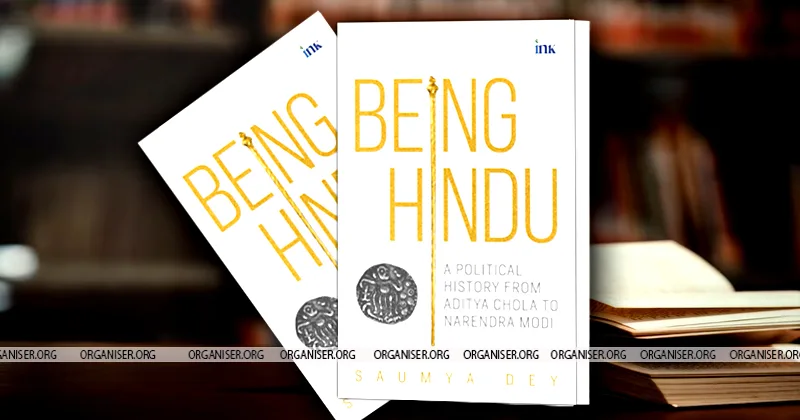
Saumya Dey’s work titled ‘Being Hindu: A Political History from Aditya Chola to Narendra Modi’, presents a narrative of political consciousness that has its roots in our history representing an intellectual framework of the Hindu political history from 9th century CE to present day. There has been scarce literature that explain the functioning of a Hindu polity and Hindu political kingship which this book theorizes and unravels. The main argument of the book lies in the consistent political framework of a Hindu state tracing its history and the author, being an intellectual historian, asserts on the idea of state as ‘culture-power formations’ which means that culture defines the state through its particular features like significance of temples and state’s cultural assertion in the public sphere. The author clearly defines the meaning of the political relevance and ‘historical authencity’ of rootedness of Hinduism in our history and its role in cultural intervention, stating a different perspective from the colonized view of Hinduism.
The author centrally argues for Hindu political expression that has been in existence before the colonial period, having a long and layered history, and contests the common tendency of Marxist historiography to treat Hindutva as a reactionary 20th century phenomenon. The Hindu political practice was deployed through ‘standard symbolic tropes’ by the Indian rulers that legitimized their kingship and also developed the ‘potency of rituals or shrines’. All these factors worked to exemplify an active support for religious groups and temple-building depicting the state’s involvement in cultural practices.
He begins his analysis with the reign of Aditya Chola I, first of the imperial Cholas, and positions him as the starting point of a distinctly form of Hindu political kingship. The book traces the significance of religious emphasis, ritualistic authority and sacredness of the region during Cholas’ rule followed by the rulers of the Vijayanagara empire and the Marathas. As mentioned by the author, it could be concluded that before the establishment of British rule in India, a cultural framework of Hindu political practice existed in India for around eight centuries, as observed by the author, “medieval Hindu political practice was textually rooted. It was a creative amalgam of textual frames and improvised, customary practice”.
The book efficiently maintains the continuity of the Hindu political legacy as the author mentions that the Hindu society transitioned to a new political paradigm during the nineteenth century. The colonial government gave the perfect push to the Hindu political behaviour that led to formation of a ‘communitas’, which can be expressed as a ‘heightened sense of community’ that transcended and served as the basis for an ‘ideologically formulated oneness of Hindu society’.
Hindu nationalism has not been a reactionary movement, but was instead an organic evolution of an indigenous political thought. Shifting towards the colonial era, the author explained the works of Raja Ram Mohan Roy, Bankim Chandra Chattopadhyay and Swami Vivekananda and their role in reinstating the Hindu identity in the wake of Western domination as the ‘theoretical formulations of Hindu communitas’. He states that, “the relatively fuller development of Hindu communitas is reflected in certain nomenclatural coinages by the Hindu elites in the nineteenth century- these represented their attempts to articulate a perception of the historically consistent social, cultural, and spiritual unity of the Hindus”. He also subsequently discusses about V.D. Savarkar and M.S. Golwalkar and how these intellectuals reimagined Hinduism in reaction to both colonial criticism and modernity. Swami Vivekananda’s focus on strength, spirituality, and pride in civilization is taken as an attempt to build a Hindu self that could hold its head high in the world.
This reconstruction formed the foundations for contemporary political Hinduism, offering ideological building blocks to be later used by the political organizations. One of the intellectual strengths of the book is the way it maps the development of political Hinduism from cultural assertion to political mobilization. The establishment of the Rashtriya Swayamsevak Sangh (RSS) in 1925 and subsequent establishment of the Jana Sangh followed by the Bharatiya Janata Party (BJP) were not seen as blocks from the past but as organizational forms that provided shape to a long cultural-political urge. The author stresses that the ideological roots of Hindutva go deeper than its electoral expressions, and thus all the formulations were not just religious but political as well and were being used as to consolidate social form and governance.
The final chapter focuses on the rise of Narendra Modi as the Prime Minister of India and the transformation of Indian politics since 2014. The author regards Modi’s rise to the role of Prime Minister not merely as a political event but as a civilizational moment. He situates him as the culmination of this ideological path whose leadership contends for a revival of an active Hindu political identity, asserting that, “The incorporative framework of politics inherited by the BJP from the Jana Sangh is coming to spectacular fruition at Ram Janmasthan under Modi’s leadership. Modi is steeped in Hindu cultural and spiritual values, and his politics often visibly derive from them. The fact that he has installed the Sengol, an ornately crafted sceptre topped with a figurine of the Nandi bull, in India’s new parliament building is an eloquent testimony to this…Under Modi’s leadership, the Indian state seems to be finally acknowledging its civilizational character and, so to speak, redeeming Bharat.” The paradigmatic shift from corporative framework to communitas eventually engendered the sangathanist ethos of the Hindu society that produced a broad Hindu vision for the Indian nation-state, and thus becoming the pathway to nation building under the leadership of Narendra Modi.
This book is an important contribution to the debate on Hindu political identity. The author presents an analysis that attempts to reclaim and reassert historical continuity of Hindu political expression. It challenges the dominant perspective of the Left and draws attention to the development of Hindu identity in the Indian subcontinent. The book provides a fascinating account that highlights the persistent interconnections between culture, religion, and politics in India and reminds us that ideologies are shaped out by tradition as well as the challenges. The author highlights the ‘dynamic and adaptive’ quality of the Hindu political society on account of which the Hindu social world functions as an ‘enormous discursive field, forever pulsating with ideas’ and ‘have not fossilized’, despite being the oldest culture in the world.










Comments