





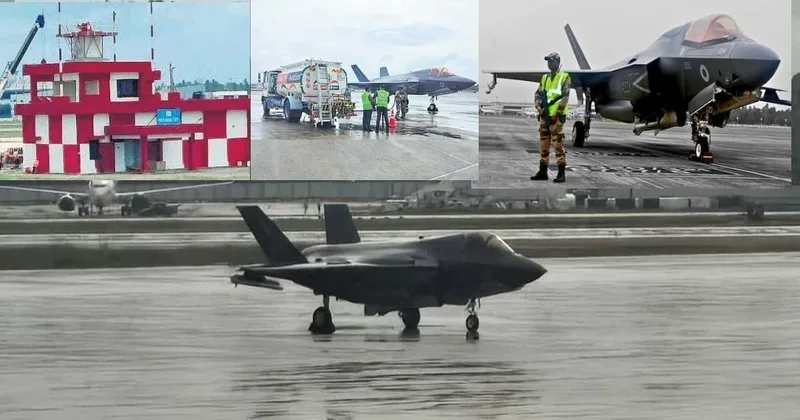
The world’s so-called most advanced fifth-generation fighter jet, the American-made F-35, is currently making headlines for all the wrong reasons. Proudly hailed by the US as a technological marvel, one of these $115 million (Rs 995 crore) stealth aircraft, purchased by Britain, has now been lying helplessly in the open at Thiruvananthapuram airport for almost a week, drenched in monsoon rain and grounded due to a critical hydraulic failure.
Manufactured by US defence giant Lockheed Martin, the F-35 was supposed to be a symbol of unmatched aerial supremacy. Instead, it’s become a symbol of costly embarrassment, both for the aircraft’s owners and its proud creators. British engineers scrambled to fix the issue, but their efforts failed miserably. Eventually, Lockheed Martin had to dispatch its own experts all the way from the US, with repairs expected to take more than two weeks. Meanwhile, the spectacle of the miracle jet soaking in Indian rain has gone viral on social media, complete with trolls and a prank listing of the aircraft for sale on OLX at a jaw-dropping price.
The US has aggressively marketed the F-35 as the crown jewel of its defence exports, boasting that it’s too advanced to share casually. Besides the US and UK, eleven countries operate it, and nations like Belgium, Germany, Poland, Switzerland, Czech Republic, Greece, and Romania have already placed hefty orders. But now, with the grounded jet attracting international ridicule in India, the prestige of this ‘radar-evading’ machine has taken a nosedive.
Ironically, the US had previously offered the F-35 to India during PM Modi’s visit, hyping it as an aircraft that can carry 8100 kg of weapons, fly at 1200 mph, and reach altitudes of 50,000 feet. It was also touted to be virtually invisible to radar. Yet, the Integrated Air Command System in Thiruvananthapuram picked it up effortlessly as it entered Indian airspace, shattering claims of its so-called stealth invincibility. Even more amusing, Iran recently claimed it had shot down an Israeli F-35, a claim mocked until now but perhaps not so far-fetched in light of recent developments.
Adding insult to injury, the F-35 variant that landed in India is equipped with vertical take-off and landing capabilities, designed for aircraft carriers. But this very system is what failed. Lockheed Martin, which had previously brushed off reports of such glitches, now stands exposed, quite literally, on the tarmac.
The situation has prompted Indian defence officials to reassess potential F-35 purchases. The Indian Air Force, which had been evaluating the fighter jet’s capabilities, may now reconsider, or significantly reduce, any planned acquisition.
In contrast, support is growing for Russia’s Sukhoi Su-57E, a fifth-generation fighter offered at a relatively modest Rs 690 crore. Crucially, Russia is also offering full source code access, a dream for any air force looking to customise, maintain, and upgrade independently.
SpaceX CEO Elon Musk once quipped that the F-35 is a mess” with “high manufacturing costs, poor performance, and heavy flying expenses. At the time, it seemed harsh. Today, the sight of a drenched, disabled F-35 waiting for rescue in Kerala is starting to prove Musk right.
To cap off this aviation tragedy-turned-comedy, word has it that Britain may now send a giant cargo plane to carry the jet back home. And if the issue proves unfixable, the most expensive fighter in the world may be quietly scrapped, a silent admission of failure for what was meant to be an icon of 21st-century airpower.















Comments