Understanding Aviation Jargon: The story behind the Air India crash
December 5, 2025
  • Read Ecopy
  • Circulation
  • Advertise
  • Careers
  • About Us
  • Contact Us
Android AppiPhone AppArattai
Organiser
  • ‌
  • Bharat
    • Assam
    • Bihar
    • Chhattisgarh
    • Jharkhand
    • Maharashtra
    • View All States
  • World
    • Asia
    • Europe
    • North America
    • South America
    • Africa
    • Australia
  • Editorial
  • International
  • Opinion
  • RSS @ 100
  • More
    • Op Sindoor
    • Analysis
    • Sports
    • Defence
    • Politics
    • Business
    • Economy
    • Culture
    • Special Report
    • Sci & Tech
    • Entertainment
    • G20
    • Azadi Ka Amrit Mahotsav
    • Vocal4Local
    • Web Stories
    • Education
    • Employment
    • Books
    • Interviews
    • Travel
    • Law
    • Health
    • Obituary
  • Subscribe
    • Subscribe Print Edition
    • Subscribe Ecopy
    • Read Ecopy
  • ‌
  • Bharat
    • Assam
    • Bihar
    • Chhattisgarh
    • Jharkhand
    • Maharashtra
    • View All States
  • World
    • Asia
    • Europe
    • North America
    • South America
    • Africa
    • Australia
  • Editorial
  • International
  • Opinion
  • RSS @ 100
  • More
    • Op Sindoor
    • Analysis
    • Sports
    • Defence
    • Politics
    • Business
    • Economy
    • Culture
    • Special Report
    • Sci & Tech
    • Entertainment
    • G20
    • Azadi Ka Amrit Mahotsav
    • Vocal4Local
    • Web Stories
    • Education
    • Employment
    • Books
    • Interviews
    • Travel
    • Law
    • Health
    • Obituary
  • Subscribe
    • Subscribe Print Edition
    • Subscribe Ecopy
    • Read Ecopy
Organiser
  • Home
  • Bharat
  • World
  • Operation Sindoor
  • Editorial
  • Analysis
  • Opinion
  • Culture
  • Defence
  • International Edition
  • RSS @ 100
  • Magazine
  • Read Ecopy
Home Bharat

Understanding Aviation Jargon: The story behind the Air India Flight 171 crash

The crash of Air India Flight 171 has spotlighted critical aviation terms as investigators probe potential causes, including a rare dual-engine failure, flap malfunction, and black box data. With 274 lives lost, the disaster has ended the Boeing 787 Dreamliner's flawless fatality-free record and sparked a global investigation.

WEBDESKWEBDESK
Jun 18, 2025, 03:00 pm IST
in Bharat
Follow on Google News
FacebookTwitterWhatsAppTelegramEmail

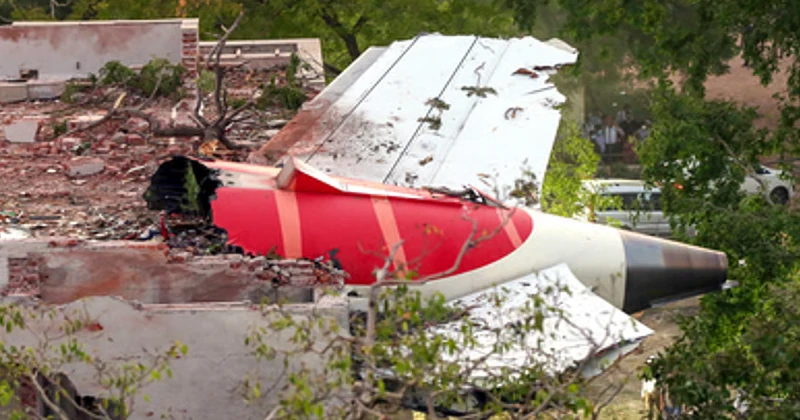
The devastating crash of Air India Flight 171 on June 12 has brought an unsettling wave of aviation terms into daily headlines. The Boeing 787 Dreamliner, carrying 241 passengers and crew, went down just seconds after take-off, killing a total of 274 people including over two dozen on the ground. This tragedy not only made global news because of the high death toll but also because it occurred during the critical take-off phase — a time when aircraft systems and pilots are under intense stress. To help make sense of the technical language now everywhere in media briefings and crash reports, here’s a simple, clear guide to the key terms that have emerged since the accident.

The aircraft involved was a Boeing 787 Dreamliner, widely known for its fuel efficiency and passenger comfort. It is a long-haul, twin-engine, wide-body aircraft, considered Boeing’s flagship in commercial aviation. Remarkably, before this incident, the Dreamliner had no fatal crash record since its introduction over a decade ago. By early 2025, Boeing had delivered more than 1,100 Dreamliners, logging nearly five million flights globally without a single fatality until Flight 171’s disaster shattered this record.

In India, the official investigation is being handled by the Aircraft Accident Investigation Bureau, or AAIB. This agency reports to the Ministry of Civil Aviation and is responsible for investigating civil aviation accidents involving Indian-registered aircraft or those occurring within India’s territory. The AAIB’s job is not just to find the cause but also to issue recommendations to prevent such disasters in the future. Meanwhile, the US-based National Transportation Safety Board, or NTSB, is expected to join the probe too. The NTSB is America’s counterpart to the AAIB but investigates accidents involving all modes of public transportation. Globally recognized for its work, it frequently appears in documentaries like National Geographic’s “Air Crash Investigation”, also known as “Mayday”. The NTSB often supports international probes involving American-built aircraft like the Boeing 787.

One piece of equipment that has come under the spotlight is the RAT, or Ram Air Turbine. This is a small, propeller-like device that deploys automatically if an aircraft loses all engine power. As the plane moves through the air, the wind turns the RAT, which generates just enough electricity to keep critical systems running — such as hydraulics, cockpit lights, and basic flight controls. Audio recordings from Flight 171’s final moments hint that the RAT may have been deployed, fueling speculation of an extraordinarily rare dual-engine failure that could have left the aircraft powerless almost immediately after take-off.

Another focus of any air crash investigation is the black box — which is actually not black but bright orange for visibility among debris. The term “black box” refers collectively to two critical devices: the Flight Data Recorder (FDR) and the Cockpit Voice Recorder (CVR). The FDR keeps track of detailed flight information like speed, altitude, heading, and engine performance, recording hundreds of parameters from the plane’s systems. This data shows investigators exactly how the aircraft behaved before the crash. The CVR, on the other hand, records all sounds in the cockpit: pilots’ conversations, alarms, switches, and communications with air traffic control. This audio record is vital to understanding what the crew experienced and how they responded to the emergency. Impressively, despite the catastrophic crash and intense post-crash fire, Flight 171’s black boxes survived temperatures up to 1,000 degrees Celsius, offering a crucial window into the doomed flight’s final seconds.

The moments before the crash were punctuated by one of aviation’s most urgent phrases: “May Day.” This word is the internationally recognized radio distress signal for life-threatening emergencies. To ensure it is understood clearly over radio transmissions, pilots always repeat it three times: “Mayday, Mayday, Mayday.” It is a clear call for immediate assistance, signaling to air traffic controllers and nearby pilots that the situation is critical. According to reports, the pilots of Flight 171 did issue a Mayday call moments before the aircraft crashed.

Guiding the aircraft during all flight phases is Air Traffic Control, commonly referred to as ATC. ATC is a network of skilled personnel and radar systems on the ground that manage and coordinate the movement of aircraft both in the air and on the runway. Their instructions help pilots maintain safe distances from other aircraft, avoid restricted areas, and navigate through take-offs and landings smoothly and safely.

Many people worldwide tracked Flight 171’s doomed journey using Flightradar24, a real-time flight tracking website. This platform collects live broadcast data from aircraft transponders and plots every commercial flight’s location, speed, altitude, and estimated arrival time on a global map. While popular among aviation enthusiasts, the service does not show flights that operators block for privacy or security, such as certain military, VIP, or private jets. In the case of Flight 171, Flightradar24’s data confirmed how quickly the aircraft lost altitude after take-off.

Another critical focus of the investigation is the status of the aircraft’s flaps during take-off. Flaps are movable panels on the wings that extend or retract to adjust the wing’s shape and generate extra lift when flying slowly — such as during take-off or landing. If the flaps were mistakenly retracted too soon, or if they malfunctioned, the aircraft could lose lift and struggle to stay airborne. This is why experts are scrutinising whether a flap-related issue contributed to the rapid loss of control seen in Flight 171’s final seconds.

The horrific crash of Air India Flight 171 is a grim reminder that even the most advanced aircraft are vulnerable during the critical phases of flight. As the AAIB, NTSB, and other global experts analyze every second of flight data, cockpit conversations, and debris from the crash site, these technical terms help the public follow along and understand what investigators are trying to uncover.

Knowing what a Dreamliner is, how a RAT works, what the black boxes reveal, why a Mayday call matters, and how flaps influence flight stability empowers everyone to grasp the complexity of modern air safety. Tragedies like this push aviation professionals to learn and evolve, ensuring that every flight is safer than the last. As the world waits for answers, understanding the language behind the headlines is a vital first step.


Topics: Ministry of Civil AviationAir IndiaBoeing 787 DreamlinerAir India Flight 171Aviation JargonFlight 171
ShareTweetSendShareSend
✮ Subscribe Organiser YouTube Channel. ✮
✮ Join Organiser's WhatsApp channel for Nationalist views beyond the news. ✮
Previous News

Illegal Conversion in Uttar Pradesh: Ghaziabad pastor, Dalit man held after Bajrang Dal files complaint

Next News

Declining Footprint of Congress Party: Bye-Elections reflect bigger challenges

Related News

Ministry of Civil Aviation mandates emergency action: IndiGo ordered to stabilise flight operations by midnight

Bankra Mosque near Kolkata Airport sparks row; BJP Slams TMC for ‘Appeasement Politics jeopardising passenger safety

Attempted hijack scare on Air India flight from Bengaluru to Varanasi: Passenger tries to open cockpit mid-air

Air India issued a travel advisory to its passengers across Europe regarding delayed check-in due to a cyberattack on the service systems

Air India cautions passengers over possible check-in delays due to the cyberattack at airports across Europe

Representative image

Domestic air travel in India records steady annual growth despite monthly dip in July 2025: DGCA

Congress leader KC Venugopal (Left)

Air India diverts flight to Chennai amid weather and technical issues: Air India & DGCA debunk claims of KC Venugopal

Load More

Comments

The comments posted here/below/in the given space are not on behalf of Organiser. The person posting the comment will be in sole ownership of its responsibility. According to the central government's IT rules, obscene or offensive statement made against a person, religion, community or nation is a punishable offense, and legal action would be taken against people who indulge in such activities.

Latest News

BJYM leader Shyamraj with Janaki

Kerala: Widow of BJP worker murdered in 1995 steps into electoral battle after three decades at Valancherry

Russian Sber bank has unveiled access to its retail investors to the Indian stock market by etching its mutual fund to Nifty50

Scripting economic bonhomie: Russian investors gain access to Indian stocks, Sber unveils Nifty50 pegged mutual funds

Petitioner S Vignesh Shishir speaking to the reporters about the Rahul Gandhi UK citizenship case outside the Raebareli court

Rahul Gandhi UK Citizenship Case: Congress supporters create ruckus in court; Foreign visit details shared with judge

(L) Kerala High Court (R) Bouncers in Trippoonithura temple

Kerala: HC slams CPM-controlled Kochi Devaswom Board for deploying bouncers for crowd management during festival

Fact Check: Rahul Gandhi false claim about govt blocking his meet with Russian President Putin exposed; MEA clears air

Union Minister for Road Transport and Highways Nitin Gadkari (Right)

India set for highway overhaul as Union Minister Nitin Gadkari unveils nationwide shift to MLFF electronic tolling

RSS Akhil Bharatiya Prachar Pramukh Shri Sunil Ambekar

When Narrative Wars result in bloodshed, countering them becomes imperative: Sunil Ambekar

Ministry of Civil Aviation mandates emergency action: IndiGo ordered to stabilise flight operations by midnight

Chhattisgarh CM Vishnu Deo Sai at Panchjanya Conclave, Nava Raipur, Image Courtesy - Chhattisgarh govt

Panchjanya Conclave: Chhattisgarh CM Sai shares views on development projects in Maoist hotbed, women empowerment

Union Finance Minister Nirmala Sitharaman

‘TMC is holding Bengal back’: Sitharaman slams Mamata govt over industrial & healthcare setbacks

Load More
  • Privacy
  • Terms
  • Cookie Policy
  • Refund and Cancellation
  • Delivery and Shipping

© Bharat Prakashan (Delhi) Limited.
Tech-enabled by Ananthapuri Technologies

  • Home
  • Search Organiser
  • Bharat
    • Assam
    • Bihar
    • Chhattisgarh
    • Jharkhand
    • Maharashtra
    • View All States
  • World
    • Asia
    • Africa
    • North America
    • South America
    • Europe
    • Australia
  • Editorial
  • Operation Sindoor
  • Opinion
  • Analysis
  • Defence
  • Culture
  • Sports
  • Business
  • RSS @ 100
  • Entertainment
  • More ..
    • Sci & Tech
    • Vocal4Local
    • Special Report
    • Education
    • Employment
    • Books
    • Interviews
    • Travel
    • Health
    • Politics
    • Law
    • Economy
    • Obituary
  • Subscribe Magazine
  • Read Ecopy
  • Advertise
  • Circulation
  • Careers
  • About Us
  • Contact Us
  • Policies & Terms
    • Privacy Policy
    • Cookie Policy
    • Refund and Cancellation
    • Terms of Use

© Bharat Prakashan (Delhi) Limited.
Tech-enabled by Ananthapuri Technologies