




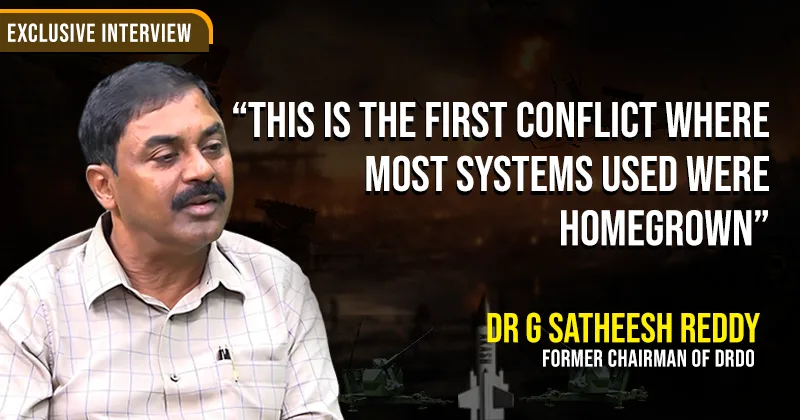
In the wake of Operation Sindoor, the spotlight has once again turned to the backbone of Bharat’s defence preparedness: indigenous technology. At the heart of this transformation is Dr G Satheesh Reddy, former Chairman of DRDO, a pioneering aerospace scientist, and one of the key architects behind Bharat’s defence innovation ecosystem. In this exclusive conversation with Organiser Editor Prafulla Ketkar, Dr Reddy reflects on Bharat’s journey from a technology-dependent nation to a rising defence exporter. Excerpts:
We have seen the extraordinary triumph of Operation Sindoor, which is also considered as a great success story for DRDO and Bharat’s defence industry. As a person who has been associated with this entire process, how do you see this?
It’s extremely satisfying to see indigenous weapons used extensively, this is the first conflict where most systems used were homegrown. It was a long-standing dream, often voiced by national leaders, to fight future wars with our own technology and now it’s a reality. Their success is a huge moral booster for scientists, Armed Forces, industry, and nation.
“Sanctions after Pokhran-II forced us to build infrastructure, processes, and technologies independently—so in a way, the sanctions were a blessing in disguise”
You’ve seen DRDO’s journey from the 1980s—from fund shortages and bureaucratic hurdles to today’s indigenous development and joint ventures. What key changes over the years made this transformation possible?
Over the past 150–200 years, repeated invasions and colonial rule eroded our confidence and technological capabilities. After Independence, DRDO’s role was mostly limited to quality checks of imported systems. Only in the late 1980s did serious system-level development began—thanks to pioneers like Dr APJ Abdul Kalam, who launched the missile programme (Agni, Akash, Trishul, Nag). Initially, there was little ecosystem support from academia or industry.
The real transformation came in the last decade—massive funding, decisive policy shifts, and active private sector participation in building missiles, tanks, UAVs, guns, and more. With consistent efforts, we built a strong indigenous ecosystem. Today, Bharat is largely self-reliant in missiles, radars, electronic warfare, aircraft, and naval systems. Indigenous content in defence has risen from 35 per cent to 65 per cent.
This shift was driven by strong political will, especially from Prime Minister Modi, who emphasised not just Make in India but Design and Make in India. That boosted confidence in Indian system, even within the Armed Forces, overcoming the long-held belief that foreign tech is superior. Now, Bharat ranks among the top nations in several defence capabilities and has moved from being an importer to an exporter.
Was Pokhran in 1998 a major turning point for Bharat’s innovation and self-reliance, especially considering the tough sanctions, halted FDIs, and yet we achieved success in developing cryogenic engines and other technologies during that period?
I see 1998 as a major turning point. When Bharat conducted Pokhran II, the world tried to contain us with harsh sanctions—blocking access to critical technologies through regimes like MTCR. But ironically, those sanctions pushed us toward self-reliance. If we had been given cryogenic engines, we might never have developed them ourselves. Today, over 90 per cent of missile components are indigenous, thanks to that pressure. It forced us to build infrastructure, processes, and technologies independently—so in a way, the sanctions were a blessing in disguise.
Now, with Operation Sindoor, we’ve seen how multiple technologies—hypersonics, AI, digital systems, space tech, and precision weapons—are being integrated. Warfare has evolved beyond land, air, and sea to include space and cyber as critical domains. Future wars will be tech-driven—network-centric and AI-powered. Whoever masters advanced tech will win.
“Bharat was once among the top defence importers. Today, we’ve exported Rs 23,600 crore worth of equipment and we’re just getting started”
Bharat is preparing for this shift. DRDO is working closely with academia and industry through 15 Centres of Excellence, now termed DIAs (Defence, Industry, Academia), focused on futuristic technologies. This collaboration is driving innovation, and Bharat is firmly on the path to mastering next-generation warfare systems.
As we build our defence ecosystem, two key challenges remain: the talent pool and raw materials. While you’ve worked on developing defence corridors, we’re still dependent on imports for components like drones and chips. At the same time, brain drain continues—many top minds prefer working abroad or in foreign institutions. Is this scenario changing? And what more can be done to make DRDO and similar institutions more attractive to top talent?
The scenario has changed significantly. Today, Bharat produces around 1.5 million engineers annually, and over 4.3 crore students are pursuing higher education—more than the population of many countries. Earlier, 75–80 per cent of IIT undergrads went abroad; now, around 75 per cent are staying back. That’s a big shift.
In defence, we’ve introduced postgraduate courses and over 20 institutes now offer degrees in defence technologies. AICTE is also launching a minor in defence tech at the undergraduate level. This is aligning talent with industry needs.
The startup landscape has exploded—from around 400 in 2016 to nearly 2 lakh today—driven by innovation. Young minds now have access to incubators, research parks, and robust funding. Earlier, starting a company was rare and risky—now, youth are taking bold steps with a globally competitive mindset, aiming to create first-of-its-kind solutions. This shift is truly transforming the nation.
When it comes to defence technology, raw material and major testing facilities like propulsion technology, is still an issue.
Most of the necessary facilities have now been established within the country. We have developed complete propulsion technologies—ranging from large motors to micro-scale systems—entirely indigenously. While there are still some challenges related to raw materials and specific components, significant efforts are underway to address them.
We’re actively working toward self-reliance in materials through advanced processing technologies, better sourcing strategies, and secure storage solutions. For critical components like sensors and detectors, indigenous development is already in progress. The semiconductor sector, once a major gap, is being addressed through the government’s dedicated semiconductor policy, with major initiatives already underway.
In the next few years, we expect to manufacture most key components—semiconductors, sensors, detectors—entirely within Bharat, achieving a high level of self-sufficiency in our defence ecosystem.
One long-standing concern has been the coordination between the departments of science, technology, space, and defence. Have these issues now been streamlined, or do bureaucratic hurdles and red tape still pose challenges to effective collaboration?
I’m not entirely sure about all departments, but among the key ones—DRDO, ISRO, and the Department of Atomic Energy (DAE)—there have always been good scientific and technological associations. While this coordination may not always extend to complete products, there have been strong cooperation at the component and subsystem levels, and that continues today.
To further improve inter-agency collaboration, certain mechanisms have been put in place. For instance, a coordination committee has been formed between CSIR and DRDO at the secretary level to align efforts and identify common areas. Similar initiatives are being explored with the Department of Biotechnology (DBT) as well. So, overall, there is a conscious effort to break silos, and the coordination among departments is steadily improving.
How do you see the future of defence industry—role of various players, especially private players, even the individual innovators? How can they contribute to this particular idea of Aatmanirbhar Bharat in defence sector?
The private sector plays a crucial role in achieving self-reliance in defence. While research organisations focus on frontier research, it’s the industry that must take this forward through applied and translational research, design, development, and innovation.
A strong manufacturing boost is only possible when private players actively participate. With increasing orders and clear opportunities, many are now stepping in. Their involvement not only creates employment—through MSMEs and large-scale industries—but also drives exports.
“We’re seeing a shift in mindset. Young Indian innovators now think globally, and startups are becoming the new engine of defence innovation”
Bharat, once one of the largest importers of defence equipment, has now exported nearly Rs 23,600 crore this year. The Defence Minister has set a target of Rs 50,000 crore, and this growth is largely due to private industry’s stronger marketing and execution capabilities, supported by proactive Government policies.
For the defence ecosystem to truly thrive, the private sector must continue to play a leading role.
The ideational and infrastructure level facilitation will be there from the Government side, but will the business part of it be taken care of?
Absolutely. The Government of India has introduced several strong support mechanisms to boost the defence industry. Schemes like iDEX, DRDO’s Technology Development Fund (up to Rs 50 crore per project), and Make I, II, III are designed to encourage industry-led innovation. The NEP scheme and the allocation of 75 per cent of the capital budget exclusively for indigenous systems further strengthen this push.
Additionally, indigenously designed, developed, and manufactured (IDDM) products are given top priority in procurement. To attract investment, FDI has been allowed—up to 75 per cent and even 100 per cent in select cases. All these measures aim to significantly enhance the domestic defence ecosystem.












Comments