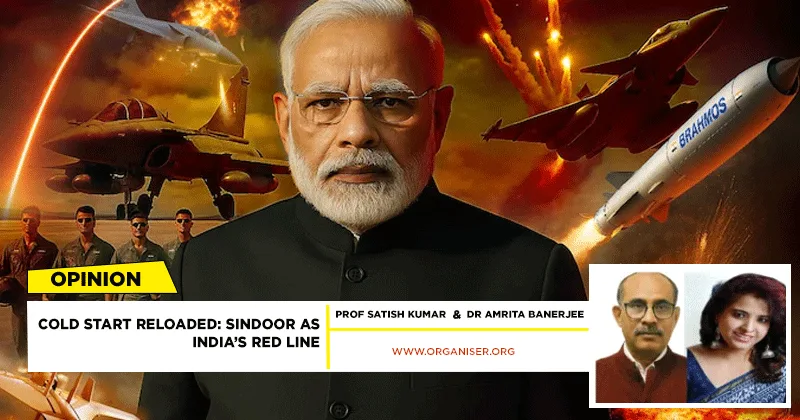
Cold Start Reloaded: Sindoor as India’s Red Line
December 5, 2025
  • Read Ecopy
  • Circulation
  • Advertise
  • Careers
  • About Us
  • Contact Us
Android AppiPhone AppArattai
Organiser
  • ‌
  • Bharat
    • Assam
    • Bihar
    • Chhattisgarh
    • Jharkhand
    • Maharashtra
    • View All States
  • World
    • Asia
    • Europe
    • North America
    • South America
    • Africa
    • Australia
  • Editorial
  • International
  • Opinion
  • RSS @ 100
  • More
    • Op Sindoor
    • Analysis
    • Sports
    • Defence
    • Politics
    • Business
    • Economy
    • Culture
    • Special Report
    • Sci & Tech
    • Entertainment
    • G20
    • Azadi Ka Amrit Mahotsav
    • Vocal4Local
    • Web Stories
    • Education
    • Employment
    • Books
    • Interviews
    • Travel
    • Law
    • Health
    • Obituary
  • Subscribe
    • Subscribe Print Edition
    • Subscribe Ecopy
    • Read Ecopy
  • ‌
  • Bharat
    • Assam
    • Bihar
    • Chhattisgarh
    • Jharkhand
    • Maharashtra
    • View All States
  • World
    • Asia
    • Europe
    • North America
    • South America
    • Africa
    • Australia
  • Editorial
  • International
  • Opinion
  • RSS @ 100
  • More
    • Op Sindoor
    • Analysis
    • Sports
    • Defence
    • Politics
    • Business
    • Economy
    • Culture
    • Special Report
    • Sci & Tech
    • Entertainment
    • G20
    • Azadi Ka Amrit Mahotsav
    • Vocal4Local
    • Web Stories
    • Education
    • Employment
    • Books
    • Interviews
    • Travel
    • Law
    • Health
    • Obituary
  • Subscribe
    • Subscribe Print Edition
    • Subscribe Ecopy
    • Read Ecopy
Organiser
  • Home
  • Bharat
  • World
  • Operation Sindoor
  • Editorial
  • Analysis
  • Opinion
  • Culture
  • Defence
  • International Edition
  • RSS @ 100
  • Magazine
  • Read Ecopy
Home Bharat

Cold Start Reloaded: Sindoor as India’s red line

Operation Sindoor emerges in a crucial geopolitical moment, amidst global distractions and heightened joint military exercises by China and Pakistan near India's Siliguri Corridor, signaling an offensive-defensive strategy to reinforce, deter, and preempt threats, integrating military posture with political narrative and cultural confidence

Dr Amrita BanerjeeDr Amrita Banerjee
May 25, 2025, 09:00 pm IST
in Bharat, Opinion, India
Follow on Google News
FacebookTwitterWhatsAppTelegramEmail

India’s post-colonial trajectory has been shaped by traumatic partitions, repeated wars with Pakistan (1947, 1965, 1971, and 1999), and a simmering insurgency culture fostered across the borders. Pakistan’s jihadist doctrine — especially post-1979 (Afghan war) — was slowly adapted against India, with Kashmir as the epicenter. Unlike conventional armies, India was now facing an enemy hidden within proxies, terror camps, and non-state actors.

Post-Kargil, India realised it couldn’t afford long mobilizations. Pakistan had found ways to strike through irregular means while hiding behind its nuclear shield. It became clear that a short-window, high-precision response strategy was essential. Thus, the idea of the Cold Start Doctrine was born — designed for swift, limited offensives without crossing the nuclear red line.

In Sanskrit and Hindu tradition, sindoor is a powerful red mark that symbolizes marital sanctity and commitment. In military parlance, naming a strategic maneuver after it suggests something deeper: an irreversible vow to protect national integrity and sovereign identity. Sindoor: The last red line. If crossed, India would not hesitate.

The timing of Sindoor is crucial. The world is distracted by elections in the West, Ukraine remains embroiled in attrition warfare, and the South China Sea is boiling with power projections. India, meanwhile, has faced an unusual escalation of joint military exercises by China and Pakistan near its vulnerable northeastern corridor. These are not routine drills. Analysts note the precision and location — near the Chumbi Valley and close to the Siliguri Corridor, the 22-kilometer-wide Chicken’s Neck connecting India to its northeast. It is the only link between mainland India and its eight northeastern states. It’s a logistical artery, and any successful strike here would sever national integration. China’s buildup near the Doklam plateau and Pakistan-backed insurgency activity in the region made this area a flashpoint. Intelligence revealed that joint China-Pak mock drills weren’t just rehearsals — they were dry runs for a coordinated two-front deception war.

Sindoor was thus born as an offensive-defensive strategy — to reinforce, deter, and if needed, pre-emptively strike. Rapid troop mobilizations were ordered, ISR (Intelligence, Surveillance, Reconnaissance) missions launched, and psychological operations activated to signal India’s readiness.

In the shadow of these drills, India activated its forward deployment readiness under the Cold Start umbrella. However, instead of announcing anything formally, the Modi administration let one word slip through closed doors: Sindoor. This was not meant for the public. It was meant for those who would listen — adversaries, intelligence communities, and strategic watchers. A leak calculated to seed uncertainty.

The Cold Start Doctrine, long denied officially, is built on the logic of speed and surprise — allowing India to respond swiftly to Pakistani aggression without breaching the nuclear threshold. But Sindoor indicates an evolved version of Cold Start, one that fuses hard military posture with political narrative warfare. It isn’t about just retaliation. It’s about controlling the sequence of escalation. Sindoor as a doctrine tests red lines, creates counter-narratives, and exposes enemy vulnerabilities by forcing them to overcommit their resources in response to feints and whispers.

India’s Panchamrit foreign policy doctrine also ties into Sindoor’s strategic logic. The five pillars — Samman (dignity), Samvad (dialogue), Samriddhi (prosperity), and Suraksha (security), and Sanskriti (culture)— frame a comprehensive world view. Under Sindoor, this doctrine transforms into realpolitik. When adversaries try to exploit India’s soft spots — ethnic identities, border disputes, minority tensions — the government doesn’t just respond with tanks. It responds with cultural confidence, economic resilience, diplomatic precision, and calculated military posture.

The Siliguri Corridor, or Chicken’s Neck, is the geostrategic jugular of India. Lose this, and the northeast is severed. China’s infrastructure buildup in the Chumbi Valley and Pakistan’s renewed emphasis on insurgent corridors in Arunachal Pradesh are not coincidental. Intelligence inputs suggest that “mock drills” by enemy forces near this corridor include real-time logistics testing, including drone-based surveillance, field communication jamming, and multi-division mobility rehearsals.

Sindoor was born in response to this pattern. It is not merely a symbol; it is a response matrix. Under Sindoor, Indian forces conducted counter-maneuvers in Sikkim, ramped up surveillance in Bhutanese buffer zones, and deployed rapid-response units that simulate Cold Start offensives. But crucially, this was done without making headlines.

When PM Modi invoked “Sindoor,” he wasn’t addressing opposition parties or appeasing domestic politics. He was speaking directly to the ecosystem of radical jihadists who thrive on symbolic defiance. By choosing a term like Sindoor — deeply embedded in Indian identity — he flipped their narrative. His message: “Your jihad will be met not just with guns, but with a civilization unwilling to kneel.” This was India’s cultural deterrence fused with strategic doctrine.

Sindoor wasn’t just a symbolic response. It was India’s most mature attempt to integrate military readiness, political narrative, and cultural identity into one unified strategic doctrine. It showed that India is no longer reactive. It has evolved.

But it also revealed the limits of strategic boldness in a system where political will alone cannot override institutional inertia, diplomatic caution, and nuclear calculus. The machinery is in place. The enemy is known. The doctrine is refined. And yet — the moment passed.

Sindoor has not failed as a strategy. It failed as a timed execution. The window was open, but the hand hesitated. And perhaps that’s the lesson for the next flashpoint. India has the doctrine. What it needs is the nerve — not just at the top, but across every node of national power. That is why India is trying to flash its doctrine through proper channels of democracy to the world. If the texts and contexts are still not understood by Pakistan, then , Sindoor remains a red line.
Topics: Siliguri CorridorHybrid warfareOperation SindoorChina-Pakistan Ties
ShareTweetSendShareSend
✮ Subscribe Organiser YouTube Channel. ✮
✮ Join Organiser's WhatsApp channel for Nationalist views beyond the news. ✮
Previous News

Book review | The Nehru Years: An International history of Indian non-alignment

Next News

Kashmir visit & social media campaign by Rahul Gandhi echoes Pakistan attack narrative, undermining Operation Sindoor

Related News

IG BSF Jammu Frontier Shashank Anand

‘Pakistan treated it as war’: BSF reveals intense cross-border clash during Operation Sindoor

Chief of Integrated Defence Staff, Air Marshal Ashutosh Dixit

Operation Sindoor only a glimpse of India’s future joint warfighting: Integrated Defence Staff Chief

PM Narendra Modi

“Earlier Govts did not retaliate after terror attacks”: PM Modi hails Op Sudarshan Chakra as “wall of security”

Western Ghats Lit Fest 2025

Tamil Nadu: Western Ghats Lit Fest 2025 showcases assertive Bharatiya renaissance in Coimbatore

Maharashtra CM Devendra Fadnavis

India missed opportunity post-26/11; Immediate ‘Operation Sindoor’ would have deterred future terror: Fadnavis

J&K: LG Sinha lays foundation for 521 new houses in Poonch-Rajouri for calamity hit families

Load More

Comments

The comments posted here/below/in the given space are not on behalf of Organiser. The person posting the comment will be in sole ownership of its responsibility. According to the central government's IT rules, obscene or offensive statement made against a person, religion, community or nation is a punishable offense, and legal action would be taken against people who indulge in such activities.

Latest News

BJYM leader Shyamraj with Janaki

Kerala: Widow of BJP worker murdered in 1995 steps into electoral battle after three decades at Valancherry

Russian Sber bank has unveiled access to its retail investors to the Indian stock market by etching its mutual fund to Nifty50

Scripting economic bonhomie: Russian investors gain access to Indian stocks, Sber unveils Nifty50 pegged mutual funds

Petitioner S Vignesh Shishir speaking to the reporters about the Rahul Gandhi UK citizenship case outside the Raebareli court

Rahul Gandhi UK Citizenship Case: Congress supporters create ruckus in court; Foreign visit details shared with judge

(L) Kerala High Court (R) Bouncers in Trippoonithura temple

Kerala: HC slams CPM-controlled Kochi Devaswom Board for deploying bouncers for crowd management during festival

Fact Check: Rahul Gandhi false claim about govt blocking his meet with Russian President Putin exposed; MEA clears air

Union Minister for Road Transport and Highways Nitin Gadkari (Right)

India set for highway overhaul as Union Minister Nitin Gadkari unveils nationwide shift to MLFF electronic tolling

RSS Akhil Bharatiya Prachar Pramukh Shri Sunil Ambekar

When Narrative Wars result in bloodshed, countering them becomes imperative: Sunil Ambekar

Ministry of Civil Aviation mandates emergency action: IndiGo ordered to stabilise flight operations by midnight

Chhattisgarh CM Vishnu Deo Sai at Panchjanya Conclave, Nava Raipur, Image Courtesy - Chhattisgarh govt

Panchjanya Conclave: Chhattisgarh CM Sai shares views on development projects in Maoist hotbed, women empowerment

Union Finance Minister Nirmala Sitharaman

‘TMC is holding Bengal back’: Sitharaman slams Mamata govt over industrial & healthcare setbacks

Load More
  • Privacy
  • Terms
  • Cookie Policy
  • Refund and Cancellation
  • Delivery and Shipping

© Bharat Prakashan (Delhi) Limited.
Tech-enabled by Ananthapuri Technologies

  • Home
  • Search Organiser
  • Bharat
    • Assam
    • Bihar
    • Chhattisgarh
    • Jharkhand
    • Maharashtra
    • View All States
  • World
    • Asia
    • Africa
    • North America
    • South America
    • Europe
    • Australia
  • Editorial
  • Operation Sindoor
  • Opinion
  • Analysis
  • Defence
  • Culture
  • Sports
  • Business
  • RSS @ 100
  • Entertainment
  • More ..
    • Sci & Tech
    • Vocal4Local
    • Special Report
    • Education
    • Employment
    • Books
    • Interviews
    • Travel
    • Health
    • Politics
    • Law
    • Economy
    • Obituary
  • Subscribe Magazine
  • Read Ecopy
  • Advertise
  • Circulation
  • Careers
  • About Us
  • Contact Us
  • Policies & Terms
    • Privacy Policy
    • Cookie Policy
    • Refund and Cancellation
    • Terms of Use

© Bharat Prakashan (Delhi) Limited.
Tech-enabled by Ananthapuri Technologies