





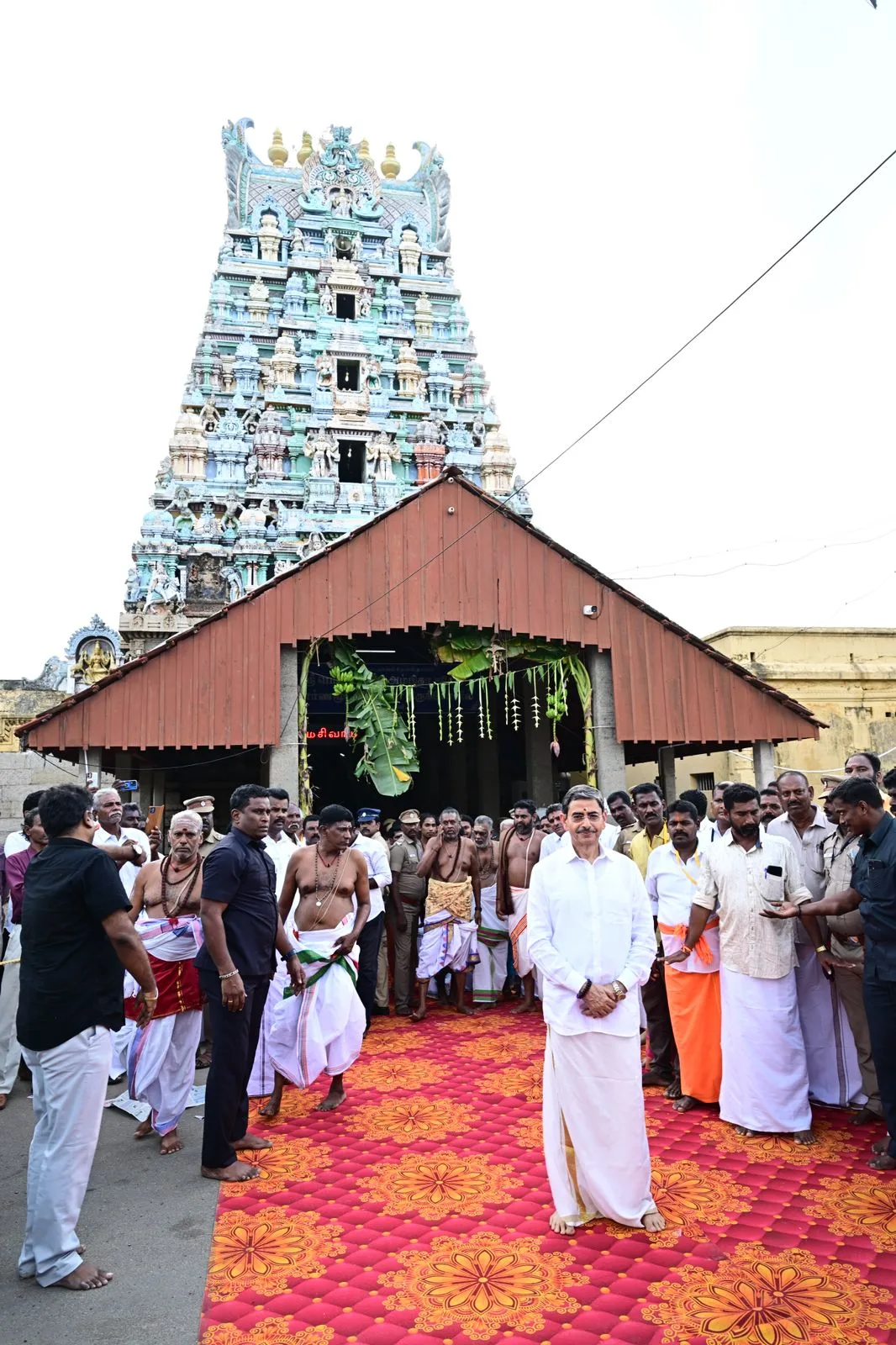
Tamil Nadu Governor R.N. Ravi lauded the historic initiative taken by the Kallar, Devendrakula Vellalar, and several other communities in resolving long-standing differences and restoring social harmony. Participating in the Kandadevi Ther and Social Harmony Function at Devakottai on May 22, he commended the efforts led entirely by local community leaders.
Calling it “an illustrious example of resolving long-festering mutual animosities and restoring social harmony entirely through the initiative of local community leaders, despite external divisive forces,” the Governor described the event as a model for others.
Governor Ravi, along with members of the Kallar, Devendrakula Vellalar and several other communities, participated in the Kandadevi Ther and Social Harmony Function at Devakottai. He praised the leaders and members of these communities for their historic step in resolving… pic.twitter.com/r9zwdX7nwk
— RAJ BHAVAN, TAMIL NADU (@rajbhavan_tn) May 23, 2025
Reflecting on his experience, Governor Ravi remarked that nowhere else in the country had he seen as many castes, sub-castes, and sub-sub-castes as in Tamil Nadu. What astonished him, he said, was that even 75 years after Independence, the resolution of such divisions was only now taking place. He found it surprising that this persisted so long, attributing it to the continuation — perhaps unconsciously — of the British-introduced policy of ‘divide and rule’ by successive rulers, even after Independence.
He lamented that no other state is as divided in terms of castes as Tamil Nadu, pointing out that people in power do not want common people to unite. Governor Ravi criticised how the British had deprived temples of land and introduced taxation to weaken their structure and create division. He said that events such as Thevar Jayanthi Guru Pooja and the Maruthu Brothers’ anniversary should be celebrated freely and in unity, but are conducted every year under heavy police protection — once again reinforcing his view that those in power resist unity among the common people.
On the historical roots of these tensions, the Governor noted that some trace the conflict back to the time of Mahatma Gandhi — even as far as 400 years ago, according to some accounts. He called it a legacy of colonial division, asserting that the British had deliberately sown discord among communities. He emphasised that the Kallar and Devendrakula Velalar communities had lived in the region for generations, contributing significantly to both land and temple, and insisted that the disputes were not native, but outcomes of British colonial policies.
Glimpses of Governor Ravi's address at the Kandadevi Ther and Social Harmony Function in Devakottai, Sivaganga. (2/7)#KandadeviTher #Sivaganga #GovernorRavi #RajBhavanTN@PMOIndia @HMOIndia @MinOfCultureGoI @EBSB_Edumin @MIB_India @PIB_India @PIBCulture @pibchennai… pic.twitter.com/0Lcf1z5XTW
— LOK BHAVAN, TAMIL NADU (@lokbhavan_tn) May 23, 2025
Expressing his concern over rising irreverence towards Hindu traditions, the Governor pointed out that some were referring to Hindu Dharma or Sanatana Dharma as “malaria” or “dengue.” He criticised this trend, particularly when it targeted bhakti, which, he said, originated in Tamil Nadu through the Alwars and Saiva saints known for their committed devotion to God. He underlined that what the today’s rulers in state wanted was for temples and worship to be forgotten. “I am proud and honoured to take part at the temple chariot festival upholding social harmony in such trying times,” he said, as brothers came together to draw the ‘Ther’ (temple car/chariot).
The temple’s annual chariot festival, held during the Tamil month of Aani on the day of the Kettai star, had been suspended for several years due to internal disputes among organising factions. Following a court directive, the festival resumed in recent years with the cooperation of four nattars (clan councils) representing 192 villages.
As part of the event, a book on the newly built chariot (constructed last year) was planned to be launched in connection with the Sri Sornamoorthiswarar Temple in Kandadevi village. The event, originally scheduled to feature Governor R.N. Ravi as the chief guest on May 22 at a private wedding hall near Devakottai in Sivaganga district, was cancelled following public opposition over the book’s content, which some viewed as controversial. Instead, the venue hosted a rebranded event on communal harmony, where the Governor delivered his speech.
At the 10th anniversary celebration of the Sri Sevugamoorthi Gousala Trust, the Governor affirmed Gau Mata’s sacred status in Bharatiya civilisation, describing her as the embodiment of spirituality, sustenance, sustainability, and the timeless bond between people and nature.
He expressed happiness at being present in the sacred land — where Lord Rama realised where Sita had been taken, where Lord Shiva resides, and near the site where Vibhishana surrendered to Rama. With Rameswaram nearby, where Rama worshipped Shiva, the Governor said the entire region was steeped in spiritual heritage. He underscored that the chariot festival was not just a ritual, but a symbol of social harmony. Communities that once refused to work together, he observed, were now united in pulling the chariot — an act he deemed sacred and historic. “Now, both these communities have successfully changed it,” he said.
Governor Ravi noted that such reverence reflects a civilisational ethic of living in harmony with the environment — a principle deeply woven into Bharat’s cultural fabric. He highlighted India’s transformative journey under the leadership of Prime Minister Narendra Modi, where ancient wisdom like natural farming is being rejuvenated and blended with modern innovations. This, he said, offers the world a path to a sustainable, inclusive, and harmonious future amid global existential crises.
Speaking on Bharat’s unique unity, Governor Ravi stated that the British were frightened by the spiritual cohesion of Indians. “They asked: what binds Indians together? The answer was temples.” He explained that temples were more than just places of worship — they were economic, social, and agricultural hubs. The British, he said, imposed land taxes to weaken these temples and, with that, community bonds. Caste divisions, too, were intensified.
Commending the Sri Sevugamoorthi Gousala Trust’s contributions, he called for immediate and collective action. Emphasising society’s vital role in preserving these ideals at the grassroots level, he urged people to foster cultural pride and work towards Bharat’s goal of self-reliance and holistic development by 2047.










Comments