





Celebrating India’s rich maritime heritage, the Indian Navy formally inducted a meticulously recreated 5th-century CE stitched ship during a ceremonial unveiling at the Naval Base in Karwar. The Hon’ble Minister of Culture, Shri Gajendra Singh Shekhawat, presided over the ceremony as the Chief Guest, officially marking the ship’s induction into the Indian Navy.
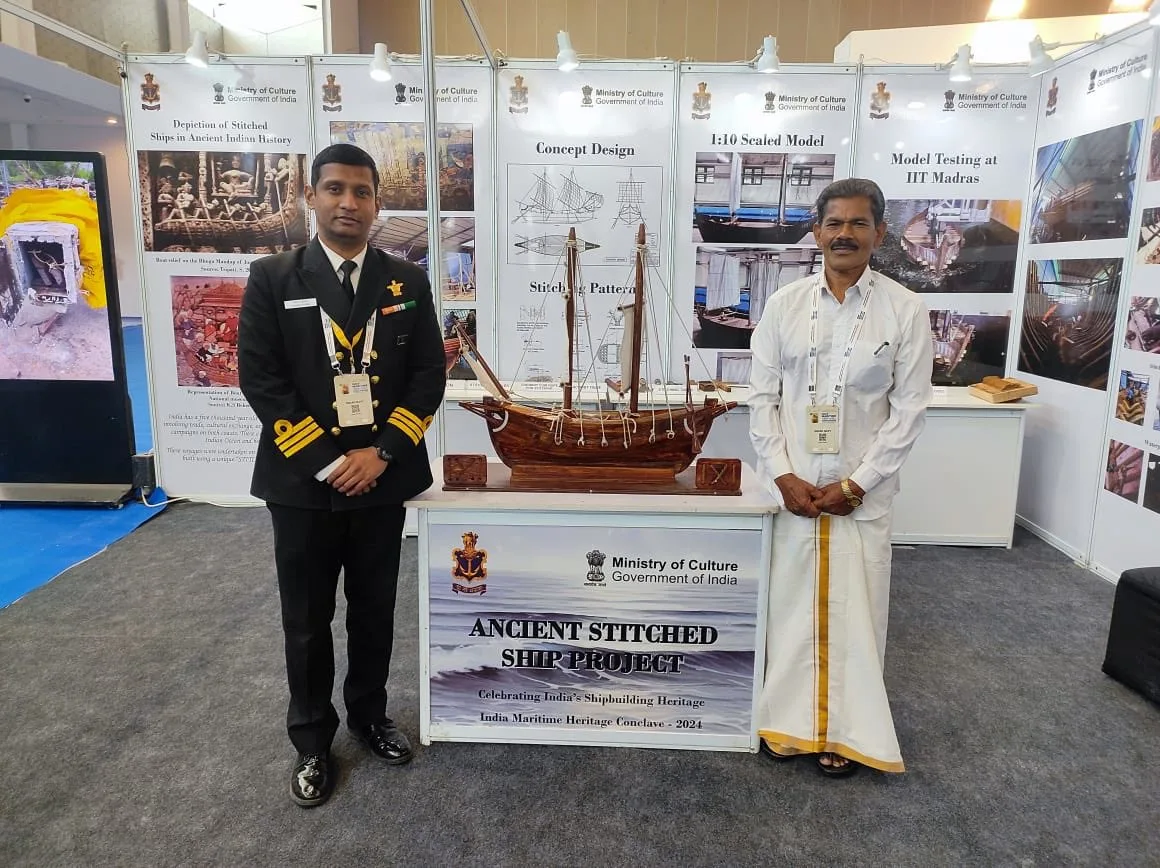
The stitched ship, a unique vessel inspired by a painting from the Ajanta Caves, represents a remarkable fusion of historical authenticity and modern engineering. The project, initiated through a tripartite agreement in July 2023 between the Ministry of Culture, the Indian Navy, and M/s Hodi Innovations, was funded by the Ministry of Culture. The keel-laying ceremony took place on September 12, 2023, as documented by the PIB, setting the stage for an ambitious endeavour to revive ancient Indian shipbuilding techniques.
Constructed entirely using traditional methods and raw materials, the ship was built by skilled artisans from Kerala under the leadership of master shipwright Shri Babu Sankaran. The hull, featuring thousands of hand-stitched joints, was crafted at M/s Hodi Shipyard in Goa, where the vessel was launched in February 2025, as announced by the Indian Navy on X.
The Indian Navy spearheaded the project, overseeing every phase from concept development to construction, in collaboration with M/s Hodi Innovations and traditional artisans. The design process posed significant challenges, as no physical remnants or blueprints of the original 5th-century ship exist. The team relied on a two-dimensional artistic depiction from the Ajanta Caves, requiring an interdisciplinary approach that combined archaeological interpretation, naval architecture, hydrodynamic testing, and traditional craftsmanship.
The ship’s design, featuring square sails, steering oars, and a stitched hull, is a stark departure from modern naval vessels. To ensure seaworthiness, the Indian Navy collaborated with the Department of Ocean Engineering at IIT Madras for model testing to validate the vessel’s hydrodynamic behaviour. Additionally, an in-house structural analysis was conducted to assess the wooden mast system, which was built without contemporary materials, balancing historical accuracy with functionality.
The successful completion of the stitched ship marks the end of the project’s first phase, bringing to life a fully functional sea-going vessel from an ancient artistic depiction. The ship, with its wooden spars and traditional steering mechanisms, stands as a testament to India’s maritime legacy and the Navy’s commitment to preserving its living traditions.
Following the induction, the project enters its second phase, during which the Indian Navy will undertake the ambitious task of sailing the vessel along ancient maritime trade routes. Preparations are already underway for the ship’s maiden transoceanic voyage from Gujarat to Oman, aiming to revive the spirit of ancient Indian seafaring.
The unveiling of the stitched ship not only reaffirms India’s historical shipbuilding prowess but also highlights the Indian Navy’s dedication to operationalising the country’s maritime heritage, bridging the past and present in a feat of cultural and technical significance.















Comments