




The violence in West Bengal’s Murshidabad that erupted on April 11–12 laid bare a brutal reality: targeted violence disguised as protest, backed by political impunity and administrative silence. While the victims screamed for help, the system watched in silence. Now, weeks later, the findings of a three-member fact-finding committee appointed by the Calcutta High Court have not only corroborated Organiser Weekly’s ground report (issue dated May 4), but also exposed deeper layers of complicity and planning.
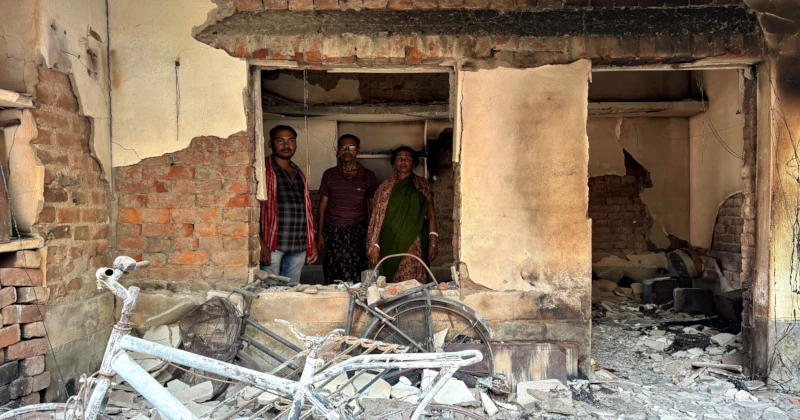
The panel—comprising Joginder Singh (Registrar, Law, NHRC), Satya Arnab Ghosal (Member Secretary, WBLSA), and Saugata Chakraborty (Registrar, WBJS)—has submitted its report to the Calcutta High Court. It submitted its report along with video footage showing the sheer scale of destruction. Over 100 houses were destroyed in Betbona. In nearby Ghoshpara, 29 shops, including grocery, hardware, and electrical stores, were gutted. Mandirs were also desecrated.
What was really appalling is how the victims suffered at the rehabilitation camp in Malda’s Parlalpur High School, where they had taken shelter. According to victims, as revealed to the committee, they were forced to return to their homes by Mamata’s police administration – a claim that was presented by Organiser in its detailed report.
As per the testimonies given by the victims to the committee, the violence began in Betbona, under the jurisdiction of Samsherganj Police Station in Murshidabad district. Victims described how masked mobs descended on their homes with weapons, petrol bombs, and hammers. Houses were set on fire, belongings looted, and temples annihilated. Water lines were deliberately cut so that residents could not extinguish the flames. In many homes, kerosene was poured over clothes and furnishings before they were torched. Women were stripped of dignity, quite literally, as miscreants burnt all the clothing in homes, leaving many without even a garment to cover themselves.
Organiser’s ground report was the only detailed media report to document the gruesome violence in deep details. The ground report detailed how the homes and shops of Hindus were reduced to ashes. A tea stall, complete with gas cylinders, refrigerator, and a month’s stock of goods, was looted and torched. What Organiser described as “punishment for being Hindu” finds judicial corroboration in the Calcutta High Court’s own words, which noted that “the vandalism and massacre are premeditated and appear to be an organised crime,” as revealed from the report of the Committee appointed by the Court.
Perhaps the most horrific testimony to committee came from Parul Das, whose house was stormed after the attackers smashed the doors and windows and hurled stones and bottles inside. Her husband, Haragovinda Das, aged 74, and her son, Chandan Das, aged 40, were forcibly taken outside the house and hacked with axe. One of the assailants stood by to ensure they died before fleeing. Parul Das testified that the attackers had covered their faces with clothes and came from nearby villages to avoid revealing their identities.
Importantly, the victims also revealed to the committee that local Trinamool Congress (TMC) councillor Mehboob Alam was seen with the mob on April 11. An unnamed TMC MLA was also reportedly present at the site of the violence. Rather than intervening, he watched the vandalism and left. The violence, however, did not stop; it intensified the following day.
The committee observed that the State’s rehabilitation model, distributing a uniform Rs 1.2 lakh under the “Banglar Bari” scheme, was grossly inadequate. It pointed out that victims suffered varying degrees of loss, depending on the structure and value of their homes and livelihoods, and insisted that qualified valuation experts be appointed to determine individual compensation.
Crucially, in the submitted report the committee also raised serious doubts about the police’s negative role, noting that initially only nine FIRs were filed despite the widespread violence. Victims repeatedly said that the police refused to register their complaints. It was only after the intervention of the District Legal Services Authority (DLSA) that 142 fresh FIRs were finally recorded. The committee observed that while the district’s civil administration had taken some relief measures post-incident, the victims remained in a state of trauma and fear, their confidence in the law completely shattered.
In a press conference held on May 21, BJP Rajya Sabha MP Dr Sudhanshu Trivedi described the report submitted by the committee on the Murshidabad violence as the most scathing indictment yet of the Mamata Banerjee-led TMC Government. “The report has laid bare the anti-Hindu brutality of the TMC regime in its most horrific form,” Trivedi stated, calling out not only the State Government but also the silence of Opposition parties and so-called peace activists. “Those who ask, ‘Why war with Pakistan?’ have not uttered a single word about the atrocities against Hindus in Murshidabad,” he remarked.
Echoing these concerns, West Bengal BJP president Dr. Sukanta Majumdar pointed out direct involvement of TMC leaders in orchestrating the violence. “The committee’s findings clearly indicate that local councillor Mehboob Alam, several MLAs, and other TMC figures played key roles. And yet, despite Alam being identified as a principal conspirator, the police chose not to act against him during the attacks,” he alleged.
The Calcutta High Court has since ordered a deeper probe. The Special Investigation Team (SIT) has been instructed to intensify its inquiry, apply relevant sections under the Bharatiya Nyaya Sanhita (BNS), 2023—notably Sections 103(2) and 113(2)(a)(b) dealing with communal and organised violence—and submit a follow-up report by the next hearing scheduled for July 31, 2025. The court also directed that the victims be rehabilitated, sheltered, and returned to their homes under adequate protection.
Considering the nature and extent of the damage caused, Court has directed the Committee to appoint a valuer at the earliest from the panel of the High Court at Calcutta who shall assess the nature and extent of damage and file a report. It also asked the State to consider the deployment of a permanent Border Security Force (BSF) camp in the region to restore community confidence.
The story of Murshidabad is no longer a contested narrative, it is now an established, verified record of organised crime, targeted persecution, and state’s failure.












Comments