





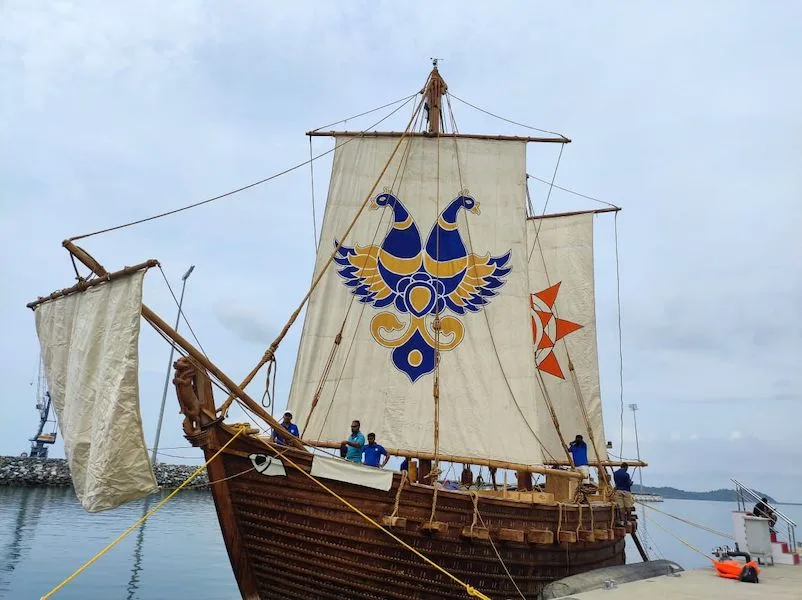
In a moment that blended maritime history with national pride, the Indian Navy on Wednesday (May 21) inducted the INSV Kaundinya, a traditional ‘stitched ship’ modelled on vessels that once sailed across the Indian Ocean more than 2,000 years ago. Named after the ancient Indian mariner Kaundinya, the vessel symbolises India’s forgotten but rich seafaring legacy and revives the remarkable legend of a sailor, a warrior queen, and the founding of the Southeast Asian kingdom of Funan.
The induction ceremony took place at the Naval Base in Karwar, where the ship, constructed entirely using ancient techniques, was formally welcomed into the naval fold. Present at the ceremony was Union Minister of Culture Gajendra Singh Shekhawat, who said the launch marked “the resurgence of India’s maritime legacy, reaffirming our deep and enduring ties with the Indian Ocean world.”
The story behind INSV Kaundinya dates back over two millennia. According to ancient Southeast Asian records, an Indian merchant named Kaundinya was sailing with his crew along the Mekong Delta in what is now southern Vietnam when their vessel came under pirate attack. Though Kaundinya valiantly fought off the pirates, the ship sustained damage and had to be beached for repairs.
It was then that the crew was surrounded by a local clan led by a fierce warrior queen named Soma. Outnumbered and facing certain defeat, Kaundinya nonetheless stood firm in defence. But fate had other plans. Queen Soma, struck by Kaundinya’s courage, fell in love with him and proposed marriage. Their union led to the establishment of the Funan Kingdom — the first Indianised state in Southeast Asia.
Speaking to The Indian Express, Sanjeev Sanyal, a member of the Prime Minister’s Economic Advisory Council who first proposed the idea of reviving a stitched ship, explained the significance of the name.
“He is the first Indian mariner, who we know by name, to have crossed the seas to visit Southeast Asia and had a significant impact on world history,” said Sanyal.
“Though India has an old maritime culture dating back to the Bronze Age, we do not know the names of those mariners who were crossing the seas. The first definitive one, who was engaging in maritime voyages to far-away lands and of whom we know, is Kaundinya. His references are recorded in Cambodian and Southern Vietnamese sources, but not in Indian records. We do not know what Kaundinya’s ship looked like. But the ships of that period looked like what we have built.”
Recounting the legend further, Sanyal noted, “Kaundinya and Soma set up a dynasty that went on to form the first Indianised Kingdom in what is now Cambodia/South Vietnam. This is corroborated by Chinese sources. All the future dynasties of the Khmer and Chams of Vietnam… to this day… trace their lineage to this marriage.”
The INSV Kaundinya has been modelled on a 5th-century ship depicted in the Ajanta caves and recreated using traditional techniques, such as coconut fibre stitching, wooden joinery, coir rope, natural resins, and cotton sails. Constructed by artisans and traditional shipwrights from Kerala, the vessel does not use rudders or modern materials. Instead, it relies on square sails, a flexible hull, and trailing oars for navigation.
Sanyal elaborated on the challenges of reviving such a design, “It was an idea which came out of a book. We know that these stitched ships were used to cross the oceans from ancient times. There is enough evidence of Indians sailing from Gujarat to Oman and Bahrain, and all the way to Mesopotamia to carry out trade. So, we obviously knew how to make these ships.”
However, historical documentation is scarce.
“The problem is that there are no records of what exactly the seagoing ships during the Harappan period looked like. The earliest clear depiction of an ancient ship is really the Ajanta painting, which began as a sort of design to build around. Then there were some historical texts like Yuktikalpataru. We also used testimonies of ancient travellers from other countries who came to the Indian Ocean and mentioned seeing these stitched ships,” he added.
The vessel, which will embark on its first voyage to Oman by the end of 2025 with a 15-member Indian Navy crew, aims to retrace ancient Indian Ocean trade routes. The journey will be a historic expedition, relearning how to navigate using ancient sailing techniques without rudders and relying entirely on wind direction.
“In modern sailing, usually, triangular sails are used. There are some advantages, but many disadvantages, because you have to basically sail with the wind. So, it is important to recognise that when we attempt to sail it, we will have to relearn the art of sailing with square sails,” said Sanyal.
The ship’s design also pays tribute to various aspects of ancient Indian culture. Its sails display motifs such as the ‘Gandabherunda’—a two-headed eagle that served as the royal insignia of the Kadamba dynasty and the Sun. The ship’s bow features a ‘Simha Yali’ (a lion-like mythical creature), and a Harappan-style stone anchor sits symbolically on its deck.
The INSV Kaundinya project is part of a tripartite collaboration between the Indian Navy, the Ministry of Culture, and Goa-based shipbuilding firm Hodi Innovations (OPC) Private Ltd. The effort aims to revive India’s oceanic traditions and inspire awareness of its ancient maritime contributions, often overlooked in historical narratives.













Comments