





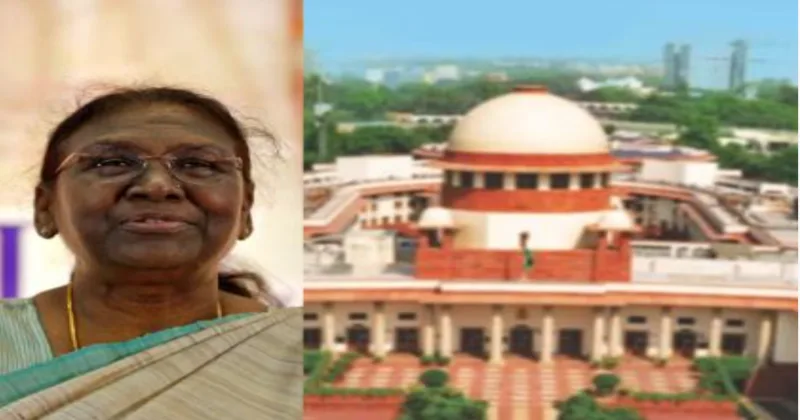
Recently, the President of India, Droupadi Murmu, invoked Article 143(1) of the Indian Constitution to seek the Supreme Court’s advisory opinion on fourteen constitutional questions. These questions primarily relate to the Supreme Court’s judgment delivered on April 8, 2025, and also extend to the constitutional powers and jurisdiction of the legislature, executive, and judiciary. The President’s queries are pointed and pertinent, raising concerns about the judiciary’s tendency to limit or control the constitutional powers of the President and the Governors in matters of legislative assent through judicial orders. Significantly, she questions the judiciary’s encroachment upon constitutional boundaries and its reinterpretation of established provisions. These queries exemplify the healthy tradition of inter-institutional dialogue embedded within India’s democratic framework.
On April 8, 2025, the Supreme Court ruled in the case of Governor vs. State of Tamil Nadu. The matter was heard by a two-judge bench comprising Justice J.B. Pardiwala and Justice R. Mahadevan. The case stemmed from the Tamil Nadu government’s allegation that several bills passed by the State Assembly had remained pending without assent from the Governor for an inordinately long period. Moreover, the government questioned the Governor’s decision to simultaneously refer multiple bills to the President, including one that sought to designate the Chief Minister as the ex-officio Chancellor of state universities. The indefinite withholding of assent by the Governor, as argued, violates the constitutional provisions.
In its judgment, the Supreme Court rearticulated certain constitutional interpretations and introduced new readings of relevant provisions. Three major aspects of the verdict stand out. First, the Court set a time limit of three months within which the Governor or President must act on a bill. Second, if no action is taken within this period, the Supreme Court may, under the writ of mandamus, direct the bill to be deemed assented. Third, the Court, invoking Article 142 of the Constitution, declared ten pending bills to have acquired the force of law—without requiring formal assent from the Governor or the President. This is unprecedented and effectively invalidates the concept of the ‘pocket veto’. It raises serious concerns about judicial overreach and the transgression of the judiciary’s constitutional limits. The decision also threatens to escalate tensions between the judiciary and the executive.
Understanding the constitutional context is essential. Article 200 of the Constitution lays down the options available to the Governor upon the presentation of a bill: grant assent, withhold assent, or reserve the bill for the President’s consideration. The provision for reservation is guided by a specific standard—that in the Governor’s opinion, if enacted, the bill would so derogate from the powers of the High Court as to jeopardize the constitutional scheme. This standard was introduced into draft Article 175 during debates in the Constituent Assembly on July 30, August 1, and October 17, 1949, and is now codified as Article 200. The phrase “in the Governor’s opinion” allows for two interpretations: (1) the Governor acts on the advice of the Council of Ministers, or (2) the Governor exercises discretion. The first interpretation is problematic—why would the Council of Ministers, which passed the bill, then advise its reservation? The second implies discretionary power. Debates in the Constituent Assembly suggest that while the framers did not intend to render the Governor’s discretion absolute or unregulated, they also did not wish to eliminate it entirely.
Article 201, another key provision in this debate, outlines the process when a bill is reserved for the President. The President may assent, withhold assent, or return the bill with certain recommendations. If the bill is re-passed by the legislature, it is resubmitted for presidential assent. However, the Constitution is silent on what must follow. Notably, this article—originally draft Article 176—was adopted without alteration in the Constituent Assembly in 1948.
According to the April 8 decision, a Governor may now keep a bill pending for no more than three months upon first presentation, and only one additional month upon resubmission. The Court also brought the Governor’s discretion under judicial review, thereby significantly curtailing its scope. Further, the Court directed that when a bill is reserved for the President under Articles 200 or 201, the President should seek the Supreme Court’s advice under Article 143(1) to avoid constitutional or legal infirmities. The Court argued that such pre-emptive advice would prevent legal ambiguities and challenges to the constitutionality of enacted laws.
The most critical question arising from this judgment is whether it violates the doctrine of separation of powers—a cornerstone of the Constitution’s basic structure. While the separation is not rigid, the Court’s instructions to the President suggest premature judicial intervention in the legislative process. The introduction and debate of a bill fall within the exclusive purview of the elected legislature. Judicial interference in this domain compromises the democratic foundation of legislative autonomy and contradicts precedents that have upheld the inviolability of this boundary. This judgment thus appears to exemplify unwarranted judicial activism.
Another contentious issue is whether constitutional interpretation can be undertaken by a non-constitutional bench. A constitutional bench, by definition, consists of at least five judges, while the aforementioned verdict was delivered by a two-judge bench. President Murmu raises this concern in Question 12 of her reference. The President and the Governors are not merely ceremonial heads of the executive; they play vital roles in the legislative process as well. The Constitution does not envisage them as robotic or symbolic figures. The discretionary powers conferred upon them are intended for specific and exceptional circumstances. Stripping these offices of substantive authority would render them ornamental. The appointees to these positions are expected to be individuals of integrity and non-partisanship. It is therefore imperative that Governors refrain from acting as agents of the ruling party at the Centre. Unfortunately, in recent decades, there has been a trend of appointing retired politicians from mainstream parties as Governors. Ideally, these positions should be occupied by non-political and distinguished individuals from fields such as literature, science, law, education, or journalism.
The Supreme Court’s decision will also have significant implications for Centre-State relations. India’s federal structure is often misinterpreted as conferring equal and independent powers upon the Centre and the States. However, several constitutional provisions clearly establish the primacy of the Union—for instance, the expansive legislative powers of the Centre.
Dr BR Ambedkar himself remarked that India is a federal polity with a unitary bias, designed to preserve national unity and prevent disorder. The Supreme Court’s response to the President’s questions will not only impact Centre-State dynamics but also redefine the relationships and jurisdictions of the three organs of state—judiciary, legislature, and executive. It is therefore imperative that the Supreme Court responds with utmost prudence and constitutional sensitivity, keeping in mind the foundational principles and spirit of the Constitution.
















Comments