




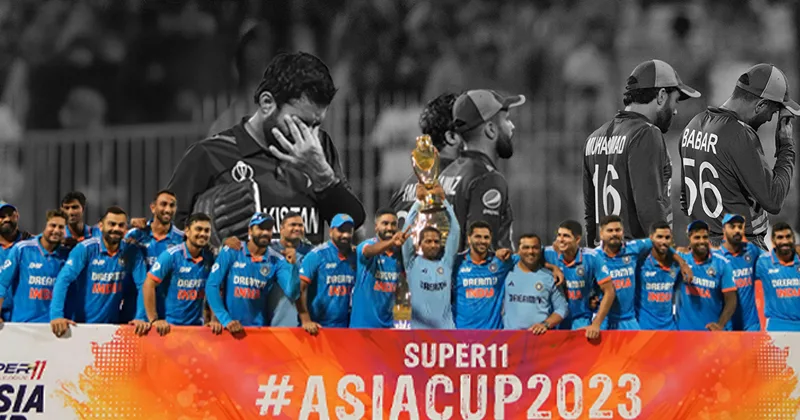
Twenty-six innocent individuals were killed in Pahalgam terrorist attack, and once again, the world expects India to ‘move on’ and even play cricket with the sponsors of terror? Not this time. Asia Cup 2025 is on the brink of collapse. Why? Because India has said ‘NO’. No cricket with Pakistan. No compromise on national security.
In the aftermath of the barbaric terror attack in Pahalgam, the Indian government has advised the BCCI to cut all ties with Pakistan, not only in bilateral series but also in multi-nation events like the Asia Cup and even ICC tournaments.
Board of Control for Cricket in India (BCCI) has reportedly pulled out of the Asia Cup 2025, scheduled to be held in India this September. With India’s likely withdrawal, the very future of the Asia Cup hangs in uncertainty, as sponsors, broadcasters, and even participating nations will face huge financial crisis.
This marks a significant shift from the previous stand where India and Pakistan only face each other in ICC and ACC events, having ended bilateral cricketing ties back in 2012-13.
This time, it’s not just a cricket board taking a decision—it’s the collective voice of the Indian people and its cricketing stars. Players and fans alike have taken to social media condemning the terror acts by Pakistan.
India’s exit from the Asia Cup is not just symbolic-:
• India is the Backbone of Asia Cup Revenues: Most sponsors of the Asia Cup are Indian, and the bulk of the viewership, over 70 per cent comes from India. Without the Men in Blue, advertisers lose interest and broadcasters will back out.
• The broadcast rights for the Asia Cup from 2024 to 2032 were sold for a staggering $170 million. India was the central figure in securing that deal. Without its participation, the deal itself is in jeopardy and the 15 per cent broadcast share given to all the members of the ACC may also be stopped.
• India contributes over 90 per cent of ICC’s global revenue. Under the ICC’s current revenue-sharing model, India gets 38.5 per cent ($230 million), while Pakistan earns 5.7 per cent ($34 million). If BCCI asks ICC to freeze Pakistan’s share sourced from Indian revenue, the PCB could face a financial collapse.
The situation is already grim for the Pakistan Cricket Board (PCB). Following the 2025 ICC Champions Trophy debacle where India refused to play matches in Pakistan, forcing the Indian matches and then knock out games to be moved to Dubai, Pakistan suffered massive losses.
Despite PKR 14 billion PKR in stadium upgrades, poor ticket sales, rain-affected matches, and India’s absence led to an estimated loss of 7 billion PKR. The financial damage pushed the PCB to take an overdraft of PKR 3–6 billion just to sustain basic operations, including player and umpire payments.
If the Asia Cup gets cancel, it’s not just Pakistan who will face the financial crisis, other cricket boards like those of Bangladesh and Sri Lanka, which rely heavily on BCCI, Indian sponsorships and viewership, will suffer collateral damage. India’s presence guarantees packed stadiums, massive digital engagement, and advertising revenue—all of which vanish if India walks away.
A report by Business Today shows that PCB earns around Rs 165-220 crore ($20-26 million) in each tournament cycle due to India playing matches. The broadcast rights for the Asia Cup from 2024 to 2032 were sold for $170 million, in which India had the biggest role.
Asia Cup 2025 now finds itself in an existential crisis. If India doesn’t participate, there is a strong possibility the tournament will be either postponed indefinitely or scrapped altogether. But beyond numbers and tournaments, this moment marks a major diplomatic stance by India—where cricket, once used as a soft diplomacy tool, is now being wielded as a powerful instrument of strategic messaging by India>
This time it is not just a government directive or a BCCI decision, it is a national sentiment to isolate Pakistan from world cricket. Cricketers and the common public have strongly voiced their stand that India should not play any match with terror state Pakistan. From Virender Sehwag to Shikhar Dhawan, voices from within cricket have called for a total boycott of Pakistan.
India has shown the world that terrorism and sports cannot go hand-in-hand. The message is loud and clear: until Pakistan reforms and dismantles its terror infrastructure, there will be no cricket, no engagement, and no normalcy.
















Comments