





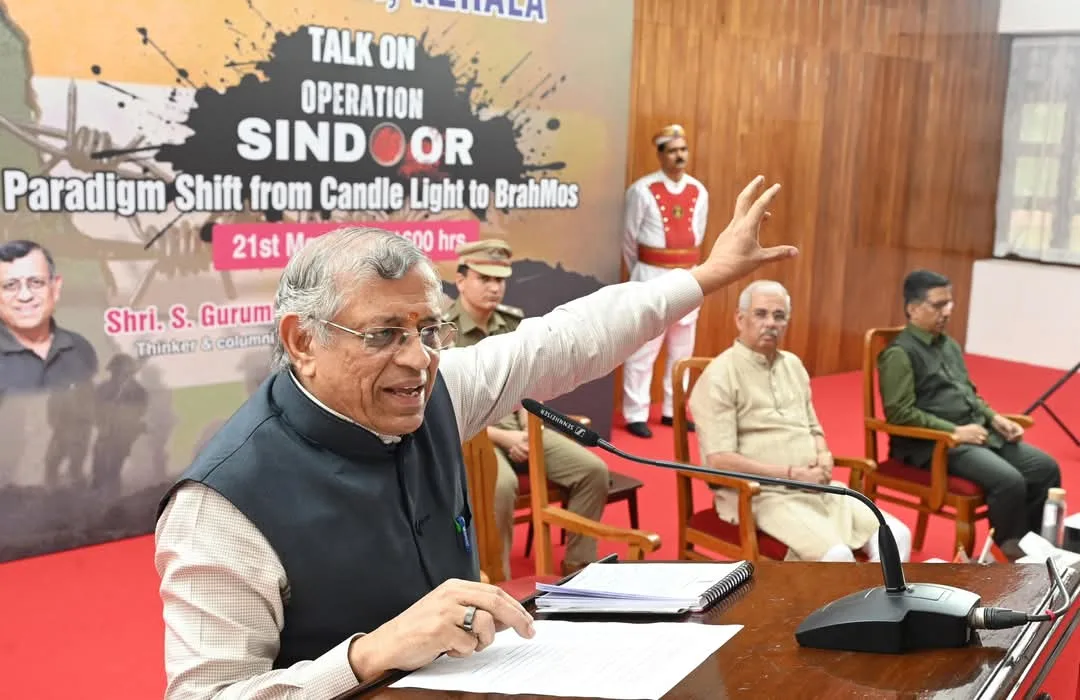
The success of Operation Sindoor is India’s shift towards a non-contact warfare model, said S Gurumurthy, Chairman of the Vivekananda International Foundation. Speaking at the Kerala Raj Bhavan on May 21 on the topic ‘Operation Sindoor: A Paradigm Shift from Candlelight to BrahMos’, Gurumurthy noted that this core aspect of Operation Sindoor is being overlooked in discussions. The event was presided over by Kerala Governor Rajendra Vishwanath Arlekar.
Gurumurthy explained that the non-contact warfare model, which does not require direct military engagement, has significantly benefited India in this fight against terrorism. He credited Prime Minister Narendra Modi for transforming the country’s defence infrastructure to embrace this model, which, he said, was instrumental in ensuring the operation Sindoor’s success. Gurumurthy also remarked that Shashi Tharoor had taken a position on Operation Sindoor that the Congress party had failed to adopt in the past fifty years.
Besides, Gurumurthy elaborated on the components of non-contact warfare, highlighting the use of long-range missiles, precision smart weapons, unmanned systems, robots, and satellites. He referenced a 2020 description from the Pakistan Defence website, which characterized such warfare as aiming for “a quick, decisive victory by remote delivery of destructive kinetic energy.”
Addressing the historical and ideological underpinnings of Pakistan’s stance towards India, Gurumurthy argued that Pakistan’s military has maintained dominance over its political and economic systems. He pointed out that the Pakistan Army has ruled the country directly for 34 years and continues to exert significant influence through entities like the Soldiers Foundation, which operates various commercial enterprises. “Pakistan’s economy, business, and polity are intermingled with the army, and politicians are merely prisoners,” he remarked. Gurumurthy also recounted the Pahalgam terror attack, describing it as one of the most brutal incidents in the history of Indo-Pak conflicts. He emphasized that victims were targeted based on their religion, underscoring the sectarian and divisive motivations behind such attacks.
Governor Arlekar, in his remarks, mentioned that Gurumurthy was invited to speak at the Raj Bhavan after the Governor read his insightful columns on Operation Sindoor and non-contact warfares. During the event, the Governor honored the family of N. Ramachandran, a native of Kochi who was killed in the Pahalgam terror attack, acknowledging their sacrifice.
The lecture concluded with a call to recognise and understand the evolving nature of modern warfare and the strategic shifts that have contributed to India’s defense capabilities. Gurumurthy’s insights provided a comprehensive overview of the factors leading to the success of Operation Sindoor and the importance of technological advancement in national security.













Comments