





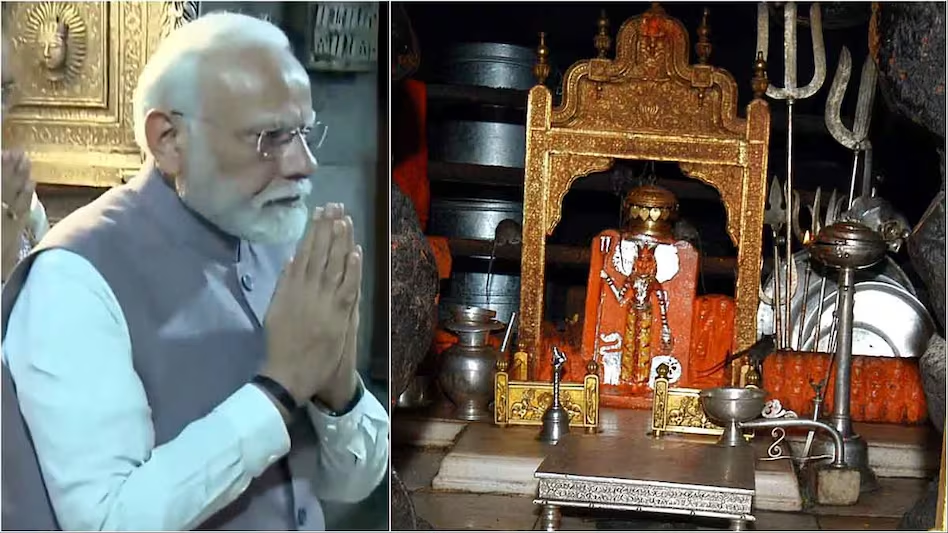
Prime Minister Narendra Modi visited Bikaner, Rajasthan, on Wednesday (May 21), where he performed a symbolic Shakti Puja at the revered Karni Mata Temple in Deshnok, a site dedicated to the goddess of power and warriors. The visit, laden with strategic and cultural significance, also included a stop at the Nal Airbase, a key military installation that played a pivotal role in India’s retaliatory strikes during Operation Sindoor earlier this month.
The operation was launched in response to a deadly terrorist attack in Pahalgam, Jammu and Kashmir, and saw Indian fighter jets take off from Nal to target Jaish-e-Mohammed’s terrorist hideouts in Pakistan.
Shakti Puja at Karni Mata Temple
PM Modi’s visit to the Karni Mata Temple, often referred to as the “Temple of Rats,” was a powerful gesture symbolising India’s strength and resolve in the face of adversity. The temple, located in Deshnok, 30 kilometres from Bikaner, is dedicated to Karni Mata, a 14th-century mystic revered as an incarnation of Maa Durga. The puja is being interpreted as a prayer for the nation’s security and victory, particularly in light of the recent military operation against terrorism.
“The Shakti Puja at Karni Mata Temple reflects the government’s commitment to safeguarding the nation while drawing on its cultural and spiritual heritage,” said Dr. Anil Sharma, a political analyst based in Jaipur quoted in media reports. “It sends a message of unity and resilience.”
Strategic Visit to Nal Airbase
Following the temple visit, PM Modi proceeded to the Nal Airbase, located just 150 kilometres from the Pakistan border, where he interacted with Indian Air Force personnel. The airbase, a critical hub for India’s western frontier defence, gained prominence during Operation Sindoor, launched on May 6-7, 2025. Indian Air Force fighter jets, including HAL Tejas MK.1A aircraft from the elite ‘Cobra’ squadron, took off from Nal to strike Jaish-e-Mohammed’s headquarters in Bahawalpur, Pakistan.
The operation was a direct response to a terrorist attack on April 22 in Pahalgam, Jammu and Kashmir, which claimed 27 lives, including one Nepali citizen. The attack, for which Jaish-e-Mohammed and Lashkar-e-Taiba claimed responsibility, targeted tourists and sparked national outrage. Operation Sindoor saw precise strikes that destroyed nine terrorist hideouts and eliminated over 100 terrorists, including 10 family members and four associates of Jaish chief Masood Azhar, according to his own admission.
Debunking Pakistan’s Claims
Pakistan had claimed post-Operation Sindoor that it successfully attacked and damaged Nal Airbase. PM Modi’s visit to the fully operational airbase effectively debunked these claims. “The airbase stands as a testament to India’s military preparedness and resilience,” said Air Marshal (Retd.) Vikram Singh to media.
“The Prime Minister’s presence here sends a clear message to adversaries that India’s defences are impregnable.”
During a previous visit to Adampur Airbase in Punjab on May 13, PM Modi addressed soldiers, stating, “When the sindoor of our sisters and daughters was taken away, we entered the enemy’s home and crushed their terror network. We destroyed nine terrorist hideouts and eliminated over 100 terrorists.”
His visit to Bikaner, just 40 kilometres from the site of the destroyed Jaish headquarters, further highlight India’s aggressive stance against terrorism.
Development Initiatives in Bikaner
Beyond its strategic significance, PM Modi’s visit also focused on development. He inaugurated the newly redeveloped Deshnok railway station, built under the Amrit Bharat Station Scheme, and flagged off the Bikaner-Mumbai Express train, which will operate weekly and cover 1,213 kilometres in 22 hours.
Additionally, he virtually inaugurated 103 Amrit Bharat railway stations across 18 states, constructed at a cost of Rs 1,100 crore. The Prime Minister also laid the foundation stone and dedicated development projects worth Rs 26,000 crore, aimed at boosting infrastructure and connectivity in the region.
Addressing a large public gathering in Palana village, PM Modi emphasised the government’s commitment to Rajasthan’s progress. “Bikaner is not just a land of valour but also a hub of development. These projects will transform the lives of people here and strengthen India’s infrastructure,” he said.
Operation Sindoor: A Game-Changer
Operation Sindoor has been hailed as a landmark in India’s fight against terrorism. The operation not only dealt a severe blow to Jaish-e-Mohammed but also showcased the Indian Air Force’s technological and operational prowess. The HAL Tejas MK.1A jets, supported by advanced air defence systems like the Akashteer, played a crucial role in neutralising threats. The operation also highlighted the effectiveness of the Agnipath scheme, with young Agniveers manning critical air defence roles alongside regular troops.
“Operation Sindoor sent a clear message to the world: India will not tolerate terrorism,” said Defence Minister Rajnath Singh in a statement. “Our forces are ready to strike at the heart of terror, no matter where it hides.”
Historical Significance of Nal Airbase
Established in 1942 by the British as a rudimentary runway during World War II, Nal Airbase was later abandoned before being taken over by the Indian Air Force. Today, it serves as a key training and operational centre. The airbase’s proximity to the Pakistan border makes it a linchpin in India’s defence strategy, housing advanced aircraft and missile systems.
PM Modi’s visit to Bikaner, combining spiritual reverence, military engagement, and developmental focus, has been described as a masterstroke in both symbolism and strategy. The Shakti Puja at Karni Mata Temple, coupled with the visit to Nal Airbase, reinforces India’s image as a nation that blends cultural heritage with military might.
As the nation continues to grapple with the challenges of cross-border terrorism, Operation Sindoor and PM Modi’s visit to Bikaner have reaffirmed India’s commitment to a zero-tolerance policy. “This is not an era of war, but neither is it an era of terrorism,” PM Modi reiterated during his address. “A zero-tolerance approach to terrorism is the guarantee of a better world.”














Comments