





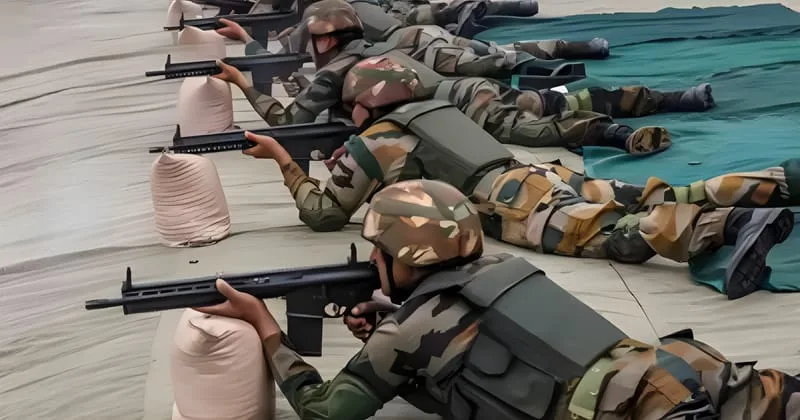
During Operation Sindoor, at least 3,000 Agniveers, most just 20 years old and recruited over the past two years, played a key role in manning critical weapons and air defence systems. These young soldiers, trained under the Agnipath scheme, formed a vital part of India’s robust air defence shield that withstood multiple waves of missile and drone strikes launched by Pakistan from May 7 to 10.
Despite the high-stakes confrontation between the two nuclear-armed nations, the Agniveers rose to the challenge, proving their mettle in a real combat scenario. Their disciplined performance in essential operational roles helped avert major damage and demonstrated the effectiveness of their training at a moment when a full-scale war seemed imminent.
“The Agniveers went through a baptism by fire, successfully helping to repel enemy attempts to strike our bases and cities,” a senior official quoted in media reports said. Reports from frontline air defence units confirm that their performance matched that of regular soldiers. “This should put to rest any doubts surrounding the Agnipath scheme,” he added.
Operation Sindoor, launched in the early hours of May 7, was India’s strong military retaliation to the Pahalgam terror attack that claimed 26 lives. What followed was four days of intense exchanges, airstrikes, missile and drone attacks, long-range artillery and heavy weaponry, before both sides agreed to halt military operations on May 10.
The Agnipath scheme, introduced in June 2022 by the National Democratic Alliance (NDA) government, marked a significant shift from the military’s traditional recruitment model for personnel below officer rank (PBOR). Aimed at maintaining a youthful and combat-ready force, the scheme offers a four-year service term, with only 25 per cent of Agniveers eligible for retention in regular service for an additional 15 years.
During Operation Sindoor, Agniveers played a crucial role in deploying and operating Akashteer — a domestically developed air defence control and reporting system. According to a defence official quoted in media reports, the system became a central component of India’s air defence network throughout the conflict.
Agniveers deployed in air defence (AD) units along India’s western front demonstrated proficiency across four key roles: gunners, fire control operators, radio operators, and drivers of heavy-duty vehicles equipped with guns and missile systems.
Officials noted that the Agniveers performed exceptionally well in each of these specialised functions.
Working alongside regular troops, they engaged enemy targets using shoulder-fired missiles, operated upgraded artillery systems like the L-70 and Zu-23-2B, and managed sophisticated air defence platforms such as the Pechora, Schilka, OSA-AK, Strela, Tunguska, and medium-range surface-to-air missile systems. They also manned radars, coordinated operations through Akashteer control nodes, supported communication lines, and drove missile transport and launch vehicles, including those for the Akash missile system. Once deployed, many drivers also served as sentries to guard the weapon platforms.
The Agnipath scheme, open to youth aged 17.5 to 21, offers recruits an annual starting salary of Rs 4.76 lakh, rising to Rs 6.92 lakh by the fourth year. It includes a Rs 48 lakh non-contributory life insurance policy and an additional Rs 44 lakh ex-gratia in case of service-related death.
Agniveers who complete their four-year service term receive a Seva Nidhi severance package of Rs 11.71 lakh, which includes Rs 5.02 lakh contributed by the individuals themselves during their tenure.
In contrast, personnel recruited under the previous system served for approximately 20 years and retired in their late 30s with pension benefits, healthcare, and access to canteen facilities—perks not extended to Agniveers who exit after four years.
In September, BrahMos Aerospace Pvt Ltd, the Indo-Russian joint venture that manufactures the BrahMos supersonic cruise missile, became the first major company to formally reserve positions for Agniveers. The company announced that 15 per cent of vacancies in technical and general administration roles would be set aside for them. Additionally, at least 50 per cent of positions in security and administrative tasks, previously outsourced, would now be allocated to Agniveers across its various centres.
The success of Agniveers in Operation Sindoor directly counters the political opposition’s longstanding narrative that the Agnipath scheme is flawed and unpopular. Many had argued that the short tenure, lack of pension, and post-service uncertainty would deter youth from enlisting, calling it a failed experiment.
Yet, the frontline performance of these young recruits under real combat conditions has effectively debunked those claims. Far from being a failed scheme, Agnipath has proven capable of producing agile, capable, and battle-ready soldiers who performed shoulder to shoulder with veterans when the nation needed them the most.












Comments