





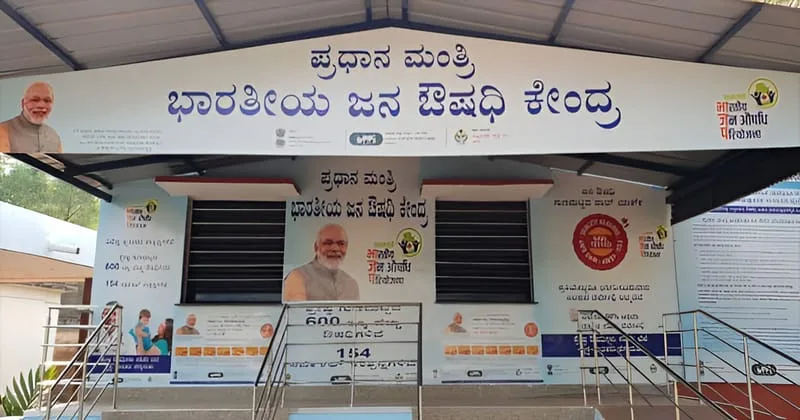
The Congress-led Karnataka state government’s decision to shut down Jan Aushadhi Kendras functioning within the premises of government hospitals has triggered a storm of criticism across the state. The move, widely seen as anti-poor and anti-public welfare, has led to political sparring between BJP MP Tejasvi Surya and State Health Minister Dinesh Gundu Rao.
At the heart of the controversy lies the government’s order to remove over 200 Jan Aushadhi outlets from primary health centres, community health blocks, taluk hospitals, and district hospitals. These centres have, for years, provided low-cost, high-quality generic medicines to economically disadvantaged communities. Now, with the closure imminent, it’s the poor and middle class who will bear the brunt.
A Blow to Affordable Healthcare
Jan Aushadhi Kendras were a lifeline for thousands of people in Karnataka who could not afford branded medicines. By sourcing generic drugs under the Pradhan Mantri Bhartiya Janaushadhi Pariyojana (PMBJP), these outlets enabled annual savings of up to Rs 40 crore for patients across the state, according to MP Tejasvi Surya. Speaking against the closure, Surya denounced the state government’s move as a direct attack on affordable healthcare for the masses.
“This is not just about shutting down a store. It is about pushing the poor back into a cycle of expensive treatments and out-of-pocket expenditures. It is about taking away an essential support system from people who need it the most,” Surya stated on social media.
The @INCKarnataka govt, under @dineshgrao’s Health Dept, has ordered the closure of Jan Aushadi Kendras in public hospitals across the state.
This forces the poor to buy medicines at higher rates instead of availing generic medicines at 70-90% reduced rates under Shri… pic.twitter.com/ztdsyZoMnu
— Tejasvi Surya (@Tejasvi_Surya) May 20, 2025
He further demanded that Health Minister Dinesh Gundu Rao immediately withdraw the directive and reinstate the Jan Aushadhi Kendras operating within hospital premises, stating that both patients’ and store operators’ livelihoods were at stake.
Political Defensiveness or Practical Reasoning?
In response, Health Minister Dinesh Gundu Rao justified the decision by claiming there was no need for discounted medicines within government hospitals when medicines are already being given free of cost. “Why should we have Jan Aushadhi inside government hospitals when patients already receive free medicines through the state system?” he countered.
While the minister’s argument may appear logically sound on the surface, the reality is far more complicated. Patients frequently complain about non-availability of essential drugs in government dispensaries. When such situations arise, Jan Aushadhi Kendras often serve as the fallback, offering crucial medications at affordable rates. Removing these options without ensuring full coverage and consistent availability of government-supplied medicines amounts to bureaucratic negligence and a disregard for public health needs.
Shifting the Burden to the People
It’s important to note that the closure applies only to Jan Aushadhi stores within hospital premises. Those located in private or commercial spaces will continue to operate. However, this distinction overlooks the practical convenience and critical support that hospital-based stores offer. For an elderly patient or a daily wage worker, walking a few kilometres to find a Jan Aushadhi store outside a hospital can mean skipped doses or delayed treatments.
Moreover, the government’s claim that its own hospitals have better medicine availability than Jan Aushadhi stores rings hollow in the face of multiple media reports and public grievances that show persistent drug shortages in state-run facilities. If anything, Jan Aushadhi outlets helped fill those critical gaps, operating as a parallel safety net.
A Misstep in Public Policy
Beyond healthcare access, this move also affects the owners of these Jan Aushadhi stores — many of whom are local entrepreneurs or pharmacists who have invested in the PMBJP model. With their stores being evicted, they face sudden unemployment and financial losses. Ironically, a welfare initiative that empowered both consumers and small business owners is now being dismantled by a government that claims to be pro-poor.
Critics argue that the decision reeks of political vendetta, with the Congress-led state government attempting to distance itself from a Central government initiative simply because it carries the stamp of the BJP. If true, this would be a dangerous precedent — one where ideological differences override public interest.
The Need for Reconsideration
Instead of abrupt closures, the government could have conducted audits to assess drug availability and ensure coordination between hospital pharmacies and Jan Aushadhi outlets. If duplication was a concern, a rational restructuring would have sufficed. However, a blanket eviction reflects a short-sighted and insensitive policy approach.
The closure of Jan Aushadhi Kendras within government hospital campuses is more than an administrative change — it is a rollback of one of the few truly people-centric initiatives in Indian healthcare. At a time when inflation is pinching pockets and out-of-pocket medical expenses are on the rise, denying citizens access to affordable medicine is regressive and unjust.
The Congress government must reconsider this move, not out of political pressure, but out of basic compassion and governance ethics. Healthcare is not a battleground for party ideologies. It is the backbone of a functioning, humane society. And policies that affect the weakest must be handled not with partisanship, but with responsibility.














Comments