





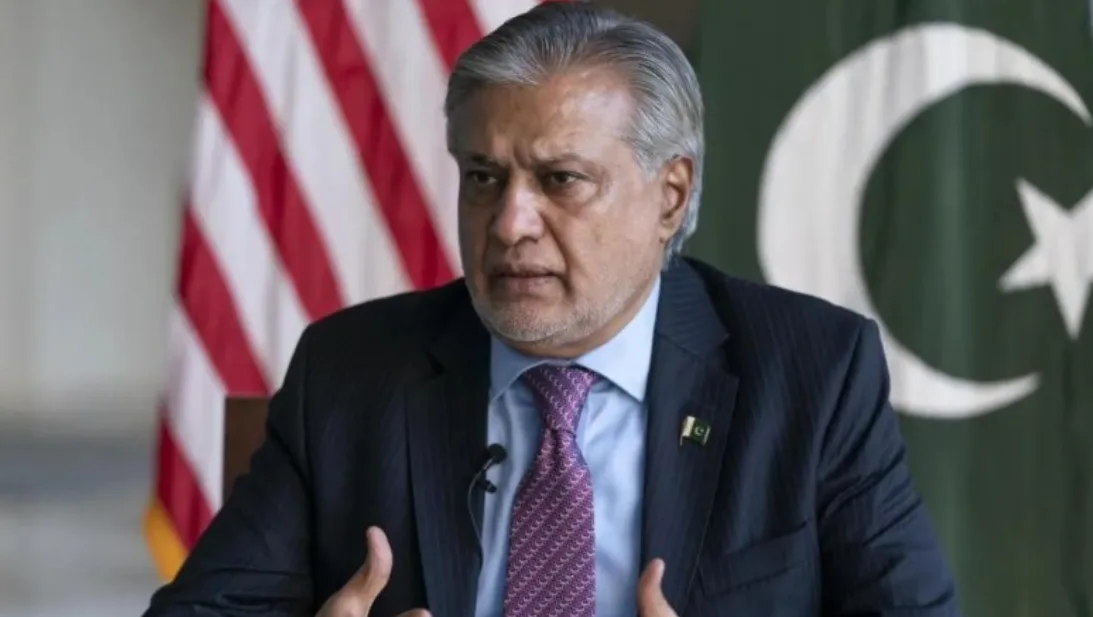
Pakistan Deputy Prime Minister & Foreign Minister Ishaq Dar has said that India needs to reconsider its decision on keeping Indus Waters Treaty (IWT) in abeyance. Otherwise, the fragile ceasefire between India and Pakistan that prevails now can crack, Dar said in an interview to TV channel CNN.
Batting for the resumption of Composite Dialogue, Dar said that all outstanding issues between the two sides could be discussed within its scope. It needs to be mentioned here that for the past many years, one has not heard of any dialogue whatsoever with Pakistan.
The National Security Council of Pakistan has said that if this Treaty is tampered, if the water is diverted or the water is stopped, we will treat it as an act of war, Dar said in response to a question. He was then asked whether he was saying that if it is not resolved, you (read Pakistan) will go back to war.
Responding cautiously, Dar said … Well, you see in moments like this there are times when you have to take some very serious decisions as we did on the 9th night …. Let’s look positively …. we want to take the whole process forward, in an amiable way .…we want to take the whole process forward in an honourable way, with dignity for both sides …. resolve through a composite dialogue the issues which will give this region peace and security.
He warned that the already precarious ceasefire could be threatened “if the water issue is not resolved” in the coming talks, referring to ongoing disputes of access to water from rivers in Jammu & Kashmir. Pakistan’s proposed solution involves reversing India’s decision to block three vast Kashmir rivers vital to Pakistan’s economy.
Many Indian media houses, citing government sources, had reported last week that New Delhi had cut off water flowing through the Baglihar dam located at Chanderkote (Ramban district). India had, in this manner, stopped the Chenab water from flowing into Pakistan. Indeed, that had happened on a particular day when the water was totally stopped.
As a result of this stoppage of water in the Chenab, people in the neighbourhood had started gathering at its banks. Hundreds of people then crossed to east and west banks marvelling at the spectacle. Later, however, water in the river was restored and it has been flowing as before for some days now.
Failure to resolve the water issue “will amount to an act of war,” Dar said. But he was not willing to go the whole hog defining what will happen in the eventuality of stoppage of water.
Dar referred to India’s strikes on targets within Pakistan and Pakistan Occupied Jammu Kashmir (POJK) as a “war” and a “wishful attempt to establish its hegemony”. He stressed that the nuclear option was never on the table as far as Pakistan was concerned.
“There are certain times when you have to take very serious decisions,” he said, “We were very sure that our conventional capacity and capabilities are strong enough that we will beat them both in air and on ground.”
When asked about the impetus for the unexpected ceasefire deal, apparently at the behest of the US, Dar told CNN that “It is in the interest of everybody to not delay or to leave such issues beyond a certain reasonable time.”
“Operation Sindoor has drawn a new line under the fight against terrorism – this is a new phase, a new normal,” Prime Minister Narendra Modi had said a couple of days ago. “If there is a terror attack on India, we will give a jaw-breaking response,” Modi had said
“India will not tolerate any nuclear blackmail,” Modi cautioned.













Comments