





Guwahati: A recent remark by Bangladesh’s interim chief Muhammad Yunus, describing India’s Northeast as “landlocked” while speaking in China, has set off strategic alarms in New Delhi. The statement, seen as a subtle assertion of Dhaka’s geographic leverage, has reinforced India’s urgency to develop alternative infrastructure that reduces reliance on Bangladesh. Far from being caught off guard, the Modi-led government had already begun charting contingency routes—especially after political tensions in Dhaka escalated in August 2024.
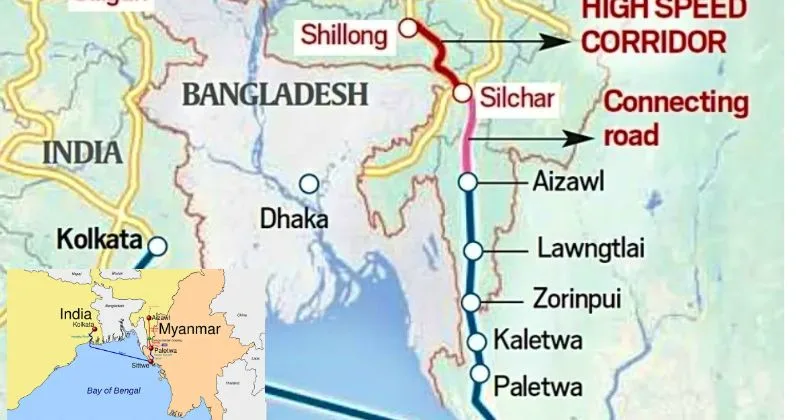
In what appears to be a strategic counter to Bangladesh’s recent geopolitical signalling, the Government of India has fast-tracked the approval of a high-speed four-lane highway connecting Shillong in Meghalaya to Silchar in Assam. The project, pegged at Rs 22,864 crore, is seen as a decisive move to reduce India’s reliance on Bangladesh for maritime access to its northeastern states and to bolster regional connectivity via Myanmar.
The decision comes in the wake of remarks made by Bangladesh’s interim government chief adviser Md. Yunus, who recently described India’s northeastern region as “landlocked” during a meeting with Chinese officials. His comment, which hinted that Dhaka is the region’s only practical sea gateway, raised concerns within India’s strategic circles and was viewed as a subtle geopolitical pressure tactic amid growing China-Bangladesh engagement.
A strategic roadmap to the East
According to officials from the National Highways & Infrastructure Development Corporation Limited (NHIDCL), the Shillong-Silchar highway is more than just a road—it is a strategic alternative. Designed to integrate with the Kaladan Multi-Modal Transit Transport Project in Myanmar, the 166.8-km highway is expected to create a viable land-sea corridor connecting northeastern states to Indian ports via Myanmar, bypassing Bangladesh.
“This project is a clear response to recent geopolitical narratives,” a senior NHIDCL official said. “By connecting Shillong to Silchar, and eventually integrating with Kaladan, we’re ensuring that the northeast has its own independent access to the sea, without having to depend on a politically unstable or unpredictable neighbor.”
High-speed corridor
The proposed high speed Shillong-Silchar corridor once completed will be an engineering achievement due to its very difficult hilly terrain.
The 166.8 kilometers highway (144.8 km in Meghalaya and 22 km in Assam) will cut short the travel time from current 9 hours to around 5 hours which will vastly improve the access to Mizoram, Manipur, Tripura and Southern Assam.
The road will feature advanced design solutions to handle landslides, heavy rainfall, and seismic sensitivity, making it not just an infrastructural project but a technological benchmark.
The project gains additional significance due to its planned linkage with the Kaladan Multi-Modal Transit Transport Project. Funded by India’s Ministry of External Affairs, Kaladan connects the Kolkata port to Myanmar’s Sittwe port, from where goods are shipped inland to Paletwa and then by road to Zorinpui in Mizoram. NHIDCL is also planning to extend the road from Zorinpui to Lawngtlai and Aizawl, thereby stitching together a seamless economic corridor under India’s Act East Policy.
Strategically, the new corridor serves as a critical safeguard against vulnerabilities at the Siliguri Corridor, also known as the “Chicken’s Neck”—a narrow strip that links mainland India with its northeastern states. With this corridor often seen as a chokepoint in the event of conflict or political disruption, the Shillong-Silchar highway offers a secure, alternative land-sea trade and transit route.
The highway is slated for completion by 2030. Once operational, it is expected to transform not only the logistics and defense outlook of the region but also act as a catalyst for economic development, unlocking opportunities in tourism, trade, agriculture, and services.
With this infrastructure leap, India is sending a strong signal: Northeast India is not landlocked—it is a land of immense opportunity, now with multiple gateways to the world.















Comments