





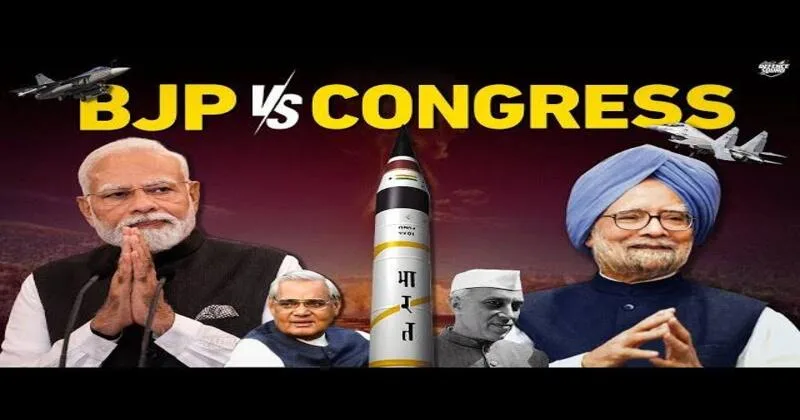
For much of post-Independence history, India’s defence policy suffered from strategic hesitation and systemic neglect. The Congress party, having ruled India for the longest span since 1947, repeatedly treated national security as an expendable variable, subordinated to misplaced idealism, diplomatic indulgence, and at times, outright corruption. From the Himalayan humiliation of 1962 under Nehru, to the debilitating Bofors scandal under Rajiv Gandhi, to the policy paralysis of the UPA decade, the Congress record on national defence is a ledger of missed opportunities and compromised priorities.
Jawaharlal Nehru’s utopian worldview, driven by Panchsheel and non-alignment, blinded India to the geopolitical reality of Chinese aggression. Despite clear warnings, the military was kept under-equipped and underprepared. The 1962 war was not lost due to lack of courage, but due to political negligence. The Chinese advance exposed a fatal flaw, India’s defence doctrine was built on moralistic assumptions rather than strategic assessment.
Rajiv Gandhi’s tenure, though infused with modernising rhetoric, witnessed one of India’s most corrosive defence scandals. The Bofors affair not only tarnished the integrity of procurement processes, but instilled a long-lasting fear of decision-making among bureaucrats and politicians. The result: an entire generation of artillery modernisation was frozen. The Indian Army continued to rely on outdated guns even into the early 2000s, with no meaningful replacements in sight.
The UPA years (2004–2014) were even more troubling. Despite an increasingly aggressive China and a perpetually hostile Pakistan, there was little urgency to build credible deterrence. Defence deals stagnated, border infrastructure remained underdeveloped, and terror incidents including the gruesome 26/11 attacks went unanswered by the state. The failure to retaliate after Mumbai was not restraint; it was abdication.
Worse, the procurement process was marred by blacklisting sprees and scandals. The AgustaWestland VVIP chopper scam further poisoned the atmosphere. The Rafale deal, crucial to upgrading India’s dwindling fighter squadrons, hung in limbo for nearly a decade. Political indecision translated into operational vulnerability.
This drift was decisively reversed with the advent of the BJP-led government in 2014. In both vision and execution, Prime Minister Narendra Modi’s national security doctrine represented a clear break from the past. The shift was immediate and unmistakable.
In 2016, the Indian Army executed surgical strikes across the LoC-a calibrated, public response to the Uri terror attack. This was followed in 2019 by the Balakot air strikes deep inside Pakistan’s Khyber Pakhtunkhwa, in response to the Pulwama attack. For the first time in decades, India demonstrated that it would retaliate beyond rhetoric.
On the policy front, defence procurement was de-bureaucratised. The long-delayed Rafale jets were acquired through direct government-to-government agreement with France. Emergency acquisitions during the Galwan Valley stand-off in 2020 ensured real-time readiness. Indigenous development received a robust push under the “Atmanirbhar Bharat” mission with major investments in the Tejas fighter jet, Dhanush artillery systems, and advanced naval platforms.
One of the most transformative pillars of India’s defence resurgence under Prime Minister Narendra Modi has been the aggressive push for indigenous manufacturing through the Make in India initiative. The government has not only increased FDI limits in the defence sector but also created a conducive ecosystem for private sector participation, start-ups, and defence tech innovation. Iconic platforms such as the HAL Tejas fighter jet, Arjun Mk-1A tank, and Dhanush howitzers now symbolize India’s journey toward self-reliance. The Defence Acquisition Procedure (DAP) has been streamlined, and procurement lists have been restructured to prioritize Indian vendors. In a significant break from the Congress era of dependency and delays, India under Modi is no longer just a defence importer, it is emerging as a defence exporter, with record defence exports exceeding ₹21,000 crore in 2023–24. This shift marks not just industrial revival, but strategic autonomy.
The BJP government also initiated structural and strategic reforms. The creation of the post of Chief of Defence Staff (CDS), a demand pending for decades, was fulfilled. Border infrastructure roads, bridges, and tunnels witnessed unprecedented acceleration. The completion of the Atal Tunnel, pending since the Vajpayee era, is symbolic of this shift.
India’s strategic partnerships were recalibrated with clarity and maturity. Foundational defence agreements with the United States LEMOA, COMCASA, and BECA were signed. The QUAD grouping gained traction. India’s role in the Indo-Pacific expanded from observer to stakeholder.
Perhaps most importantly, the BJP reinstated dignity and trust in the armed forces. From increased pension reforms and disability benefits to a greater representation of military leadership in policy making, the forces were empowered, not politicised.
The contrast with Congress could not be more striking. Where the grand old party stalled, the BJP has acted. Where it feared controversy, the BJP has prioritised capability. Where it relied on diplomacy to mask weakness, the BJP has used diplomacy to amplify strength.
Criticism and scrutiny are necessary in a democracy. But no amount of political spin can erase the structural reality: India’s national security was repeatedly compromised under Congress rule. It has been revitalised under the BJP.
Modern Proof: Operation Sindoor and India’s Strategic Posture
The recent Operation Sindoor marked a watershed moment in modern Indian military operations. Conceived as a multidimensional response to threats across land, sea, air, and cyberspace, the operation showcased India’s ability to pre-empt, neutralise, and dominate in a 21st-century conflict environment.
Two assets were central to the success of the operation: the Rafale fighter jets and the S-400 Triumf air defence systems. While Rafale jets carried out precision strikes and deep-penetration sorties with superior electronic warfare capabilities, the S-400 shield effectively neutralised potential aerial incursions and cruise missile threats. Together, they established integrated air dominance, a capability previously only demonstrated by major global powers.
More significantly, Operation Sindoor was not reactive; it was preemptive, calculated, and proportionate. It blended space-based ISR (intelligence, surveillance, reconnaissance), cyber capabilities, and kinetic force in perfect harmony, a doctrine of deterrence that aligns with the demands of hybrid warfare.
The world took notice. International military observers, from Washington to Tel Aviv, acknowledged the precision, discipline, and technological sophistication with which India executed the operation. For a country that once hesitated to use air power beyond its borders, India has now emerged as a nation capable of full-spectrum, high-tempo military response.
India’s new defence architecture is no longer a paper doctrine, it is battle-tested, digitally integrated, and geopolitically respected.
India cannot afford to regress to the days of diplomatic hesitation and defence delays. The BJP has redefined the nation’s approach from reactive silence to strategic dominance. Operation Sindoor is not just a military success; it is the culmination of years of policy correction and political will.
In contrast, the Congress legacy in defence remains a cautionary tale, a reminder of what happens when national interest is sacrificed at the altar of ideology, corruption, or cowardice.
Today, India’s enemies take it seriously, because India, finally, takes its own security seriously.















Comments