





India, irrespective of Politics, is actively working to inform the international community about Operation Sindoor and the circumstances that led to its initiation. As part of a strengthened diplomatic campaign to expose Pakistan on the global stage, highlighting incidents such as the Pahalgam terror attack, India is sending an all-party delegation abroad, led by Congress MP Shashi Tharoor. He termed it as a national interest.
Meanwhile, public sentiment within India is growing increasingly hostile not only towards Pakistan but also towards nations perceived to support it. The boycott Turkey campaign has gained momentum, with citizens voluntarily withdrawing from tourism and trade engagements with the country.
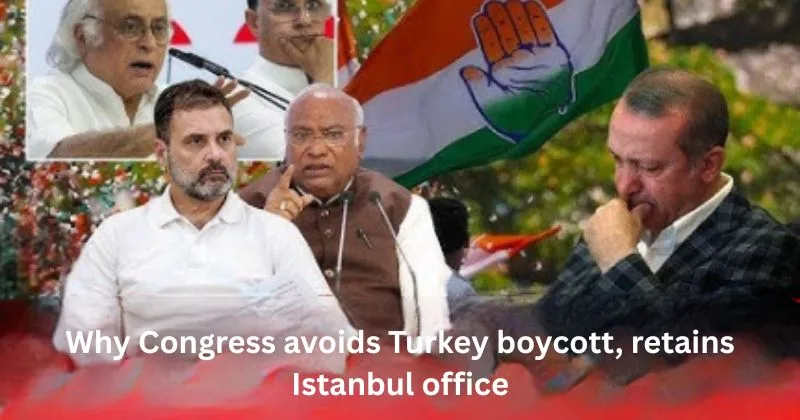
Yet, amid this heightened national sentiment, the Indian National Congress, India’s oldest political organisation, finds itself in a difficult position, as it continues to maintain an official presence in Turkey, a terror sponsoring country that has frequently challenged and criticised India’s sovereignty globally.
Turkey’s anti-India Stance
Turkey, under President Recep Tayyip Erdogan family, has not hesitated to align itself with Pakistan on contentious issues, particularly Kashmir. Erdogan has repeatedly raised the Kashmir issue at the United Nations, spreading Pakistan’s narrative and accusing India of islamophobia and their human rights violations. His government has also facilitated the spread of anti-India narratives through media, academia, and diplomatic channels. Turkey’s approach is not just hostile, it is strategic, anti-hindu and deeply damaging to India’s global standing and economic growth.
Congress’s Istanbul Chapter: A Shameful Step
In this context, Congress’s continued presence in Erdogan’s backyard is a political setback for Indian state and diplomatically harmful. In November 2019, the Congress party, through its Indian Overseas Congress (IOC) wing, opened an official office in Istanbul, just three months after the Indian government abrogated Article 370 and revoked Jammu and Kashmir’s special status. The party appointed Muhammad Yusuf Khan as the head of the Istanbul chapter. This move came at a time when Turkey had launched an international campaign against India’s Kashmir policy, becoming one of its most vocal critics alongside Pak linked anti-India nexus.
Congress Must Stop Aligning Foreign Interest Over National Interest
The Congress party is silent on Erdogan’s repeated attacks on India. However, there has been no official condemnation of Turkey’s fake narratives on behalf of Pakistan, no distancing from Erdogan’s anti-India campaigns, and no public attempt to defend India’s position on global stages. Instead, the party has indulged in posturing that, at times, mirrors Ankara’s rhetoric, whether through its vocal support for Palestine during the Israel-Gaza conflict or its continued worries on Kashmir.
This silence is not merely political negligence; it undermines India’s diplomatic efforts, unity and sends mixed messages to the global community. At a time when the nation is uniting under a ‘Boycott Turkey’ sentiment, be it through curbing Turkish commercial operations like Celebi, suspending media platforms like TRT World, or reassessing bilateral ties, it is imperative that domestic political actors show a united front.
Congress must act now to restore its credibility and reaffirm its commitment to India’s national interest. The first step should be the immediate closure of its office in Turkey. This symbolic yet powerful move would send a clear message that India’s unity despite electoral politics. Secondly, Congress must publicly denounce Turkey’s anti-India stance, especially its support for Pakistan on Kashmir. The party must send a clear message to both national and global level that it stands with India, not with foreign powers that seek to undermine and exploit India’s sovereignty and unity.
If Congress wishes to be seen as a responsible opposition, it must shed its silence and take a firm stand. National interests must come first. Anything less would be a betrayal of the people it seeks to represent.














Comments