





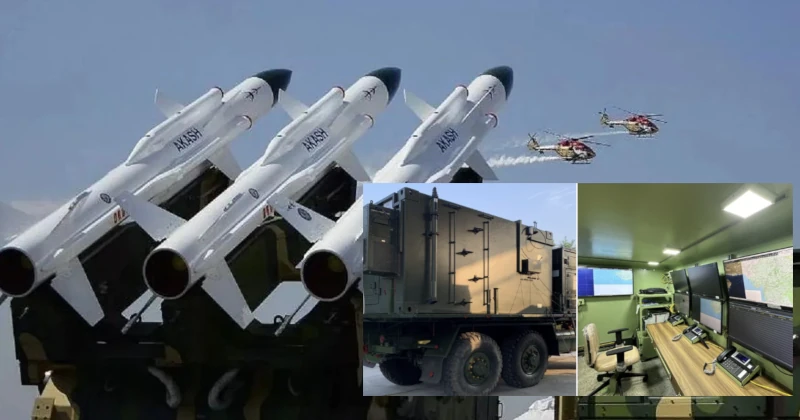
Bharat Electronics Limited (BEL) manufactured and indigenously designed air defence system, Akashteer, has demonstrated its prowess at the height of the tensions between the two neighbours, intercepting numerous drones,, missiles, micro UAVs, and loitering munitions, emerging as a globally actionable defence asset.
Lauding its effectiveness in real-world conflict, significantly enhancing India’s air defence capabilities during recent tensions with Pakistan, BEL on Wednesday stated that the system had performed beyond its expectations, providing robust Air Defence to India during the current conflict.
“BEL is proud to announce that our in-house designed & manufactured Air Defence System, Akashteer, has proved its mettle in the war field. Ground-based Defence Systems integrated with Akashteer made it hell for Pakistan’s air adventures,” the Navratna Defence PSU stated on X.
“The system performed beyond users’ expectations, providing robust Air Defence to India during the current conflict. Akashteer ensures a seamless & unified air situation picture accessible to the lowest operational units of Army AD, enhancing situational awareness across the force,” it added.
BEL is proud to announce that our in-house designed & manufactured Air Defence System, Akashteer, has proved its mettle in the war-field. Ground-based Defence Systems integrated with Akashteer made it hell for Pakistan's air adventures. @DefenceMinIndia pic.twitter.com/e6eO0bftp4
— Bharat Electronics Limited (BEL) (@BEL_CorpCom) May 14, 2025
The Akashteer system, developed under a Rs 1,982 crore contract signed in March 2023, integrates surveillance assets, radar systems, and command units into a unified network, providing seamless situational awareness to the Indian Army’s Air Defence units.
Akashteer enables monitoring of low level airspace over the battle areas of Indian Army and effectively control the Ground Based Air Defence Weapon Systems.
During the recent conflict following India’s ‘Operation Sindoor’ on May 7, which targeted nine terror camps in Pakistan and Pakistan-occupied Kashmir (PoK), Akashteer neutralised numerous Pakistani drone and missile attacks, ensuring zero casualties and minimal material losses.
“Akashteer empowers units on the front lines, enabling dynamic engagement decisions and preventing friendly-fire incidents,” BEL further stated.
Akashteer stands as a testament to the nation’s growing self-reliance in defence technology, aligning with the ‘Atmanirbhar Bharat’ initiative. Along with Akashteer, the indigenously developed Akash surface-to-air missile air defence system had also played a crucial role in thwarting Pakistani drone attacks targeting Indian assets.
Why AkashTeer Stands Alone
- 100 per cent Indigenous Stack: No imported chips, software, or foreign GPS dependencies
- Zero-Latency AI Combat Cloud: Real-time decision-making without human delay
- NAVIC Precision: India’s own satellite navigation system enables unmatched accuracy
- Mobile Command Units: Can be operated from a jeep, bunker, or moving war room
- Self-Healing Swarms: Drone formations can reconfigure mid-air if units are lost
- Friendly Fire Prevention: Integrates air and ground radar to avoid overlap and errors
The Akash missile, which has successfully intercepted enemy missile threats, was first conceptualised in 1983.
Prahlada Ramarao, former DRDO scientist behind India’s Akash missile system, described the Akash Missile defence system as a dream project of Dr APJ Abdul Kalam, revealing that it held a special place in his heart.
Speaking to media, Scientist Prahlada Ramarao said, “The indigenously developed defence missile system Akash was the dream and a favourite project of Dr Abdul Kalam. I wish he were here to witness this missile’s performance. I can only thank him in my heart for his vision and support.”
He shared insights into the crucial moments and challenges during the missile’s development.
In an interview with media, Ramarao reflected on the long journey of developing India’s missile technology. He also highlighted his close collaboration with Kalam during the initial stages of the project in the 1980s.
Recalling his early experiences, Ramarao said, “In 1983, I was a junior scientist, working alongside Dr Kalam. He was my mentor, and we would frequently interact on testing and mathematical modelling. I vividly remember when Dr. Kalam asked me a question, and I prepared a chart to present my findings to him. He was satisfied with the way I had perceived the problem.”
In 1984, the missile system was officially named “Akash.” Ramarao’s dedication and hard work eventually led to his appointment as the Project Director of the Akash missile program. At the time, he felt overwhelmed by the responsibility, given his youth and the scale of the project.
“In 1984, the name of the missile was given as AKASH. To my pleasant surprise, I was given the title of Project Director. I was young at that time and scared about handling such a massive responsibility. The project was taking longer than anticipated, with over 15 years of work, and I was concerned about whether I could manage it,” Ramarao recalled.
The development of the Akash missile faced several hurdles. The missile, along with its radar systems and ground infrastructure, needed to function in perfect harmony to counter fast-moving, manoeuvring aircraft equipped with electronic warfare technology.
“It was complex–the missile was complex, the radar, the ground system, and the entire ecosystem were also complex. The target is the aircraft, which includes flying, manoeuvring… and also it carries electronic warfare. It is a very tough job. It took 15 years; for 10 years, we were doing research and development. In the last 3 years, we did the testing and later asked the armed forces to come for flight testing. That is how it took place,” he explained.
Ramarao also highlighted the unique challenges posed by the missile’s design, particularly its ability to engage multiple targets simultaneously.
“Everything was a challenge. We were all very young, most of us were under 30. The Air Force and Army had specified that the missile should be a multi-target handling surface-to-air missile system. If the enemy sent 6-8 aircraft, the missile had to destroy all of them at once. The radar had to be customised for beam agility, so the missile wouldn’t miss a target,” Ramarao said.
He further elaborated, “The enemy aircraft had to be matched with us, as in which missiles would go to which aircraft. That could have also been done because of the intelligence we have built in the radar and the command-control system inside the missile. This would ensure that it would match different targets, missiles simultaneously, accurately, and reliably.”
The coordination between the radar, command and control systems, and the missile itself was crucial to ensure accurate targeting and simultaneous engagements of multiple targets.
“The radar had to be customised specially for beam agility. The electronic beams should be swift and at a fast speed so that we cannot miss the target,” he said.
Another significant challenge was the missile’s speed. Ramarao discussed the creation of a special system called the Ramjet propulsion system to enhance the missile’s speed. “The other biggest challenge was the speed of the missile. We had to make a very special propulsion called RAMJET propulsion for the system. This also took a lot of time. We had 1,000 scientists working in about 12 laboratories all across the country. Coordinating all of them to get the desired results was a monumental task,” he recalls.
Despite the challenges, the entire team’s dedication and the relentless support of Dr Kalam kept the project on track, he said.
With its successful testing and eventual deployment, the Akash missile system became a cornerstone of India’s defence, playing a vital role in safeguarding the country against external threats.
Ramarao’s perseverance and Dr Kalam’s visionary leadership turned what began as an ambitious dream in the 1980s into a significant defence milestone for India.















Comments