





As expected in legal circles following the 8 March division bench order fixing deadlines for Presidents and Governors to give assent to Bills passed by State Legislatures — and for the President to act on State Bills — in the Tamil Nadu vs Governor case, the President of India has now sought legal opinion through 14 questions. The President also raised the question of whether the Supreme Court can fix deadlines for the President and Governors to give their nod to Bills.
On 8 March, while disposing of a petition moved by the Tamil Nadu government, the apex court bench comprising Justices J.B. Pardiwala and R. Mahadevan fixed a timeline for the Governor and the President to clear Bills passed by State Assemblies. This evoked sharp reactions from political and legal circles, describing it as an act of judicial overreach and inconsistent with the Constitution. However, the DMK hailed the verdict, stating that it reaffirmed the rights of the States and compelled the Governor to follow or give assent to Bills passed by the Legislatures.
Chief Minister M.K. Stalin, on 27 April, honoured Supreme Court lawyers who represented the State in the important case concerning the Governor’s approval of Bills passed by the Tamil Nadu Assembly. He congratulated senior advocates Abhishek Singhvi, Rakesh Dwivedi, and P. Wilson — who is also a DMK Rajya Sabha member. Former Attorney General Mukul Rohatgi, who had also argued for Tamil Nadu in the case, could not attend the event.
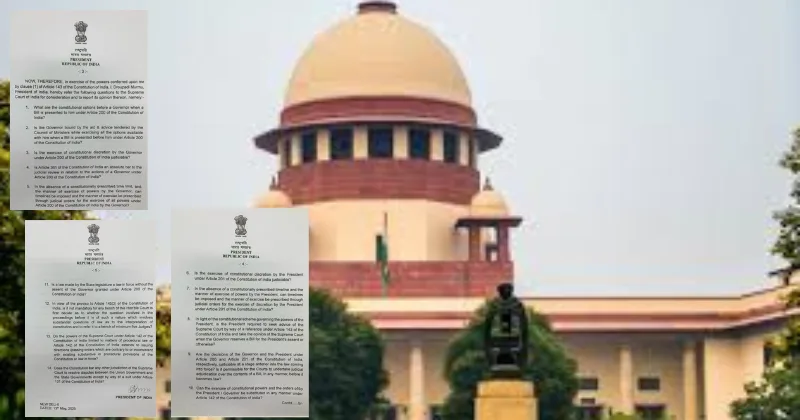
In this background, President Droupadi Murmu has made a reference to the Supreme Court to determine whether such actions can be directed through judicial orders in the absence of any constitutionally prescribed timeline. The Central Government has now invoked the President’s powers under Article 143(1) of the Constitution to seek the Supreme Court’s opinion on a plethora of contentious issues raised by the 8 March judgement.
This advisory jurisdiction allows the President to consult the apex court on significant questions. In the reference made on 13 May 2025, the President sought the opinion of the Supreme Court on 14 questions — including whether the exercise of constitutional discretion by the President under Article 201 of the Constitution of India is justiciable.
The questions raised are as given:
1. What are the constitutional options before a Governor when a Bill is presented to him under Article 200 of the Constitution of India?
2. Is the Governor bound by the aid & advice tendered by the Council of Ministers while exercising all the options available with him when a Bill is presented before him under Article 200 of the Constitution of India?
3. Is the exercise of constitutional discretion by the Governor under Article 200 of the Constitution of India justiciable?
4. Is Article 361 of the Constitution of India an absolute bar to the judicial review in relation to the actions of a Governor under Article 200 of the Constitution of India?
5. In the absence of a constitutionally prescribed time limit, and the manner of exercise of powers by the Governor, can timelines be imposed and the manner of exercise be prescribed through judicial orders for the exercise of all powers under Article 200 of the Constitution of India by the Governor?
6. Is the exercise of constitutional discretion by the President under Article 201 of the Constitution of India justiciable?
7. In the absence of a constitutionally prescribed timeline and the manner of exercise of powers by the President, can timelines be imposed and the manner of exercise be prescribed through judicial orders for the exercise of discretion by the President under Article 201 of the Constitution of India?
8. In light of the constitutional scheme governing the powers of the President, is the President required to seek advice of the Supreme Court by way of a reference under Article 143 of the Constitution of India and take the opinion of the Supreme Court when the Governor reserves a Bill for the President’s assent or otherwise?
9. Are the decisions of the Governor and the President under Article 200 and Article 201 of the Constitution of India, respectively, justiciable at a stage anterior into the law coming into force? Is it permissible for the Courts to undertake judicial adjudication over the contents of a Bill, in any manner, before it becomes law?
10. Can the exercise of constitutional powers and the orders of/by the President / Governor be substituted in any manner under Article 142 of the Constitution of India?
11. Is a law made by the State legislature a law in force without the assent of the Governor granted under Article 200 of the Constitution of India?
12. In view of the proviso to Article 145(3) of the Constitution of India, is it not mandatory for any bench of this Hon’ble Court to first decide as to whether the question involved in the proceedings before it is of such a nature which involves substantial questions of law as to the interpretation of constitution and to refer it to a bench of minimum five Judges?
13. Do the powers of the Supreme Court under Article 142 of the Constitution of India limited to matters of procedural law or Article 142 of the Constitution of India extends to issuing directions /passing orders which are contrary to or inconsistent with existing substantive or procedural provisions of the Constitution or law in force?
14. Does the Constitution bar any other jurisdiction of the Supreme Court to resolve disputes between the Union Government and the State Governments except by way of a suit under Article 131 of the Constitution of India?













Comments