





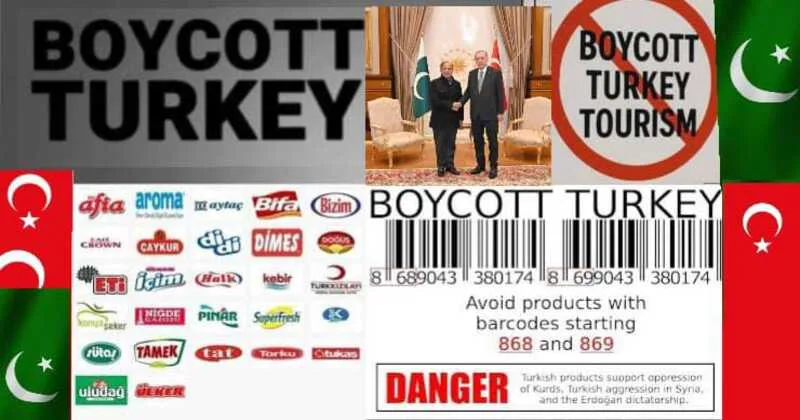
An editorial published recently in Deepika, the mouthpiece of the Christian Church in Kerala, made a striking and bold assertion: Turkey is “a country sweating to bring back the caliphate of Islamic terrorism in the modern era.” The editorial also denounced China as “a communist dictatorship that is the protector of Islamic terrorism in Asia”. While China’s anti-Indian stance is widely known, Indians must understand the depth and scale of Turkey’s covert and overt hostility towards India. It’s time we listen. The case for a comprehensive boycott of Turkey is now stronger than ever, not just because of its alignment with Pakistan, but because of its extensive and calculated campaign to discredit India globally.
Turkey’s Geopolitical Ambitions: India in the Crosshairs
Under the leadership of President Recep Tayyip Erdogan, Turkey has repositioned itself as a self-declared leader of the Muslim world, seeking to revive Ottoman-era grandeur under the guise of pan-Islamism. This ambition has manifested in an aggressive foreign policy that includes systematic attacks on India’s internal affairs, particularly in Kashmir and on issues concerning Indian Muslims.
After India abrogated Article 370 in 2019, Erdogan became one of the most vocal international critics of the move, repeatedly raising the Kashmir issue at global platforms such as the United Nations General Assembly. His speeches parroted Pakistan’s narrative, framing India as an occupier and abuser of Muslim rights, often drawing comparisons between Kashmir and Palestine. This wasn’t mere rhetoric, it was part of a broader campaign to project India as an oppressor of Muslims and to undermine its international image.
Turkey-Pakistan-Muslim Brotherhood Axis: A Network of Hostility
Turkey’s collaboration with Pakistan and the Muslim Brotherhood has formed a dangerous ideological and geopolitical triangle. These actors share a common goal: to challenge secular democracies and promote Islamist agendas globally. Turkey provides the diplomatic and media infrastructure, Pakistan contributes intelligence and propaganda support, and the Muslim Brotherhood activates its global network of NGOs, clerics, academics, and online influencers.
This unholy alliance operates across multiple fronts, from media and diplomacy to education and civil society, targeting India’s secular ethos. By echoing and amplifying each other’s anti-India messages, they have managed to inject a consistent and toxic narrative into global discourse. India is portrayed as an Islamophobic, fascist state in need of international censure and economic boycotts.
Turkish State Media: Disinformation Dressed as News
At the heart of this campaign is Turkey’s state-controlled media machinery, particularly TRT World and Anadolu Agency. These outlets have dedicated significant resources to framing India in a negative light. Their reports frequently spotlight fringe voices critical of India, while ignoring or dismissing the official Indian position. Coverage of Kashmir is laden with emotionally charged language, selective facts, and sometimes outright misinformation.
TRT World has run several documentaries and special reports accusing India of human rights violations in Kashmir, painting the Indian Army as an oppressive force, and presenting the region as a war zone under siege. These materials are crafted not for Turkish audiences but for international consumption, particularly in Western countries and Muslim-majority nations.
Weaponising NGOs and Academia
Turkey’s campaign doesn’t stop at media. It extends into academia and civil society through carefully cultivated institutions. Turkish universities and think tanks, often backed by Erdogan’s regime, have hosted events and published research that aligns with Pakistan’s narrative on Kashmir and India’s domestic politics. These forums are not neutral but they are politically loaded, often featuring speakers known for their hostility to India.
Several NGOs such as the IHH (İnsan Hak ve Hürriyetleri İnsani Yardım Vakfı), TİKA (Turkish Cooperation and Coordination Agency), and the SETA Foundation have organised conferences and publications focused on “Hindutva fascism”, “Indian Islamophobia”, and “Kashmir under occupation”. These NGOs work hand-in-hand with Brotherhood-linked Western organisations and Pakistani diaspora groups, using the language of human rights to mask a political and ideological agenda.
Digital Warfare and Social Media Campaigns
One of the most insidious aspects of Turkey’s anti-India campaign is its use of social media to manufacture outrage and spread disinformation. Coordinated hashtag campaigns like #BoycottIndia, #FreeKashmir, and #StandWithKashmir have flooded Twitter, Facebook, and Instagram, especially following significant events in India, such as the CAA-NRC protests or the Tablighi Jamaat controversy during COVID-19.
Investigations into these campaigns have shown the presence of automated bots, fake accounts, and coordinated influencer networks with links to Turkey, Pakistan, and Qatar. Graphics, infographics, and emotional videos are often produced in Turkey and then disseminated through a transnational Islamist network. These digital operations have succeeded in shaping perceptions, particularly among Arab youth and diaspora communities.
Influence Operations in India: A Quiet Infiltration
More alarming is Turkey’s quiet but deliberate attempt to extend its ideological influence inside India, particularly in Kerala. Turkish-backed NGOs and Islamic charities have reportedly offered scholarships, religious education, and all-expenses-paid trips to Indian Muslim youth. Indian security agencies have flagged attempts to fund hardline preachers and religious institutions, with some individuals offered large sums to spread radical interpretations of Islam in line with Ankara’s worldview. These influence operations aim to create ideological footholds within India, preparing the ground for long-term polarisation and unrest.
A National Response is Long Overdue
Despite clear and consistent provocations, India’s response to Turkey has been measured. Diplomatic engagement has been downgraded, and foreign-funded NGOs are under increased scrutiny. But this is not enough. India must take a firmer stand, economically, diplomatically, and culturally.
Cut all cultural exchanges with Turkish state institutions. Discourage Indian tourism to Turkey and limit bilateral trade. More than three lakhs Indian tourists visit Turkey annually and the country earns more than 3000 crores. Besides, Expose and counter disinformation spread by Turkish media in global forums. Finally, strengthen fact-checking networks and raise awareness among the Indian public and diaspora.
Turkey is not a neutral observer with ideological differences but it is a hostile actor working to systematically undermine India’s sovereignty, secular fabric, and global image. Its alliances with Pakistan and Islamist networks, weaponization of media and academia, and attempts to radicalise sections of Indian society make it clear: Turkey is waging a hybrid war against India.The time for passive observation is over. It is time to Boycott Turkey, economically, culturally and ideologically.












Comments