





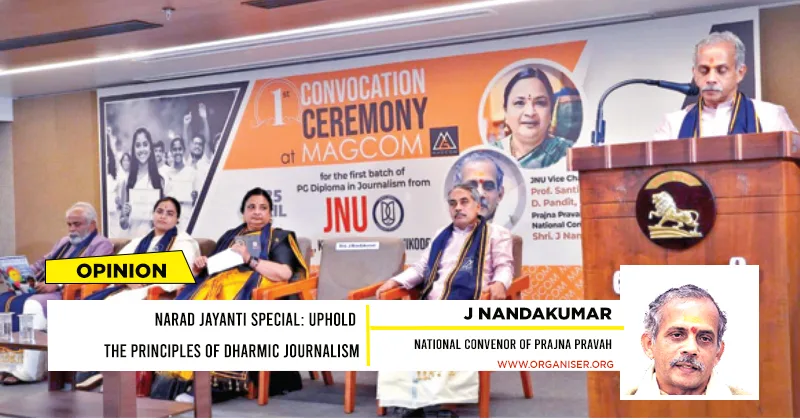
We live in a time where the phrase “ethical journalism” has almost become an oxymoron. What is taught in classrooms often stands in stark contrast to what is practiced in newsrooms. The core values of journalism- truth, integrity, impartiality-seem to have been eclipsed by the overpowering forces of sensationalism, commercialism, and ideological biases.
Gone are the days when media commanded deep public respect, when stalwarts like KR Malkani, Pothen Joseph, BG Verghese, MV Kamath, and TVR Shenoy were household names, synonymous with credibility and courage. Today, such figures are rare. But that only makes your mission all the more urgent and meaningful. It is my sincere hope that you, this pioneering batch of MAGCOM, will rise to restore the dignity of this noble profession. Uphold the principles of ethical, or more rightly, Dharmic journalism, journalism rooted in truth, guided by values, and tempered with compassion. Bring back the human touch to storytelling. Be fearless, but also fair. Be critical, but not cynical. Be driven, but not compromised.
Journalism is a profession that must be approached with a spirit of tyaga or sacrifice. In an age dominated by paid news and corporate interests, a media person must remain free from greed and all forms of personal weakness. The journalist is expected to uphold the noble values of freedom, courage, and neutrality, and remain steadfast in the pursuit of truth and Dharma.
Among these guiding principles, the idea of तटस्थता (tatasthata), as rooted in Bharatiya Darshana, holds particular significance. Tatasthata literally means “being situated on a bank or declivity.” It suggests a state of detached observation, like someone watching the flow of a river from the riverbank,engaged, yet unaffected.
But there is a deeper dimension. To stand on a declivity, a sloped surface, tilted at a risky 45 degrees, is no easy task. There are possibilities that you may lose control of yourself and fall down. Yet, maintaining your balance, standing straight and firm in such a position, is a metaphor for the ethical challenge of journalism. It reflects both the difficulty of the role and the strength of character it demands.

Tatasthata, in this sense, is not passivity; it is a disciplined detachment anchored in Dharma. When you stand firm in Dharmic values, everything else will follow. This principle must never be lost—because it is what provides real strength and dignity to your voice as a journalist.
Media is often hailed as the Fourth Pillar of democracy, in safeguarding Freedom of Speech and championing fearless journalism. I believe it echoes the timeless wisdom of the Mahabharata: Dharmo Rakshati Rakshita, Dharma protects those who protect it. Similarly, if we uphold the principle of Freedom of Speech despite threats and adversities, it will protect those who courageously defend it. The truth, fearlessly published by the media in the face of intimidation and threats, became a lifeline for the nationalist media fraternity during a critical trial. If responsible media can collectively fulfil their duties to counteract threats to free speech, the same will definitely come to your rescue later. That’s what we have seen in the history of journalism. So never be disillusioned with short-term hindrances and setbacks, the ultimate success will always be there waiting for you. So always be focussed on the long-term goal. Dharma ultimately prevails but we have to give time for it.
You are now stepping into a world that is noisy, fast-changing, and often uncertain — and yet, never has the world needed journalists more than it does today. You enter the profession at a time when misinformation spreads faster than facts, when public trust must be earned anew every day, and when truth itself is often contested. It may seem daunting. But remember this: journalism has never thrived in comfort. It has always grown stronger when tested. You are not just writers or broadcasters or content creators. You are watchdogs. You are storytellers. You are the bridge between events and understanding. You carry the responsibility of making the invisible visible, of speaking for those without a voice, of holding power to account, with courage, fairness, and integrity.
As you leave this campus and enter newsrooms, field assignments, media houses or digital platforms, hold on to the values that brought you here. Stay curious. Stay skeptical. Stay compassionate. The world will ask you to take sides. Journalism asks you to take a stand, for truth, for justice, for people.
(The article is based on the speech delivered by National Coordinator of Prajna Pravah J Nandakumar on April 17 at the first convocation ceremony of the JNU-MAGCOM PG Diploma Programme held at Kesari Bhavan Kozhikode, Kerala)














Comments