





The Indian Institutes of Technology (IITs) are the bastions today of Bharat’s intellectual prowess. They can be viewed as modern-day gurukuls, shaping from among the brightest minds a cadre with which to lead its people toward progress and self-reliance. These institutions were envisaged in terms of a resurgent India, embodying the timeless spirit of Hindu civilisation that has nourished knowledge, innovation, and dharma over the millennia. Indeed, the precision of Aryabhata in astronomy, and much more the philosophical profundities of the Upanishads, all have echoed that Hindu Dharma has always championed the path integrity of intellect within the paradigm of righteousness. But the deepest of such shadows now hovers over one of such IITs; where the Humanities and Social Sciences (HSS) department seems to be the battleground for the ideological war of subversion through the guise of academic research-methods under which projects favourably inclined to Islamic theology proliferate while Hindu students are meted out suppression for meritocratic support of their faith and patriotism. This not only threatens the integrity of IITs, but rather the very soul of Bharat: its Sanatan Dharma. In light of the latest Hindi cultural ethos and the principles of Indic jurisprudence, this editorial entreats enough for Hindu Dharma to call their adroit reclamation of such ivory towers from the clutches of Islamic radicalisation.
By the mid-20th century, the IITs were conceived as a source of technical excellence for a modern Bharat capable of challenging the mighty. Their mandate was straightforward: produce engineers and scientists to spearhead the industrialisation, innovation, and pride of the nation. To complement this original mandate, courses in the humanities, literature, philosophy, economics, and others were to mold well-rounded individuals with social responsibility. The guiding inspiration behind these subjects was to come from Bharat’s rich cultural heritage: the enlightening visions of the Vedas embodied in the ethical precepts of the Mahabharata and carpeted in the poetic grandeur of Kalidasa’s Meghadootam. The term shiksha, in Hindi, expresses the complete nurturing and development of mind, body, and spirit, an idea inherent in the Sanatan Dharma. Such nurturing was envisaged to occur in the HSS departments, tempering technical skills with cultural roots.
But today it stands a mile apart from this vision. The HSS department of an IIT has abandoned its supportive existence and has now taken the shape of a hub for ideological agendas set at loggerheads with the nationalist ethos of Bharat. Research projects, camouflaged as serious inquiry in academics, have suddenly gone berserk with drenched tension upon Islamic theology and culture. Studies related to Islam in oral narratives with ecological traditions in coastal communities or about sartorial practices of Muslim scholars are the cutting-edge scholarship gracing the academic background; however, their overstretch on Islamic narratives at the cost of Hindu inputs seeks a deeper quest. These projects are not mere researches and activities; these are cultural subversion tools aimed at normalising radical ideologies while fading away the Hindu ethos, which has witnessed through centuries, the survival of Bharat.
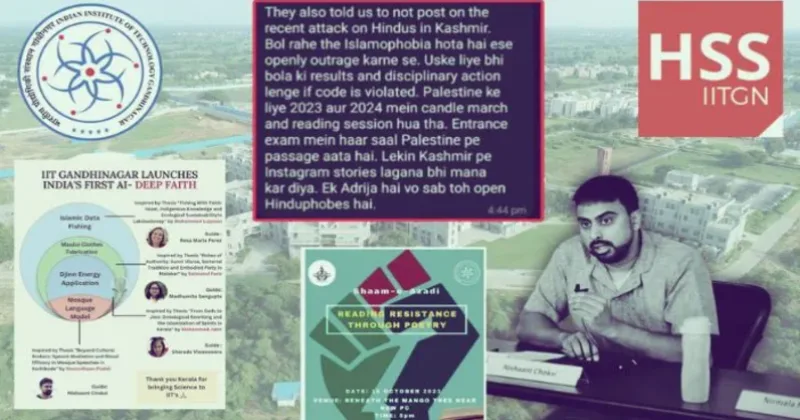
The recent controversy at IIT Gandhinagar has sparked intense debate, particularly regarding the MA Society and Culture program of the Humanities and Social Sciences (HSS) department, with its project ‘DeepFaith’ under severe scrutiny. The above concerns that the thesis subjects concerning Islamic cultural practices in the states like Kerala and Lakshadweep serve as a facade to influence radical Islamic theology diverting the focus from Hindu concerns while creating a biased, antagonistic environment against Hindus. Critics, further amplified by the likes of social media platforms X, identify intimidation faced by Hindu students in raising such issues and protests against these activities, like condemning the Pahalgam attack, as indicators of an agenda that can broadly be termed as “academic jihad.” These accusations were covered by media news outlets, including the Ahmedabad Mirror, dated May 3, 2025, referring to four specific thesis topics charged with romanticising Islamic rituals without touching Bharat’s Sanatan heritage. Further, it raises questions regarding aligning the department with the broader technical and nationalist ethos of the IIT.
However, no story is free from counterpoint. IIT Gandhinagar’s Director, Prof Rajat Moona, has defended the program, saying that the theses given in this cohort among 40 MA students are not endorsements of any ideology though they are legitimate academic inquiries into literature, attire and cultural practices. The HSS department, supposed to promote interdisciplinary research, claims that such studies are in keeping with global trends in digital humanities and AI-driven cultural analysis, according to their statements. Unfortunately, a project has been cleared without due transparency, and the alleged suppression of dissenting Hindu voices kindled suspicion; some have gone so far as to accuse it of violating the principle of samatva-cum-equality enunciated in the Dharmashastra by favouring the narrative of one community. The case in question holds out promise of revealing deeper tensions: freedom of the academy versus Hindu identity of Bharat, a concern rooted in the Indic jurisprudence’s call for institutions to uphold rajdharma—governance that protects cultural unity.
The bigger cultural clash is evident in the leading universities of Bharat. The Arthashastra states that sovereignty, so far internal, may be jeopardised. The critics see the deeds of the HSS department as consisting of subtle erosion of the Hindu swabhiman (self-respect), reminiscent of the ideological imposition battles in history. Social media posts on X, inflammatory as they tend to be, galvanised nationalist sentiments that demanded reforms to ensure that IITs are bastions of rashtrabhakti, or national devotion. Strong echo of the Hindi ethos of sanskriti ka sanrakshan resonates with the urging administration to probe allegations, restore meritocratic standards, and realign research with Bharat’s pluralistic but Hindu-rooted heritage so the intellectual gurukuls do not lose their sacred purpose.
Sanskriti ka sanrakshan-this is the Hindi phrase that sums up the urgency of this juncture-the- the preservation of culture. This is the bedrock of Bharat and, therefore, Hindu Dharma emphasises satyam, dharma, ahimsa. Still, the furtherance of Islamic-centric inquiry in a premier institution like an IIT is a sure means of legitimisation of some narratives historically considered counter this ethos. The Islamic conquests in medieval India brought on the entire destruction of temples and the imposition of jizya, leaving indelible scars on the psyche of Hindus. It is now when the very subtle infiltration of Islamist sympathies under layers of academic spaces increases the chances of opening these wounds afresh and alienating Hindu students and weakening their resolve to defend their faith against those who wish to undermine it. The interests that the HSS department promotes through such research, while concomitantly professing indifference to Hindu perspectives, is a betrayal of IITS’ role to serve the nation.
Indian jurisprudence, whose roots lie in texts like Dharmashastras and Arthashastra, might thus offer a basis for understanding this crisis of ours. The Dharmashastras, together with Manusmriti, insist on a very interesting line: the responsibility of institutions to uphold dharma, the cosmic order sustaining society. In other words, an institution such as IIT takes on an obligation to push knowledge that enables national unity and culture pride. Kautilya’s Arthashastra tells how vigilant one should be against threats to sovereignty from within, including ideological subversion. Programs which favour only one religious narrative over others break these principles: they raise discontent and compromise the integrity of the state. The actions of the HSS department in promoting Islamic theology while relegating Hindu contributions and justifying set ideas contravene the spirit of Indic jurisprudence, which seeks balance, fairness, and loyalty to Bharat’s civilizational ethos.
At the heart of this controversy lies the plight of Hindu students. IITs represent the aspirations of millions who wish to forge ahead in life in equal measure with them. These young men and women have earned this opportunity from the IITs after passing the arduous Joint Entrance Examination (JEE). Treading the path of tapasya, which stands for valiant disciplined effort in the Hindu scriptures, these students dream of channelising their energies into building a prosperous and self-reliant Bharat. In their own institution, however, they have to live in an environment hostile to their faith and values. According to reports, Hindu students have been silenced or intimidated for raising questions about the pro-Islamic tilt of the research in Humanities and Social Sciences or for condemning acts of terrorism in the name of radical ideologies. Such suppression is not only an attack on freedom of expression but also an assault on Hindu Dharma, which teaches satyam vada dharmam chara—speak the truth and follow righteousness.
The term swabhiman i.e self-respect, carries a deeper relevance here. Hindu students inspired by such personalities as Swami Vivekananda, who is a proponent of pride in India’s spiritual legacy, are denied the right to uphold their swabhiman. Punishing Hindu students for standing up for their faith or expressing solidarity with terror victims sends a chilling message: that dedication to Bharat and Sanatan Dharma is never welcome in their very own institutions. This amounts to a kind of cultural violence, echoing persecution inflicted upon Hindus in history acts of foreign rule. The Bhagavad Gita declares that dharma rakshati rakshitah—dharma guards those who protect it. The department, by silencing Hindu voices, would not only serve to betray its own students but also to hasten a decline of the very values that have cherished Bharat.
An increase in the number of these departments has worsened tensions. These originally supportive departments in technical education are now wider than originally intended, with MA and PhD programs whose faculty and students have mixed loyalties. While an engineering student earns his place by a rigorous meritocratic way, many humanities students take the pliable paths into lesser competition, casting the prevailing perception of dilution of standards. Such differences breed bitterness among undergraduates, who believe the IITs as sacred spaces for excellence. And the admission of faculty with radical leanings, some professedly sympathisers to a globalist or Islamist agenda, has turned these departments into fields of ideological warfare. What seems missing in such lines is rightly that the Hindi phrase vidya vinay deti-knowledge bestows humility from those who use academic platforms for propagating divisive narratives, angsting against the unity of Bharat.
The stakes are very high for Hindu Dharma. Bharat is under existential threat from various fronts-demographic changes fueled by uncontrolled migration, conversion through aggressive mission work, and the rise of radical Islam. The IITs, being the bastions of intellect, should lead in confronting Sanatan Dharma’s enemies rather than aiding them. With the HSS department supporting Islamic-centred study, it thereby stands a chance to normalise ideas antagonistic to Hindu way of life, with the possibilities of creating a united front to inculcate and polarise innocent minds in this regard. Don’t forget that the Ramayana teaches the need for constant vigilance because Lord Rama remained watchful against Ravana’s deceptions. Today, Hindus must show similar determination, knowing that the battle for their culture is fought not only on territory but within classrooms.
Indic jurisprudence provides a sort of roadmap for resolving the present crisis. The Yajnavalkya Smriti, one of the important Dharmashastras, emphasises the place of education in upholding satyam and dharma. Educational institutions must stand as protectors of truth, thereby making sure knowledge promotes rather than destabilises social harmony. The inability of the HSS department to balance its research agenda according to this principle—one that favours one community’s narrative over general good—is unacceptable. Kautilya’s Arthashastra forewarns rulers that threats arising from within the fold should be defused, either through dialogue or direct action. For the IITs, this means excising ideological demons and restoring allegiance to the nationalist vision of Bharat. Rajdharma-the duty of governance- compels the administrators to take prompt action to ensure the protection of Hindu students and uphold the sanctity of these institutions.
The social media platform, that is, X, has, to a large extent, played a role in the exposition of this crisis. Anonymous posts and patriotic voices have unveiled the actions of the HSS department, which led to the nationwide uprising. However, social media sometimes acts as a two-sided knife, increasing the circulation of truth as well as misinformation. The rapid dissemination of claims about “academic radicalisation” has aggravated communal tensions, which indicates that discourse must be responsible. These discussions must be anchored in the advice of the Hindi proverb satya ka saath do—stand with the truth—so that all criticism of the HSS department is based on evidence and aimed toward constructive reform. Hindu students and alumni should therefore unite on these platforms to defend their Dharma against narratives intended to divide, inspired by the Rig Veda’s edict of ekam sat (truth is one).
This betrayal of the founding ideals of the IITs is particularly grievous, as these institutions now have the task of nurturing the future of Bharat. The very existence of these institutions stands upon the sacrifice of countless Hindus who envisioned a nation free of foreign domination and cultural erosion. The teachings of the Gita regarding nishkama karma—selfless action—should inspire administrators, faculty, and students in carrying out their duties without fear or favor, keeping the greater good at heart. It would indeed betray this legacy should the HSS department serve as a shopfloor for Islamic radicalization; and this development threatens to change the IITs into battlegrounds of civilizational conflict. The Hindi phrase, rashtrabhakti, which stands for devotion to the nation, should preside over their actions to prevent the institutions from diverging from their historic mission.
Reclaiming the IITs requires multiple strategies based on the concepts of Hindu Dharma and Indic jurisprudence. First, the content in the HSS curriculum that politicizes in the name of that or any other Islamic brand should be removed. The curriculum should then support research on Bharat’s culture and heritage, including the contributions of sages like Ramanuja, who combined philosophy and devotion, or Bhaskaracharya, who through his mathematical ability laid the foundation for modern science. Research into Islamic practices is fine and needed, but that must be complemented with research into Hindu traditions so as not to exclude anyone. Dharmashastras teach the principle of samatva—equality and no position in which one community’s narrative prevails over another.
Secondly, IITs must create an atmosphere where students can practice their faith and patriotism without much fear and rather be inspired by the call of satyam, dharmam, shivam in the Taittiriya Upanishad. The faculty should face stringent consequences as prescribed under the principles of accountability as stated in Kautilya, if they intimidate and silence students for the sake of upholding Dharma. Such campus forums, inspired by the ancient tradition of shastrartha, could create a safe space for dialogue as students would be able to voice their concerns and propose solutions.
Thirdly, the process of admission in the HSS programs should also be reformed such that it is consonance with the meritocratic standards existing for JEE. Arthashastra, for example, puts the competence condition of holding any authority, and the IITs must see to it that this condition of the competent-ness for holding any authority applies also for the students taking admission into these programs. This will discourage the non-representatives from using easy ways to prove advancement for communal agendas, affecting trust on the part of students and alumni. Quality-the Hindi word gunvatta-with regard to admissions or research, must define everything about the IITs.
Fourthly, faculty composition in HSS departments must embody the nationalist ethos of Bharat. Recruiting scholars with a foundation in Hindu values who understand the importance of Sanskriti and Dharma will help to keep in line with the teaching and research work of the IITS’ mission. The Vishnu Purana states that knowledge exists for the upliftment of society, and faculty, as role models, must bring this idea alive to generate an environment of pride in Bharat’s cultural heritage. International collaborations with a worthy purpose are, nevertheless, to be examined stringently in order to avoid unwarranted `imports’ of anti-Hindu ideologies: a concern Kautilya voiced about foreign influences undermining sovereignty.
The IITs need to take matters into their own hands with respect to social media, participating proactively to modify the narrative. By lending a voice to Hindus and by showcasing research celebrating Sanatan Dharma, IITs can stand against propaganda and develop a stakeholder constellation. The ethos in the Rigveda that invokes sangachhadhwam—let us move together—can inspire unyielding effort to redeem the sanctity of the IITs. Accountable for the nationalism-inspired unity would be the unending sufferings of the IITs, which now seek a collaborative effort spearheaded by various organisations.
The IITS are not mere institutions; they are the Custodians of modern India’s dreams, and now take upon themselves the duty of paving the way for a generation that shall steer this nation towards greatness. This will be such a monstrous betrayal of the sacrifices that Hindus made in fighting to preserve this land’s Sanatan identity if they allow these bastions to serve as conduits for Islamic radicalisation. Yuddhasva vigatjwarah—the call of the Gita—fight without a fever, disallows us to act decisively, free from doubt or hesitation. Cleansing ideological biases, protecting Hindu students, and restoring the IITs’ alignment with Hindu Dharma is the way forward to safeguard that these institutions remain true to their purpose. United, we invoke the light of Sanatan Dharma to renew our intellectual bastions and save Bharat’s tomorrow under the beacon of truth, right, and unity.
The IIT Gandhinagar debacle deserves attention, as it sets in motion the cry for the reclamation of the intellectual spaces of Bharat from the subversive schemes of Islamic radicalisation that threaten to turn these spaces into strongholds of Hindu Dharma and their pride. Let us be determined to rid these institutions of sham scholars who sow seeds of discord under the praiseworthy cover of scholarship and turn against our Sanatan heritage. By expelling the destructive influences of namskara from these institutes, the route is made easy in an environment of harmony and meritocracy with the guidance of Arthashastra against threats to internal security. In this sacred mission, may we stand together for the sake of the Hindi soul of shanti aur ekta, creating a society where everyone lives in peace, devoid of the shadow of radical ideologies, and the light of Hindu Dharma shines upon Bharat’s pathway to greatness.













Comments