





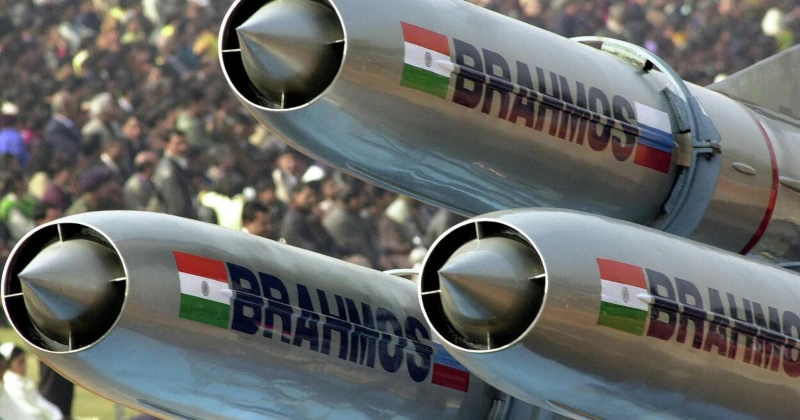
When the thunder of BrahMos missiles pierced the silence of early dawn across the Line of Control during Operation Sindoor, it wasn’t merely the sound of metal tearing through the atmosphere — it was the loud proclamation of Bharat’s unrivaled tactical supremacy. In a conflict that saw a hostile neighbour miscalculate and pay a heavy price, BrahMos emerged not just as a missile, but as a symbol of decisive power and unmatched precision. This is the untold, hard-hitting story of how the Indo-Russian joint venture weapon — a marvel of modern warfare — shaped the course of the brief but brutal Bharat -Pakistan war during Operation Sindoor.
Origins: A missile born out of necessity and strategic vision
In the aftermath of the Kargil conflict in 1999 and years of asymmetric warfare with Pakistan, the Indian defence establishment recognised the need for a rapid-response, supersonic cruise missile system that could strike deep into enemy territory with surgical precision. The result was BrahMos — a fusion of Russian propulsion mastery and Indian software and targeting genius. BrahMos, derived from the names of Brahmaputra and Moskva rivers, became operational in 2005.
With a speed of Mach 2.8 to 3.0, a range that was originally capped at 290 km (now extended beyond 450 km post Bharat’s MTCR entry), and a payload of 200-300 kg, BrahMos was tailor-made for blitzkrieg-style deterrence. By 2025, DRDO had successfully tested extended-range variants capable of pinpoint accuracy up to 800 km, transforming BrahMos from a tactical to a strategic gamechanger.
By late 2024, tensions between Bharat and Pakistan had escalated following repeated provocations along the LoC and a terror attack on Indian soil that intelligence linked directly to ISI-backed proxies. Despite international calls for restraint, Pakistan mobilised its armoured brigades near Bhimber, and Indian satellite imagery detected logistical movements indicating pre-emptive war plans.
The Indian Armed Forces launched Operation Sindoor — a meticulously planned tri-services operation. The strategic objective was clear: degrade Pakistan’s forward bases, logistics supply chains, and key military infrastructure within 72 hours, forcing a ceasefire without escalating into nuclear brinkmanship. And at the heart of this operation lay the BrahMos missile.
D-Day: BrahMos strikes first and fast
On Day 1 of Operation Sindoor, BrahMos was unleashed in a wave of calculated saturation strikes. Within the first three hours, over 48 missiles were launched from mobile land-based platforms, Su-30MKI fighter aircraft, and even naval destroyers in the Arabian Sea.
Key targets included:
- Sargodha Airbase: Pakistan’s Western Air Command hub. BrahMos cruise missiles evaded radar, destroyed two hangars housing F-16s, and cratered runways within 4 minutes.
- Skardu Garrison: Vital for logistics to Gilgit-Baltistan. BrahMos shattered ammunition depots, paralyzing forward supply.
- Chaklala Military HQ (Rawalpindi): A deep-strike variant of BrahMos launched from Su-30MKIs penetrated Pakistani airspace at treetop height, striking the HQ’s communications array.
- Gwadari Naval Outpost: Pakistan Navy’s western-most early-warning node. A BrahMos Block-III with top-attack trajectory demolished radar and sonar installations, blinding Pakistani maritime monitoring.
In each case, the missile’s 2.8 Mach velocity and low-altitude trajectory rendered interception virtually impossible. Pakistani forces had no response mechanism that could match the missile’s speed, accuracy, and surprise factor.
Tactical Superiority: BrahMos in Joint Operations
Operation Sindoor was not merely a display of Bharat’s offensive might, but of inter-services synergy. BrahMos was used in tandem with:
- Air strikes by Rafale and Tejas aircraft, which jammed Pakistani radars and dropped precision-guided munitions on secondary targets.
- Parachute Regiment Special Forces teams, who confirmed post-strike damage via encrypted satellite uplinks.
- INS Visakhapatnam and INS Kolkata, which launched BrahMos missiles as part of a naval pincer maneuver off the Karachi coast.
This orchestration ensured that BrahMos not only destroyed targets but also created corridors for deep troop movement, unimpeded by enemy radar or artillery response.
Pakistan’s Collapse: Intelligence and communications paralysed
By Day 2, the Pakistan Army was in disarray. Satellite intel confirmed mass troop withdrawals from forward posts. Radio intercepts revealed that the army had lost command and control over at least three infantry divisions. Panic spread through Islamabad’s war rooms as military brass realised Bharat’s new warfare doctrine had evolved beyond mere retaliation.
The psychological impact of the BrahMos strikes was profound. Pakistani news channels, despite ISPR censorship, could not hide the images of burning bases and twisted metal. Civilian morale plummeted as BrahMos became a household term — feared and respected alike.
By the end of Day 3, with over 72 BrahMos missiles launched and more ready in reserve, Pakistan’s strategic depth was compromised. The threat of further BrahMos strikes on sensitive facilities in Lahore and Karachi forced the Pakistani leadership to request international mediation.
Bharat, having achieved its tactical objectives with minimal casualties, declared a unilateral ceasefire. Operation Sindoor was over — a success by every military metric.
Why BrahMos was the deciding factor
- Speed and Surprise: No Pakistani air defense system — including their Chinese-made HQ-9 equivalents — could intercept a BrahMos once launched.
- Precision with Minimal Collateral Damage: This allowed Bharat to hit military targets while avoiding civilian casualties, crucial for diplomatic optics.
- Multi-platform Deployment: Land, sea, and air variants created a 360-degree threat environment.
- Interoperability: Enabled swift deployment by the Army, Navy, and Air Force without overlap.
- Psychological Warfare: The very mention of BrahMos created fear in the Pakistani ranks.
Post-Operation Sindoor, Bharat’s global defence credibility soared. Nations in Southeast Asia and Africa renewed interest in BrahMos exports. The Philippines, already a buyer, fast-tracked its second order. Vietnam, UAE, and even Brazil initiated procurement talks.
China, observing the surgical effectiveness of BrahMos, recalibrated its South China Sea deployments. The US Defence Department released a white paper stating: “BrahMos is not just a missile; it is a force-multiplier.” Pakistan, on the other hand, faced unprecedented internal turmoil. The military’s failure to protect critical assets led to mass resignations and a full-scale parliamentary inquiry.
BrahMos Beyond 2025: Future Frontiers
As DRDO and BrahMos Aerospace work on the next generation BrahMos-II (hypersonic, Mach 7+), the success of Operation Sindoor has already redefined Bharat’s war doctrine — from defensive posturing to precision proactive strikes. The missile’s lighter variants, submarine-launched configurations, and AI-integrated guidance systems are expected to be operational within the next three years.
Bharat’s plan to equip all frontline Tejas and Rafale squadrons with air-launched BrahMos variants is now underway. A new doctrine of ‘Strategic Saturation Strike’ based on BrahMos will soon be adopted by the Integrated Defence Command.
Lucknow: The Unsung Node in the BrahMos Triumph
The Lucknow facility, sprawling across 80 hectares of land provided free of cost by the Uttar Pradesh government, stands as a high-stakes collaboration between India’s Defence Research and Development Organisation (DRDO) and Russia’s NPO Mashinostroyeniya, under their joint venture BrahMos Aerospace. With an investment of Rs 300 crore, the project has transitioned from blueprint to reality in just four years a feat rare in India’s public sector defence timelines.
The facility here is more than just an assembly line. It houses the Strategic Materials Technology Complex, producing titanium and aerospace-grade superalloys vital for next-gen weapons. A new Defence Testing Infrastructure Scheme (DTIS) site also serves as a national-level proving ground for indigenous systems, reinforcing Lucknow’s strategic importance.
Together, these infrastructures aim to transform Uttar Pradesh into a critical node on Bharat’s defence manufacturing map — rivaling global centres of military innovation. The BrahMos unit, at full capacity, is expected to employ over 5,000 skilled workers and generate business for dozens of MSMEs and component suppliers. This is defence modernisation with national security and socio-economic dividends rolled into one.
The story of BrahMos is not just about one missile system. It is the evolutionary outcome of Bharat’s Integrated Guided Missile Development Programme (IGMDP), launched in the 1980s under Dr APJ Abdul Kalam, which gave Bharat the Agni, Prithvi, Akash, and Nag missiles. BrahMos was designed to meet the battlefield’s most urgent need — precision, range, and speed — and it has exceeded all expectations.
From naval anti-ship variants to land-based mountain warfare versions, and from air-launched cruise missiles to future submarine-launched systems, BrahMos remains Bharat’s most versatile and deployment-ready strike platform. With over 70 per cent indigenous components in the latest versions, it has become a global benchmark and a flag-bearer of the Make in Bharat initiative.
Following its reported use during Operation Sindoor on May 10 in retaliation to Pakistani aggression the world is now watching BrahMos closely. It has demonstrated what Bharat’s defence preparedness looks like when powered by indigenous innovation and strategic clarity.















Comments