





A day after India and Pakistan agreed to halt military operations, top Indian military officials held a detailed press briefing on Sunday (May 11) evening at the National Media Centre in New Delhi, shedding light on the Indian Navy’s critical role in compelling Pakistan to request a stoppage of firing. The briefing, led by Director General of Military Operations (DGMO) Lieutenant General Rajiv Ghai, Air Marshal A.K. Bharti, Director General of Air Operations, and Vice Admiral A.N. Pramod, Director General of Naval Operations, revealed for the first time the deployment of Indian Navy assets in the northern Arabian Sea, close to the Pakistani coast, as part of Operation Sindoor.
Indian Navy’s Full Combat Readiness in the Arabian Sea
Vice Admiral A.N. Pramod disclosed that the Indian Navy had deployed its Carrier Battle Group (CBG), surface forces, submarines, and aviation assets in the northern Arabian Sea with “full combat readiness” following the April 22, 2025, terror attack in Pahalgam, Jammu and Kashmir, which targeted civilians and was attributed to Pakistani-sponsored terrorists.
“In the aftermath of the cowardly attack on innocent tourists at Pahalgam, Jammu and Kashmir, by Pakistani-sponsored terrorists on April 22, the Navy’s Carrier Battle Group, surface forces, submarines, and aviation assets were immediately deployed at sea with full combat readiness in consort with the joint operation plan of the Indian Defence Forces,” Pramod stated.
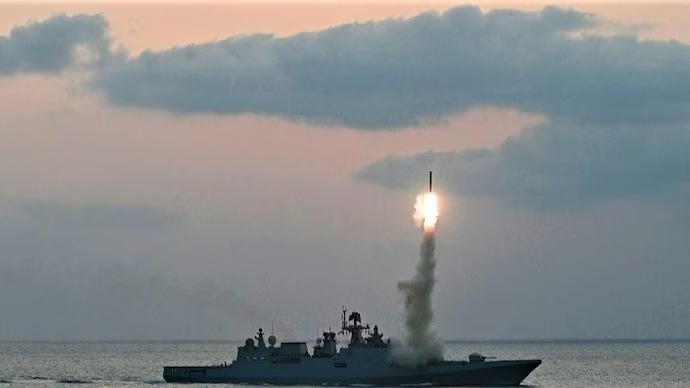
Within 96 hours of the attack, the Navy conducted live-fire drills to ensure operational readiness.
“You may be aware that we tested and refined tactics and procedures at sea during multiple weapon firings in the Arabian Sea within 96 hours of the terrorist attacks. The aim was to revalidate our crew, equipment, ordnance, and platform readiness to deliver various ordnance on selected targets precisely,” Pramod elaborated.
These drills were part of a broader strategy to maintain a “decisive and deterrent posture” with the capacity to strike select targets, including the Pakistani port city of Karachi, at a time of India’s choosing.
Naval Dominance and Pakistani Defensive Posture
The Indian Navy’s forward deployment in the northern Arabian Sea significantly altered the operational dynamics, forcing Pakistani naval and air units into a defensive stance.
“The forward deployment of the Indian Navy compelled the Pakistani naval and air units to be in a defensive posture, which we monitored continuously,” Vice Admiral Pramod noted.
He emphasised that the Navy maintained “continuous marine dominance” throughout the operation, with full awareness of the location and movement of Pakistani units, most of which remained confined to harbours or close to the coast.
Pramod underscored the Navy’s operational edge as a decisive factor in Pakistan’s decision to seek a stoppage of firing.
“Along with the kinetic actions by the Indian Army and Indian Air Force, the overwhelming operational edge of the Indian Navy at sea contributed towards Pakistan’s urgent requests for a stoppage of firing yesterday,” he said.
The Navy’s readiness to strike targets, including Karachi port, was a key element of this strategy. “Our forces remained forward deployed in the northern Arabian Sea in a decisive and deterrent posture with full readiness and capacity to strike select targets, including Karachi, at a time of our choosing,” Pramod added.
Operation Sindoor: A Proportionate yet Firm Response
Operation Sindoor, launched in response to the Pahalgam terror attack, involved precision strikes by Indian forces on nine terror camps across Pakistan and Pakistan-occupied Kashmir, eliminating over 100 terrorists, according to official figures. These strikes were followed by shelling and drone incursions from Pakistan, to which the Indian Army responded in kind, keeping escalation within manageable limits.
Despite the aggressive posture, Vice Admiral Pramod emphasised that India’s response was “measured, proportionate, non-escalatory, and responsible from day one.”
Sources told news agency ANI that Operation Sindoor remains active, with India informing all countries in contact after the terror attack that New Delhi will respond decisively to any future provocations by Pakistan.
“If Pakistan fires, we fire – this is the new normal,” the sources noted. When asked directly about India’s preparedness to strike Karachi in the event of escalation, Vice Admiral Pramod was unequivocal: “If Pakistan dares take any action, it knows what we are going to do.”
Ongoing Deterrence in the Arabian Sea
Even after the stoppage of the firing agreement, the Indian Navy remains deployed in the Arabian Sea to deter potential threats. “As we speak, the Indian Navy remains deployed at sea in a credible deterrent posture to respond decisively to any inimical action by Pakistan or Pakistan-based terrorists,” Pramod stated.
This sustained presence underscores India’s resolve to maintain vigilance and readiness in the wake of the April 22 attack.
The briefing highlighted the coordinated efforts of India’s armed forces in responding to the Pahalgam attack and the Navy’s pivotal role in shaping the strategic outcome. As tensions with Pakistan remain high, the Indian military’s message is clear: any further provocations will be met with a swift and decisive response.













Comments