





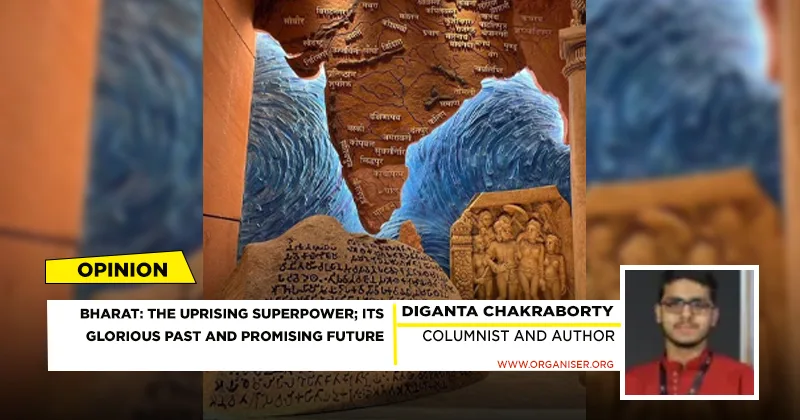
We live in a time when our nation is at the centre of global attention. Superpowers like the United States and Russia are now compelled to recognise India as a rising and influential force on the world stage.
As the world hurtles toward a new global order, one ancient nation is steadily, confidently reclaiming its place at the high table of global power—Bharat, known to the modern world as India. Once the beacon of philosophy, science, art, and prosperity, Bharat has emerged from centuries of subjugation and rediscovered its strength. With rapid economic growth, technological leadership, and a rich cultural legacy, India is not only a rising power but a resurging civilisation. Long before the rise of modern Western states, Bharat was known across continents as the cradle of advanced human thought. The Indus-Saraswati Civilisation, one of the world’s oldest, boasted urban planning, trade systems, and social organisation. The Vedic Age laid the philosophical foundation of Sanatana Dharma, encompassing universal values such as non-violence, truth, and unity in diversity.
Will Durant, the renowned American historian, once wrote:
“India was the motherland of our race and Sanskrit the mother of Europe’s languages… She was the mother of philosophy… mother of ideals embodied in Christianity… Mother India is in many ways the mother of us all.” Indologist Max Mueller reflects a similar strain: “If I were asked under what sky the human mind has most fully developed some of its choicest gifts, has most deeply pondered on the greatest problems of life, and has found solutions, I should point to India.”
Bharat’s intellectual output was unparalleled from Ayurveda and Yoga to mathematics and astronomy. Scholars like Aryabhata, Bhaskara, Patanjali, Sushruta, and Charaka shaped the very foundations of global knowledge systems. The universities of Takshashila and Nalanda were international learning centres long before Oxford or Cambridge existed. Sri Lankan, Chinese, Persian, and Greek travellers wrote admiringly of Bharat’s governance, education, and spiritual depth. Despite its brilliance, India became a victim of successive invasions, culminating in the British Raj, which systematically dismantled its economy, culture, and education systems. In 1700, India held 24% of the world’s GDP, according to economic historian Angus Maddison. By 1947, it was down to less than 3%. British colonisation drained resources and created a psychological dislocation, replacing native pride with subservience.
Mahatma Gandhi rightly described this condition as: A nation that has lost its soul lives a life worse than death.
But even in its lowest moments, Bharat never lost the spark of resilience. From the Swadeshi movement to spiritual reformers like Vivekananda, Sri Aurobindo, and Rabindranath Tagore, the call for swaraj—political and civilisational—continued to echo.
In 1947, India’s per capita income was a mere $64. Today, Bharat is the fifth-largest economy by nominal GDP (IMF, 2024), with projections to reach third position by 2027, behind only the U.S. and China.
As Christine Lagarde, former IMF chief, observed: India is a bright spot in the global economy. According to the World Bank, India lifted over 415 million people out of poverty between 2005 and 2021. The Startup India mission has catalysed over 100 unicorns, making Bharat the third-largest startup ecosystem in the world.
India’s foreign policy, especially under its recent leadership, has become a model of strategic autonomy. Unlike Cold War alignments, Bharat now speaks the language of multipolar balance. Its principled stance in conflicts like Russia-Ukraine and leadership in the Global South Summit showcase this maturity. Hosting the G20 Summit in 2023 was not merely symbolic—it was substantive. India successfully pushed for the inclusion of the African Union as a permanent member and emphasised themes of sustainability, digital inclusion, and women-led development.
As External Affairs Minister Dr. S. Jaishankar aptly observed, “India is a civilisational state exercising global responsibilities, not just global rights.” In the preface of his seminal book Why Bharat Matters, he notes: “A New India, indeed an India that is able to define its own interests, articulate its own positions, find its own solutions and advance its own model. In short, this is an India that is more Bharat.”
India’s space journey began humbly in 1969 with borrowed equipment and bicycle transport of satellites. Today, the Indian Space Research Organisation (ISRO) is among the most respected space agencies globally. With Chandrayaan-3, India became the first nation to land on the Moon’s south pole. Plans for the Gaganyaan human spaceflight, deep-space exploration, and a space station are underway.
According to the press Information Bureau report, in October 2024, Unified Payments Interface (UPI) achieved a historic milestone by processing 16.58 billion financial transactions in a single month, underscoring its pivotal role in India’s digital transformation. Launched in 2016 by the National Payments Corporation of India (NPCI), UPI has revolutionised the nation’s payment ecosystem by integrating multiple bank accounts into a single mobile application. The World Bank, in its 2023 report, lauded India’s digital public infrastructure as a model for the world.
Bharat’s defence capabilities have witnessed remarkable growth in recent years, marked by a decisive shift towards indigenisation and strategic exports. Today, India exports defence equipment to over 70 countries, reflecting its emergence as a reliable global defence partner. Guided by the vision of Atmanirbhar Bharat, the nation is transitioning from being one of the world’s largest arms importers to becoming a net exporter of advanced military technology.
This transformation is not merely material—it also signals a deeper civilisational confidence. India’s strength in defence has increasingly drawn international attention. Reflecting on India’s enduring influence, Hu Shih, the renowned Chinese diplomat, scholar, and philosopher, once observed: “India conquered and dominated China culturally for 20 centuries without ever having to send a single soldier across her border.”
Bharat’s soft power—rooted in culture, language, spirituality, and heritage—is finding new global resonance. Now practised by over 300 million people worldwide, yoga has been immortalised through the International Day of Yoga, celebrated every June 21. Indian cinema, cuisine, classical music, dance forms, and festivals are now global. From Hollywood to Haridwar, Indian values like mindfulness, vegetarianism, and holistic health shape international discourse. Nobel laureate and eminent French scholar Romain Rolland once said, “If there is one place on the face of the Earth where all the dreams of living men have found a home… It is India.”
Sri Aurobindo, envisioning Bharat’s spiritual and civilisational destiny, wrote: “India is rising. Not to copy Europe but to be herself and to give the message of her soul to the world.” That message is one of Dharma, global harmony, and universal oneness. In an era marked by ecological crises, spiritual voids, and rising political polarisation, Bharat offers not merely an alternative, but a timeless and futuristic civilisational path. The resurgence of Bharat is not a historical accident—it is the reawakening of a civilisation that once lit the path for the world and is now poised to do so again. Its rise is not rooted in conquest or dominance, but in contribution, anchoring a delicate balance between science and spirituality, economic growth and ethical responsibility, strength and compassion.
As Swami Vivekananda passionately declared: “Let New India arise—out of the peasant’s cottage, grasping the plough; out of the huts of the fisherman, the cobbler, and the sweeper. Let her emanate from the factory, from marts and from markets, and from groves and forests, from hills and mountains.”
Today, that vision is becoming a reality. Bharat is rising vertically in power and horizontally in inclusivity, from every corner and class across its vast social and geographical spectrum. The collective awakening of a nation carries the soul of a civilisation.












Comments