





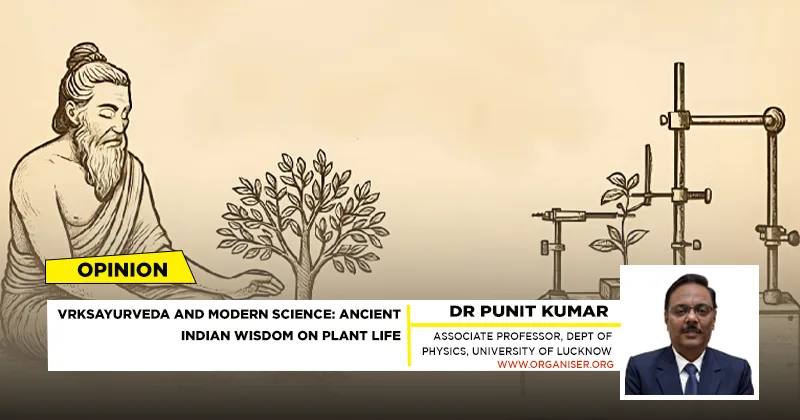
The ancient Indian treatise Vrksayurveda offers a sophisticated and holistic understanding of plant life. Attributed to Surapala, a renowned scholar of the 10th century CE, this work presents a rich repository of knowledge on tree anatomy, health, nourishment, reproduction, disease management, and ecological importance. Long before modern biology acknowledged plants as living, reactive organisms, Indian sages articulated a view of trees not just as biological specimens, but as sentient beings integral to life and cosmic balance.
The very term Vrksayurveda (वृक्षायुर्वेदः) literally translates to ‘Ayurveda for trees’. Just as Ayurveda deals with the health and wellness of humans, Vrksayurveda applies similar principles to the world of plants. The core philosophy of the text is captured in this revolutionary verse :
“यथा पुरुषस्य औषधोपचारः तथैव वृक्षस्य।”
(As there is medicine for humans, so there is for trees)
— Vrksayurveda, Verse 6
This declaration reflects a scientific and empathetic outlook. Trees are portrayed not as inert wood, but as living patients who can experience disease, pain, and healing. The text treats the plant body with the same seriousness as the human body, detailing the root (mūla), trunk (kāṇḍa), bark (tvac), leaves (patra), flowers (puṣpa), and fruits (phala), each with diagnostic and therapeutic relevance.
Surapala offers guidelines on the ideal time and method of planting, as well as choices of land based on soil type, sunlight, water sources, and astrological considerations. Soil preparation and organic manuring are explained with precise recipes involving cow dung, ash, sesame oil, milk, and decoctions made from herbal leaves. The following verse underlines the importance of ritual, purity, and intention in plant growth :
“शुचिर्भूमिप्रदेशः, मन्त्रजलं सिंचनं च वृक्षवर्धनाय भवेत्।”
(A clean area, sanctified water, and chanting of mantras help trees flourish)
— Vrksayurveda, Verse 12
Notably, the treatise describes grafting (samropaṇam), budding, rejuvenation, and treatment of diseased trees. Techniques of wound healing using herbal pastes, application of protective coatings, fumigation with natural resins, and the use of insect repellent plants like neem are also given. Here is a verse showing early recognition of plant pathology :
“दुष्टं पत्रं पीतवर्णं, लोहितं वा स्रवेद्रुधिरं च।”
(Diseased leaves turn yellow, red, or ooze sap like blood)
— Vrksayurveda, Verse 50
The Vrksayurveda reflects not only a technical understanding, but also a spiritual reverence for trees. The Atharvaveda, much earlier, also regarded plants as divine entities :
“वनस्पते नमस्ते अस्तु, यं त्वं बिभर्षि तेन नः पाहि।”
(O tree, salutations to you. May that with which you sustain life protect us)
— Atharvaveda, 5.4.3
In ancient India, trees like Asvattha, Banyan, and Tulsi were worshipped and considered sacred. This was not merely symbolic, it emerged from a recognition of their ecological, medicinal, and psychological significance.
This holistic view of plants is echoed in the Manusmṛti, which equates a tree’s value with the lives of many :
“दशकूपसमा वापी, दशवापीसमो ह्रदः।
दशह्रदसमः पुत्रो, दशपुत्रसमो द्रुमः॥”
(A pond equals ten wells, a reservoir ten ponds, a son ten reservoirs, but a tree equals ten sons)
— Manusmṛti, 3.284
These insights, preserved in the Vedic and Ayurvedic tradition, anticipated several concepts that modern science is only now beginning to validate.
Modern Scientific Rediscovery of Ancient Truths
In the modern era, it took centuries of botanical research before science came to terms with the idea that plants are living, sensing, and responsive organisms. For a long time, Western science considered plants as passive, lacking a nervous system and sensory organs. This view began to change significantly with the pioneering work of Sir Jagadish Chandra Bose in the early 20th century.
Using his invention, the Crescograph, Bose demonstrated that plants exhibit electrical responses, heartbeat like pulsations, and even pain sensitivity when injured. He showed that plants sleep, get tired, respond to stimuli, and can even be anesthetised. His conclusion was deeply influenced by Indian philosophy :
“There is no absolute dividing line between the living and the non-living.”
— Sir J.C. Bose, 1902
Bose’s findings reflect the very essence of Vrksayurveda. The idea that trees suffer when wounded and can recover with care was already present in the ancient texts :
“वृक्षाः पीडां प्रयान्ति, शुष्यन्ति, रुधिरं स्रवयन्ति च।”
(Trees suffer pain, wither, and bleed)
— Vrksayurveda, Verse 49
Today, plant biologists have discovered that trees communicate via chemical signals, send alarm messages through root networks, and even release airborne volatile organic compounds to warn neighbouring plants of pests. This emerging field of plant neurobiology studies how plants process environmental information, much like a decentralised nervous system.
Recent experiments with Mimosa Pudica (touch-me-not) show that plants can learn, remember, and even adapt their responses to harmless stimuli. This aligns with ancient beliefs about the impact of mantras, intentions, and emotional care on plant growth, as expressed in Vrksayurveda. Moreover, practices such as organic farming, crop rotation, and soil enrichment using compost and biofertilisers, now promoted in sustainable agriculture have roots in ancient Indian methods. The detailed instructions in Vrksayurveda about land type, seasonal planting, and ecological balance predate current environmental sciences by centuries.
Even the modern understanding of phytotherapy, or the use of plants in medicine, finds echoes in Vrksayurveda. The document not only talks about healing trees but also how healthy trees are healers themselves, producing fruits, leaves, and bark used in human medicine.
What modern science confirms through data and instrumentation, ancient Indian wisdom intuited through deep observation, reverence, and experimentation. Both recognise that plants are not inert life forms, but intelligent and responsive beings, contributing to the larger web of life.
The knowledge encoded in Vrksayurveda is not merely historical curiosity, it is a scientific and ethical resource. It teaches us that caring for trees is akin to healthcare, and that tree consciousness, though different from ours, is real. The Sanskrit verses in this ancient text resonate with ecological urgency and scientific insight, suggesting a profound unity between knowledge systems of the past and present.
As we face climate change and biodiversity loss, revisiting Vrksayurveda is not just an act of cultural preservation, but a sustainable path forward. The synergy of ancient plant wisdom and modern botanical science offers solutions grounded in compassion, ecology, and scientific awareness. In the union of these traditions lies the hope for a greener, more harmonious future.













Comments