





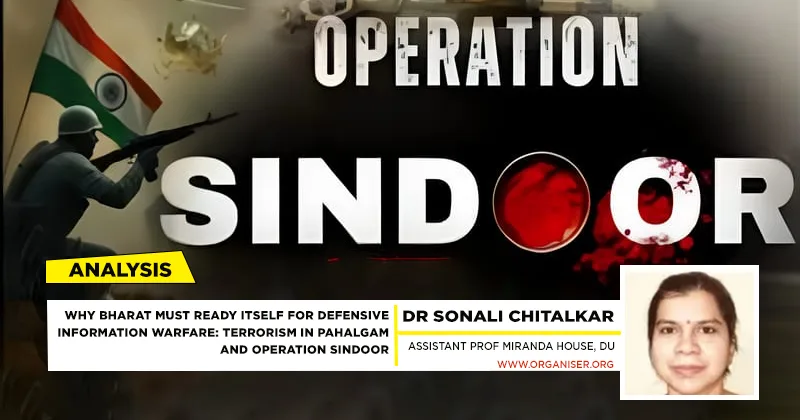
On April 22, 2025, a brutal terrorist attack in Pahalgam, J&K, claimed the lives of 26 individuals, predominantly Hindu men, in one of the deadliest civilian massacres in India in recent times. The assailants, affiliated with the Pakistan-based Lashkar-e-Taiba, profiled victims based on religious identity. Among the deceased were two members of the Indian armed forces: Lt. Vinay Narwal of the Navy from Haryana, and Tage Haliyang, Indian Air Force personnel from Arunachal Pradesh, who belonged to the Apatani tribal population of the State. The civilians killed hailed from all over the country. The victims included one person from Nepal and one local Shia from Pulwama, Kashmir. Among States, Maharashtra bore the heaviest toll with six deaths, followed by Gujarat and Karnataka, which lost three residents each. West Bengal lost two. One death each was reported from Uttarakhand, Haryana, Uttar Pradesh, Bihar, Punjab, Kerala, Odisha, Andhra Pradesh, Madhya Pradesh, and Arunachal Pradesh.
The forthcoming analysis will look at the unleashing of Information Warfare, post the Pahalgam terror attack, looking specifically at the media reportage and academia’s response in warlike conditions.
The Incident: Who and Why
The responsibility for the terrorist attack in Pahalgam was taken by The Resistance Front or TRF which was founded in October 2019; months after the union government bifurcated J&K, and read down Article 370. It is an offshoot of the Lashkar-e Tayabba(LeT). Pakistani academician and South Asia expert Arif Jamal describes the Let as a sub-outfit of the Jamat–ud–Dawah (Jud), which in turn traces its roots to Juhayaman-Al-Otyabi’s Ikhwan. Under persecution for the attack on Mecca Masjid in 1979, the group scattered worldwide and gave a call for transnational Jihad. One such branch became the JuD led by Hafeez Sayeed is entrenched in Pakistani society, takes in recruits from families and has a vast student network, many of whom are engineering students and are now in Pakistans Atomic Energy Commission. In effect, Otyabi’s core Salafist group scattered worldwide, and the global Jihadist network is linked to each other by this core affiliation. There are many names, but the core ideology remains the same. All these are facts in the public domain
The people of Kashmir have at various times engaged with the ideology described above. What was a push and pull in the mid twentieth century led to a full-blown Islamic subversive secessionist movement in the nineties as the Pakistani policy of bleeding India by a thousand cuts materialised. While crests and troughs in terrorism went on, the Indian State has tried to negotiate this terrain with a combination of military and political means.
The Indian government under PM Narendra Modi possibly took the boldest political steps ever to orient the State away from terrorism towards democratic progress and economic prosperity. If the resolution to the Kashmir issue had to be political, this government has tried to create a policy regime in the interest of Kashmir with substantial dismantling of the local terror apparatus being undertaken in recent times. Elections were held in 2024, and whatever Kashmir had to offer in terms of political representation was put in place. Tourists were flowing back into Kashmir. The terrorist attack in Pahalgam was timed to derail this process.
The basic facts as they emerge are the following: The terrorist attack was undertaken by Pakistan and local Kashmiri support organisations, which have deep roots in Pakistan. The Lashkar –e –Taiba is an offshoot of the Jamat-ud Dawah with headquarters in a suburb called Muridke in Lahore. Therefore, Pakistan is the enemy.
Secondly, the terrorist attack in Pahalgam was religiously motivated and had clear markings of transnational jihad. As per available media reports, the sole Christian victim was asked about Palestine. The majority of the victims were Hindu and were asked to convey to ‘Modi’ about the terror attack. This was not the first time that Hindus have been profiled and killed by terror groups. This format has been used in Punjab and J&K throughout the eighties onwards. Many terrorist attacks in J&K in the eighties and nineties had the same format. J&K was the only State in independent India that saw a genocide against the minority community in the decade of the nineties. Thirdly, local Kashmiri support for the forces of transnational jihad is a continuing challenge for the people of J&K and the Indian government.
Information Warfare after Pahalgam
Information warfare is the weaponisation of information by the enemy to achieve strategic aims without kinetic action. One major dimension of Information Warfare is Psychological Operations. Psychological Operations were undertaken by Hamas in the much publicised attack on Israel on October 7, 2023. Bharat has been a victim of Information warfare in Kashmir and Punjab during and after the terrorist subversive movements in both States. After the terrorist attack in Pahalgam, Information Warfare was activated against India by Pakistan and its allies in India.
Dimensions of Information Warfare after the Pahalgam attack
Psychological warfare is a domain of Information warfare that the enemy uses to manipulate the psychological mind-space of the adversary to attain strategic aims.
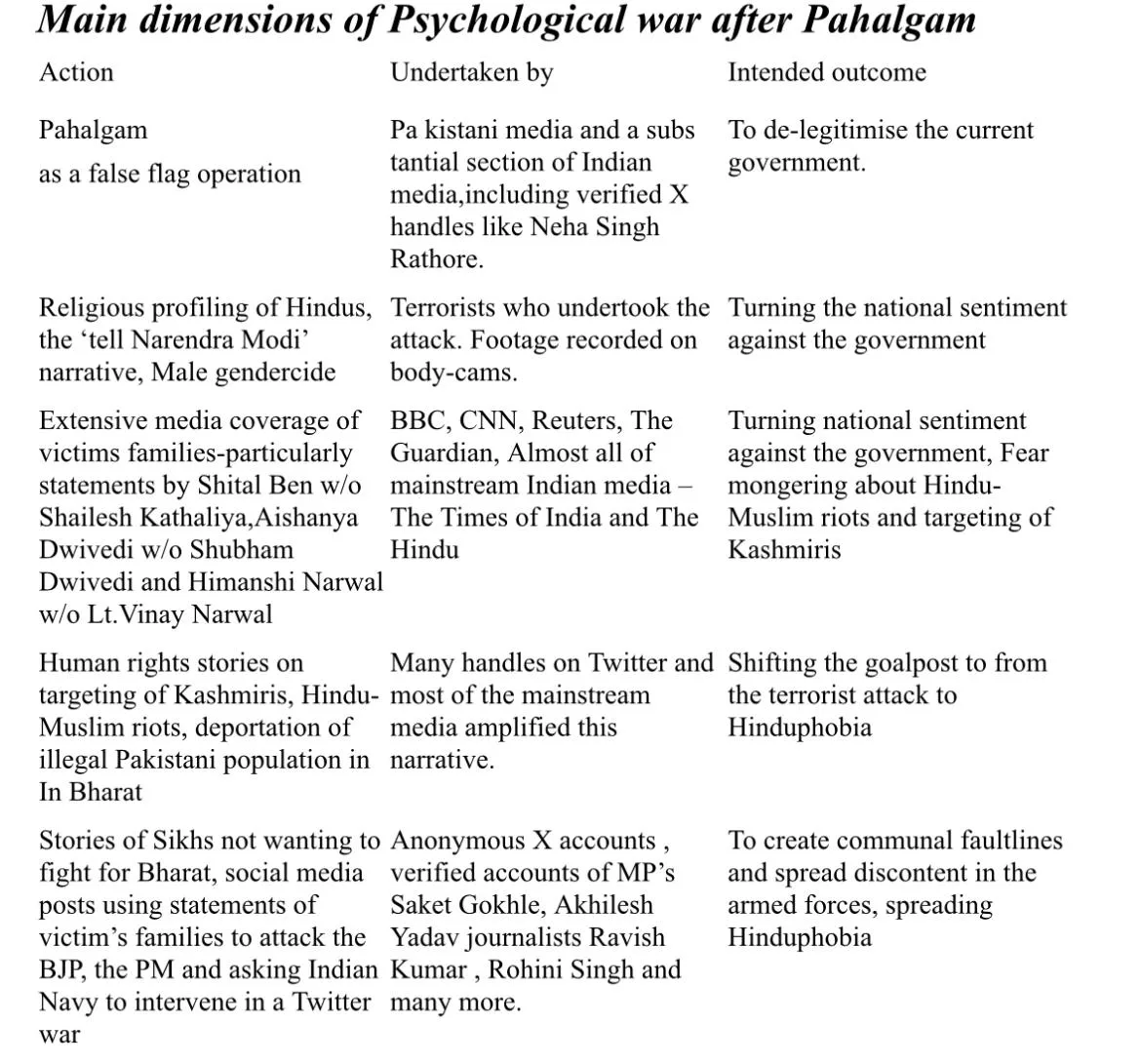
The main themes around which the psychological war was operationalised by Pakistan and its domestic allies after Pahalgam has been around the core theme of Hinduphobia. Such people label the ruling Bharatiya Janata Party as a Hindu-fascist outfit—anti-Muslim, anti-Sikh, anti-Kashmir, anti-human rights, and even against the armed forces. In short, they portray a Hindu-led government as both weak and anti-minority.The purpose of this psychological warfare as tabulated below has been to shift the narrative away from the main act of Islamic terrorism that happened in Pahalgam and shift the narrative to Hindu-Muslim along communal lines. The focus has been to tie the government’s hands on any retaliation either by diplomatic or legal means. The identification and action against Kashmiri terrorists, deportation of illegal Kashmiris living in Bharat all are being termed as anti-muslim and anti – minority moves.
What can be done by the media to counter psychological warfare during war
The Government of India issued an advisory to the media on April 26, 2025, broadly asking them to ensure that none of their reporting or actions are inimical to the national interest. The media, especially the verified mainstream and social media handles, individuals have been asked to maintain caution. This advisory should be followed. Publications like The Hindu have violated the advisory by posting false news about Indian Air Force jets being shot down by Pakistan. Simply, any media, social media and individual found violating national interest during war time must face legal action.
What can be done by Academia during war
Universities play the role of defining national interest during peace and war. Major universities like the University of Delhi do not have undergraduate syllabi in subjects like Political Science that include the political history of major Indian wars.
Major security and boundary issues, Information Warfare have been left out of undergraduate syllabi. As the country faces a major conflict, these syllabi must be included. Our civilians and citizens must know about our military and security challenges and play a role therein. Universities can also ramp up programs like the National Cadet Corps,which plays a role in civil-military fusion. Universities are the key in defensive information warfare, which is a 24/7 program and can not be undertaken solely by the military.
In conclusion, Information Warfare in the current conflict situation requires that we bring back the focus on Pakistan as the hub of transnational jihad of which Pahalgam was an example. We cannot allow the citizens of the country to forget that Pakistan is home to the Jamat ud Dawah, which is the motherboard of Islamic terrorist organisations operating in the Islamic crescent of which Kashmir is a part.











Comments