





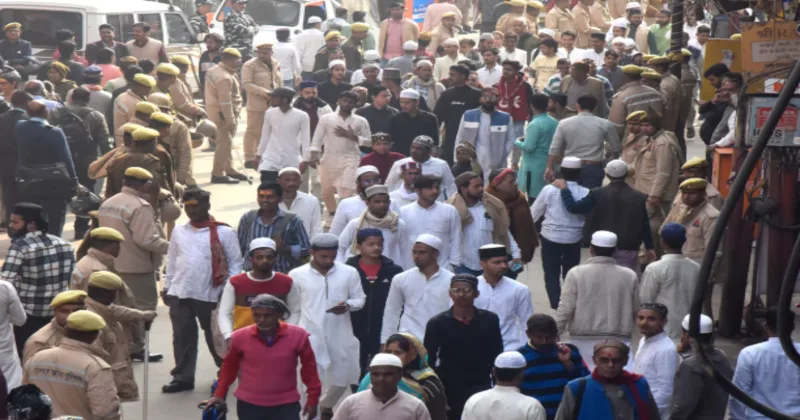
In the wake of the recent Pahalgam jihadi attack, the Bharat government has taken bold and decisive steps to root out individuals from Pakistan who have, over decades, stealthily embedded themselves into Indian society. The Modi government’s move to revoke visas and deport Pakistani nationals illegally or dubiously residing in India has unearthed a deep, disturbing web of infiltration, deceit, and systemic failure that has long gone unchecked. This silent incursion was not just a security lapse but a manifestation of years of negligence, political appeasement, and institutional compromise.
What was once dismissed as a provocative slogan—”Har ghar se Afzal niklega” (An Afzal will emerge from every house)—has now materialized into a chilling truth. This was not just a seditious chant at a Left-liberal rally commemorating terrorist Afzal Guru in Delhi’s JNU; it was a veiled prophecy that is now taking form. Today, we see this unsettling statement come to life, not in metaphor, but in flesh and blood. Afzals are indeed emerging from every corner—not just in ideology but in real, physical identities, equipped with documentation, privilege, and access.
Afzal Guru—the mastermind behind the heinous Parliament attack 2001—was no ordinary terrorist. He symbolized an ideological war against Bharat. The fact that segments of India’s so-called intellectual elite organized events to honour him is a travesty beyond comprehension. These were not fringe elements; these were individuals who are now mainstream political players—like Kanhaiya Kumar, who now finds a comfortable place within the Congress party’s fold. Their glorification of such anti-national elements signals an ideological rot festering in the heart of Bharat’s political discourse.
But the threat has evolved. We are no longer dealing with mere slogans or support for convicted terrorists. We are now grappling with an institutional crisis where Pakistani nationals with dubious identities have infiltrated Indian civil society to its core. These individuals possess Indian voter IDs, Aadhaar cards, ration cards, domicile certificates, and, shockingly, even employment in highly sensitive institutions like the Jammu & Kashmir Police.
Take, for instance, Iftekhar Ali—a PoK national who successfully embedded himself in India for 27 years. His employment with the Jammu & Kashmir Police, with his final posting at none other than the Mata Vaishno Devi shrine—a site sacred to millions—should set alarm bells ringing. His case is not an anomaly; it is a symptom of something far more dangerous.
His wife, now lamenting his deportation, may draw sympathy from certain quarters. But the real question is—how did he evade the system for nearly three decades? Who were the enablers? How could such illegal infiltrators acquire legitimate Indian documents and rise to hold a government position without setting off any red flags? And perhaps most alarming—how many more such Iftekhar Alis are currently embedded in our systems, influencing decision-making, and posing as ordinary Indian citizens?
Then there’s the unsettling case of Osama from Rawalpindi. Entering India in 2008, he went on to obtain a domicile certificate from Jammu & Kashmir, vote in local elections, and enjoy public services and welfare schemes reserved for genuine Indian citizens. The contrast is striking: while Osama votes and enjoys rights he never earned, the Kashmiri Pandits—true inheritors of the land—remain refugees in their own nation, still waiting to return home.
Consider Minal Khan, a Pakistani woman who married a CRPF jawan online and began living in India. To the liberal eye, this may appear to be a romantic tale of cross-border unity. But can we afford such sentimentalism when our very sovereignty is at stake? When a Pakistani citizen resides with someone defending our borders, does that not pose a clear and present danger? Where are the background checks, the security clearances, the legal protocols?
And these are not isolated incidents. Parveen Akhtar and many unnamed women from Karachi and other parts of Pakistan have lived in India for over four decades—on extended visas, without applying for Indian citizenship. They marry local men, raise children, and use the Indian public system, all while retaining allegiance to a foreign nation. This duality—of enjoying Indian benefits while remaining Pakistani citizens—is not just opportunistic; it is perilous.
Meanwhile, the bitter irony continues. Genuine citizens—Dalits, tribal populations, Gorkhas, and especially displaced Kashmiri Pandits—face barriers to full voting rights in Jammu & Kashmir. But Pakistani nationals, with forged documents or state-sponsored leniency, vote freely, contest local elections, and shape the political destiny of sensitive regions.
This is not a random administrative lapse. This is the rotten fruit of decades of appeasement politics, open-border romanticism, and vote-bank calculations. For years, the so-called “human rights” lobbies have cried hoarse over issues of statelessness and emotional unity, often ignoring the strategic threats these infiltrators pose. They will now predictably frame the deportation of such individuals as a humanitarian issue—of love separated by borders, of lives disrupted by state action. But let us ask ourselves: can a civilization-state like Bharat afford to risk its internal security for emotional tokenism?
When Pakistani nationals can manipulate their way into our systems—securing jobs, voting rights, and policy influence—we are no longer looking at individual breaches. We are witnessing a systematic, silent invasion aimed at hollowing Bharat from within.
The Modi government’s crackdown is not only justified—it is a historic necessity. National security cannot be held hostage to misguided compassion or ideological softness. Every Pakistani who has infiltrated India under false pretenses must be identified, thoroughly vetted, and deported without hesitation. This is not an act of vengeance; it is a measure of survival.
Citizenship is not a charity doled out for convenience or sentiment. It is a sacred pact—a mutual vow between the nation and the individual. Only those who respect, uphold, and commit themselves fully to this pact should be allowed to stay and integrate.
The chilling reality of “Har ghar se Afzal niklega” is no longer a hypothetical warning. It is our national reality. If we fail to respond with vigilance, decisiveness, and unapologetic nationalism, it won’t just be infiltration—it will be our civilizational unraveling.














Comments