





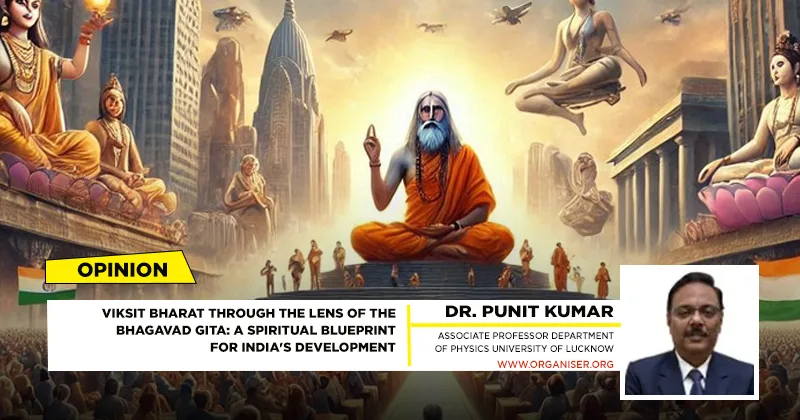
As India steps into a transformative era, it envisions becoming a “Viksit Bharat” (Developed India) by 2047, marking 100 years of independence. This ambitious vision, promoted by the Government of India, aims to achieve economic growth and technological progress, nurturing cultural revival, ensuring social equity, and fostering sustainable development. While strategic plans and policy frameworks lay the roadmap for progress, India’s strength lies in its rich civilisational heritage and timeless wisdom. A remarkable source of such wisdom is the Bhagavad Gita, a philosophical and spiritual classic that has guided generations through life’s complexities. The Gita offers insights into leadership, duty, selfless action, and inner harmony values that resonate deeply with the vision of a developed and enlightened nation.
1. Karma Yoga: The Ethic of Duty and Selfless Service
“कर्मण्येवाधिकारस्ते मा फलेषु कदाचन” (Bhagavad Gita 2.47)
“You have a right to perform your duties, but never to the fruits of those actions.”
This profound verse encapsulates the essence of Karma Yoga, the path of selfless action. It teaches one to remain committed to action without attachment to its outcomes. In building a Viksit Bharat, this principle holds immense relevance. A truly developed nation is not merely the result of policies and infrastructure but reflects a people’s mindset rooted in responsibility, discipline, and collective consciousness.
Karma Yoga urges individuals to dedicate themselves to their duties with sincerity and devotion, whether as teachers, doctors, farmers, scientists, or civil servants. It is about nurturing a work ethic where excellence is pursued not for personal recognition but for the larger well-being of society and the nation. This philosophy inspires a shift from self-centred ambition to seva bhav (spirit of service), creating a culture where every action contributes to the greater good. If every citizen of India embraces Karma Yoga, the foundation of Viksit Bharat will rest not just on external growth, but on an inner transformation that aligns personal effort with national purpose.
2. Svadharma and Atmanirbharta: The Call for Self-Reliance
“श्रेयान् स्वधर्मो विगुणः परधर्मात् स्वनुष्ठितात्” (Bhagavad Gita 3.35)
“It is better to perform one’s own duty, even if imperfectly, than to perform another’s duty perfectly.”
This timeless teaching from the Bhagavad Gita underscores the importance of svadharma, one’s path and responsibility. It champions staying true to one’s inherent nature, role, and duties, even if the results are modest or imperfect. In the context of Atmanirbhar Bharat (self-reliant India), this verse resonates as a powerful call for cultural, economic, and intellectual independence.
Self-reliance does not imply isolation, but confidence in one’s identity and capabilities. A Viksit Bharat must develop models of progress rooted in its civilisational wisdom, not borrowed blueprints. Whether creating a more inclusive education system, strengthening traditional medicine alongside modern healthcare, or promoting local industry through sustainable practices, India’s development must emerge from within, true to its svadharma.
This principle encourages individuals to discover their strengths and contribute authentically to society. When individuals and institutions confidently embrace their svadharma, the nation becomes truly Atmanirbhar, strong, self-aware, and independent in thought, spirit, and action.
3. Leadership as Yajna: Duty, Sacrifice, and Vision
“यज्ञार्थात् कर्मणोऽन्यत्र लोकोऽयं कर्मबन्धनः” (Bhagavad Gita 3.9)
“All actions, except those done as an offering to Yajna (sacrifice), cause bondage in this world.”
This powerful verse from the Gita presents a profound perspective on leadership as an act of Yajna, or sacred sacrifice. The verse teaches that actions rooted in selfish motives lead to entanglement, while those performed with a spirit of service liberate both the individual and society. In the vision of a Viksit Bharat, this principle holds special importance for leadership at all levels.
According to the Gita, a true leader does not seek position or privilege but dedicates their skills, energy, and vision to the collective welfare. This aligns with Mahatma Gandhi’s ideal of ‘sarvodaya’, the upliftment of all, and the concept of servant leadership, where authority is rooted in empathy and responsibility. Whether at the level of a village head or a national policymaker, the Gita urges leaders to act selflessly, with the long-term well-being of the people in mind.
As India strives to become a developed nation, cultivating such ethical and visionary leadership imbued with the spirit of Yajna will be essential. It ensures that governance becomes a sacred trust, promoting equity, justice, and sustainable progress.
4. Samatvam and Emotional Intelligence: The Inner Strength of a Nation
“समत्वं योग उच्यते” (Bhagavad Gita 2.48)
“Equanimity is called Yoga.”
This concise yet profound teaching from the Gita defines Samatvam, the state of inner balance and emotional steadiness as the very essence of yoga. It is a reminder that real strength lies not merely in physical or intellectual prowess but in the ability to remain calm, centred, and undisturbed in the face of success and failure. This emotional intelligence becomes a national asset in the journey toward a Viksit Bharat.
Today’s rapidly changing world demands a psychologically resilient and emotionally mature society. The need for mental discipline, empathy, and emotional balance is greater than ever, from youth dealing with academic and career pressures to leaders making high-stakes decisions under stress. Samatvam fosters these qualities. It teaches individuals to handle criticism and praise, victory and defeat, with equal poise, thereby promoting harmony within and without.
For India to thrive amidst global challenges, be it pandemics, geopolitical tensions, or environmental crises, its citizens must embody the spirit of Samatvam. Integrating this principle into education, leadership, and public discourse can cultivate a stable and compassionate society. Thus, the Gita offers spiritual wisdom and a timeless framework for inner strength and national well-being.
5. Nishkama Karma: A Collective Mindset for National Development
“तस्मादसक्तः सततं कार्यं कर्म समाचर” (Bhagavad Gita 3.19)
“Therefore, without attachment, constantly perform your duty.”
This verse encapsulates the spirit of Nishkama Karma, selfless action performed with dedication but without attachment to the results. The Gita teaches that true fulfilment and progress arise when duties are carried out sincerely, without ego or expectation. This philosophy offers a transformative collective mindset for a nation striving to become a Viksit Bharat.
Nishkama Karma fosters a culture of integrity and purpose. Imagine a society where teachers teach not just for salaries, but out of passion to shape young minds; where doctors serve with empathy, not just for profit; where civil servants act with transparency, not for recognition. Such karma yogis are the foundation of a truly developed nation.
Moreover, this principle guards against the lure of short-term populism, encouraging policymakers to focus on sustainable and inclusive development rather than immediate gains. Long-term progress in sectors like education, health, infrastructure, and the environment demands steady, selfless action over fleeting political victories. By nurturing Nishkama Karma at all levels, individual, institutional, and national, India can move steadily towards a future marked by ethical growth, shared prosperity, and deep-rooted resilience. It transforms development from a mere goal into a sacred duty.
6. Jnana Yoga and Innovation: Knowledge as Enlightenment
“न हि ज्ञानेन सदृशं पवित्रम् इह विद्यते” (Bhagavad Gita 4.38)
“There is nothing as purifying as knowledge in this world.”
This profound verse from the Bhagavad Gita glorifies Jnana (knowledge) as the ultimate purifier and guiding light. In the context of Viksit Bharat, it affirms that education, innovation, and intellectual inquiry must be the cornerstone of national progress. Jnana Yoga, the path of wisdom, does not merely refer to academic knowledge but includes deep reflection, discernment, and application of truth in life and governance.
For India to emerge as a global leader, it must nurture a culture that values scientific research, technological innovation, and philosophical insight. This includes promoting excellence in STEM (Science, Technology, Engineering, Mathematics) alongside the revival of Indic knowledge systems, Ayurveda, Yoga, Sanskrit texts, and Vedanta that offer time-tested approaches to wellness, sustainability, and ethics.
A truly Viksit Bharat is economically advanced and intellectually and spiritually awakened. When modern science is guided by dharmic wisdom and innovation is driven by ethical vision, India can offer holistic solutions to the world, from AI ethics to climate resilience. Jnana Yoga thus inspires a development model where knowledge is not just information, but transformation, leading to inner clarity and outer excellence.
7. Equality and Social Harmony: The Spirit of Vasudhaiva Kutumbakam
“विद्या विनय सम्पन्ने ब्राह्मणे गवि हस्तिनि।
शुनि चैव श्वपाके च पण्डिताः समदर्शिनः॥” (Bhagavad Gita 5.18)
“The wise see with equal vision a learned Brahmin, a cow, an elephant, a dog, and an outcaste.”
This iconic verse from the Bhagavad Gita conveys the profound ideal of sama-darshana, equal vision. It emphasises that true wisdom lies in perceiving the same divinity in all beings, regardless of social status, species, or appearance. As India strides towards becoming a Viksit Bharat, this message is relevant for fostering equality, inclusivity, and social justice.
A developed nation is not defined solely by GDP or infrastructure, but by how compassionately it treats its marginalised, underprivileged, and voiceless. The Gita inspires us to transcend divisions of caste, religion, gender, and class, and build a society rooted in dignity and mutual respect. This vision aligns beautifully with the ancient Indian ethos of Vasudhaiva Kutumbakam (the world is one family).
For social harmony to thrive, we must ensure equal access to education, healthcare, opportunities, and justice for all citizens. Inclusion must be embedded not just in policy, but in cultural consciousness. The Gita’s ideal of equal vision provides a moral and spiritual framework to achieve this, reminding us that a truly enlightened society sees unity in diversity and uplifts every member of its family.
8. Ethical Governance: Dharma as the Ruler’s Compass
“तस्मात् धर्मं अनुसरत नरः सर्वात्मना” (Gita-inspired
“Therefore, one must follow dharma with all sincerity.”
Though not a direct quote from a single verse, this Gita-inspired statement reflects the essence of the Bhagavad Gita’s teachings on dharma (righteous duty). Dharma is not merely a religious or cultural code; it is the guiding principle that upholds justice, truth, and ethical behaviour in personal and public life. For Viksit Bharat to flourish, governance must be deeply rooted in dharma.
In a democratic society, dharma implies justice, transparency, accountability, and compassion. When leaders act not out of self-interest but by higher moral values, they create institutions and policies that are inclusive and equitable. Corruption, favouritism, and neglect of the marginalised are dharma, eroding the foundation of progress.
The Gita emphasises that leaders like Arjuna on the battlefield must often make difficult decisions, which must be grounded in righteousness. Ethical governance requires inner integrity and outer courage, ensuring power is exercised as a service, not as domination.
A dharma-based administration promotes trust in public institutions, inspires civic responsibility, and sets a global example of value-driven leadership. In this way, the Gita becomes a spiritual text and a timeless manual for transformative governance.
9. Inner Transformation and National Rejuvenation
“उद्धरेदात्मनात्मानं नात्मानमवसादयेत्।
आत्मैव ह्यात्मनो बन्धुरात्मैव रिपुरात्मनः॥” (Bhagavad Gita 6.5)
“Let one uplift the Self by the Self; do not let the Self be degraded. The Self alone is the friend of the Self, and the Self alone is the enemy of the Self.”
This powerful verse from the Bhagavad Gita underscores that true progress begins from within. A nation’s transformation is not merely about infrastructure or economy; it rests upon its people’s character, consciousness, and conduct. The path to a Viksit Bharat lies in inner development, where individuals cultivate self-discipline, clarity of purpose, and moral integrity.
The Gita teaches self-mastery through introspection, meditation, and disciplined action. Citizens who are emotionally balanced, ethically grounded, and socially responsible naturally contribute to collective upliftment. Programs that integrate value-based education, yoga, and mindfulness into school and university curricula can lay this foundation from an early age.
In workplaces, encouraging self-awareness and ethical conduct can create a culture of excellence and empathy. When people see their duties as service and their lives as purposeful, they become catalysts for national rejuvenation. Thus, as individuals elevate their inner Self, the nation rises, strong, united, and enlightened.
10. Lokasangraha: The Collective Good as the Highest Goal
“यद्यदाचरति श्रेष्ठस्तत्तदेवेतरो जनः।
स यत्प्रमाणं कुरुते लोकस्तदनुवर्तते॥” (Bhagavad Gita 3.21-25)
“Whatever a great person does, others follow; their example becomes the standard for the world.”
The concept of Lokasangraha, the world’s welfare, articulates a profound vision for leadership and responsibility. The Bhagavad Gita highlights that leaders, thinkers, and influencers shape society not just by their words, but by their actions. When the great live in harmony with higher principles, acting with integrity, compassion, and service to the greater good, their example naturally becomes a guiding light for the masses. This creates a virtuous cycle of collective progress.
For a Viksit Bharat, success should not solely be measured by personal accomplishments or material wealth, but by contributing to society’s welfare and the legacy of kindness. National leaders, innovators, and professionals must become role models, demonstrating that true success is embedded in service, empathy, and ethical responsibility. As the Gita teaches, the conduct of one person can inspire the whole nation, creating a culture where service to society becomes the highest ideal. A Viksit Bharat will be one where leaders at all levels, whether political, economic, or cultural, act for the welfare of all, thereby ensuring unity, peace, and sustainable progress for the future.
The Government of India’s vision for a Viksit Bharat by 2047 goes beyond economic goals; it calls for a civilisational resurgence. With its timeless wisdom, the Bhagavad Gita can serve as the spiritual and ethical guide for this transformation. It advocates a development model that is not merely materialistic but holistic, not imitative but rooted in India’s authentic identity, and not fragmented but unified. By embracing the teachings of the Gita, India can emerge as a Vishwa Guru, a beacon for the world demonstrating how science and spirituality, progress and ethics, power and peace can coexist harmoniously. This is the vision of both the Gita and a Viksit Bharat, an India that thrives in balance, integrity, and collective well-being. May the wisdom of Krishna guide India towards a future marked by strength, unity, and enlightenment.
















Comments