





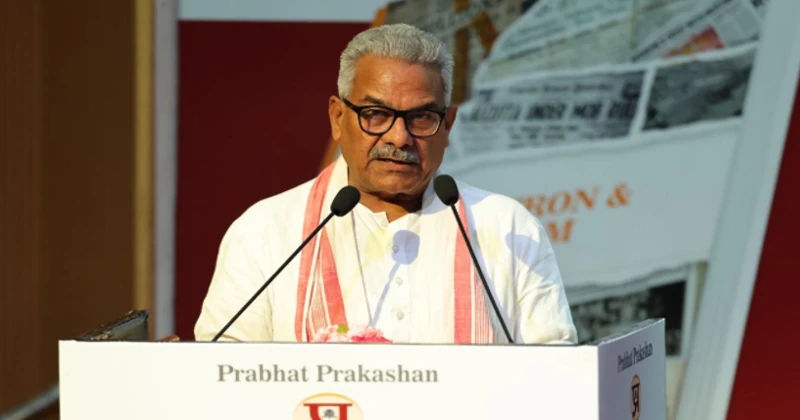
Expressing concern over the growing climate of “intolerance” on the global scale, Rashtriya Swayamsevak Sangh (RSS) Sah Sarkaryavah Dr Krishna Gopal said Bharat, on the other hand, was a testament to unity in diversity. “This diversity was clearly in evidence in the recently held Maha Kumbh, where we witnessed the participation of 50 crore Bharatiyas, who spoke different languages, yet came together on one platform. Ten thousand bhandaras were organised for pilgrims.”
Releasing the book Ink, Saffron and Freedom by Kedar Nath Gupta at Dr Ambedkar International Centre on Janpath, Delhi, Dr Krishna Gopalji said Hindu society is the only one that is tolerant and accepts everyone.
Pointing out that after Gandhi’s assassination, there was action against the Sangh, RSS Sah Sarkaryavah said: “A ban was imposed on Sangh and thousands of people associated with Sangh were sent to jail. A commission was appointed and after going into details it categorically concluded that there was no involvement of Sangh. But Congress wanted to punish the Sangh.”
Betrayal of Sanatanis
Mahatma Gandhi had proclaimed that Partition of Bharat will happen only over his dead body. So, Hindus were convinced that the country would not be split into two. However, within a few days, people’s belongings, homes would be robbed away from them. “One cannot trace a single example in world history where there was so much displacement of people as witnessed during the Partition. So many atrocities were committed on women. But all this was not documented. If people had been warned about Partition, they would have been in a better position to make arrangements. As it was announced without warning, people couldn’t sell their properties. Who was responsible for keeping so many people in the dark? This is a long story but I think that Syed Ahmed Khan, who declared Muslims cannot live with Hindus, came up with the idea of a separate homeland for Muslims. Even Allama Iqbal showed his true colours by stating that we will live independently.”
Demand for Muslim Homeland
Earlier, Muslims were well versed in Bharatiya sanskriti. But there were others who wanted a separate homeland for Muslims that eventually led to the creation of Pakistan. Then they said, “We should not adopt the habits of Hindus.”
After the creation of Pakistan, the new country saw friction between Bengalis and Urdu-speaking people. “Bengalis did not want to learn Urdu. In 1971, it saw intolerance. Sindhis and Pakhtuns cannot stay together. We are seeing this now. “
Expressing displeasure over the fact that our ancient books have been set on fire, Dr Krishna Gopalji said Nalanda university was destroyed. “However, Hindus never looted, we did not sell slaves. Even though we had great Chola Rajas and other rulers but we never made anyone ghulam (slaves), you cannot trace a single example.”
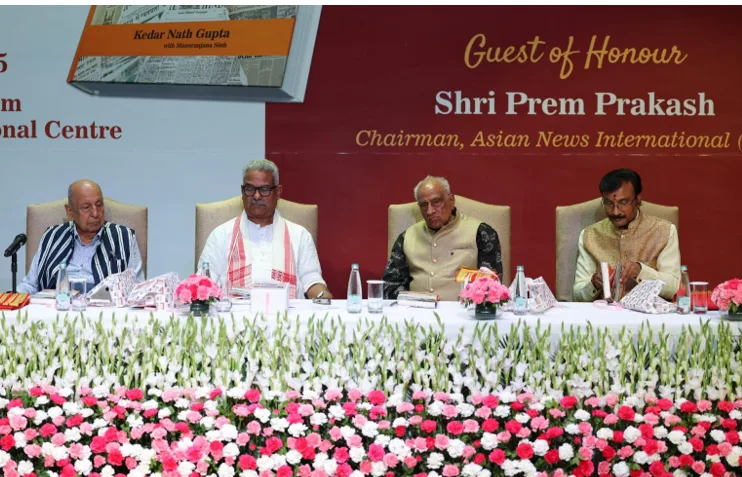
Shedding light on the book that highlights horrors of Emergency and how The Motherland exposed dictatorial functioning of then Congress Government, Dr Krishna Gopal said the book documents Kedar Nath Gupta’s childhood days at Ballimaran (in Old Delhi), his time spent in Shakha and how as a teenager he was sent to jail after Gandhi’s death. “The author has been through many ups and downs in his life.”
The title of the book captures details from the horrors of Partition to smoke-filled corridors of Delhi’s early newsrooms. Ink, Saffron and Freedom showcases Bharat’s journey. Ink means patrikarta (journalism). Saffron means desh bhakti, and freedom is self-explanatory, said Dr Krishna Gopal, who was chief guest at the function.
Published by Prabhat Prakashan Pvt Ltd, the book is a chronicle of courage, culture and civilisational calling.
Prem Prakash, Chairman of Asian News International, said he and KN Gupta grew up in Purani Dilli which was a lively city then. “None of you know about Ballimaran, it had a lake where there were boat men… Independence was a difficult time. RSS did great work. However, it was banned for no rhyme or reason. Here was a 16-year-old boy who was taken to Buxar jail. When Bhagat Singh went on a long fast he made sure that he was a political prisoner. The British are ruling our country. Yet Kedar Nathji was treated as a criminal. My friend Kedar Nath suffered all that yet he completed his studies.”














Comments