





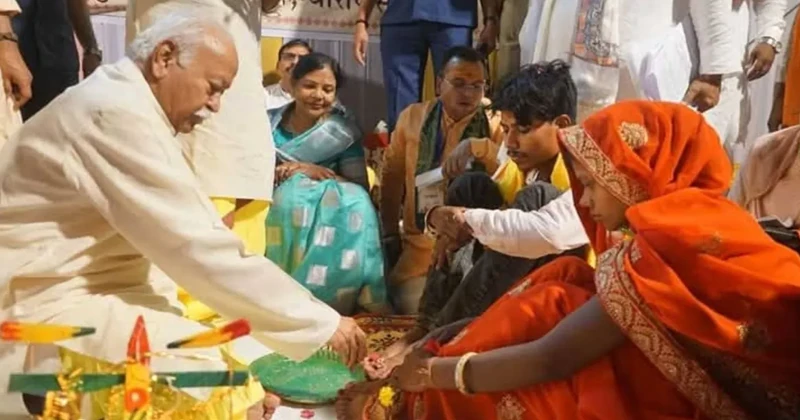
Rashtriya Swayamsevak Sangh (RSS) Sarsanghchalak Dr Mohan Bhagwat performed the sacred ritual of kanyadan during a grand mass wedding ceremony in Varanasi on the auspicious occasion of Akshaya Tritiya. The emotionally charged moment unfolded near the Shankuldhara Kund, where 125 couples from diverse social backgrounds tied the knot amid chanting of Vedic mantras, sacred fires, and a shared spirit of cultural inclusiveness.
In an act that broke social barriers and inspired thousands, Dr Bhagwat washed the feet of Rajwanti, a Vanvasi bride from Jogidih village in Sonbhadra district, before solemnly offering her hand in marriage to Aman, a Vanvasi groom from Renukoot. Referring to Rajwanti as his daughter, the RSS Sarsanghchalak gave a symbolic wedding gift (neg) of Rs 501 and gently told Aman, “Take good care of my daughter and keep her happy always.”
The event, dubbed the “Akshay Kanyadaan Mahotsav”, wasn’t just a ceremonial gathering—it was a potent reflection of Bharatiya cultural values, aimed at bridging caste divides, reducing economic burden on families, and reinstating sanskars (values) as the foundation of society.
The unique celebration was hosted by Virendra Jaiswal, a senior RSS functionary from Eastern Uttar Pradesh, who pledged to marry off 101 underprivileged daughters in conjunction with the wedding of his younger son Vibhav to bride Grishma. Inspired by the RSS ethos of selfless service, Jaiswal expanded his family celebration into a community-wide marriage ceremony, giving a new dimension to the idea of samajik samrasta (social harmony).
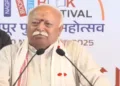
RSS Sarsanghchalak Dr Bhagwat, addressing the gathering, said, “A wedding is not just the union of two individuals but the convergence of two families, and through them, the strengthening of the society.” He urged elders and participants who had acted as symbolic guardians during the kanyadaan to remain in contact with the newlyweds, visiting them at least once or twice a year to offer moral support and guidance.
He remarked that a family must never be seen in isolation, confined to just husband, wife, and children. “It must be considered a living part of the larger society, deeply rooted in tradition, mutual care, and sanskars.”
The festivities began with an impressive wedding procession—featuring 125 grooms on horses and carriages, accompanied by brass bands, DJs, fireworks, and devotional rituals. Beginning at the iconic Dwarkadheesh Mandir, the “baraat” (groom’s parade) moved towards Khojwa, with people from surrounding areas showering flowers and serving refreshments, turning the streets of Varanasi into a vibrant canvas of community celebration.
The ceremony at the Shankuldhara Kund included rituals for village deities, groom worship, and mandap rituals where each couple received blessings from spiritual and social leaders. Prominent citizens acted as fathers to the brides, performing kanyadaan and reinforcing the collective responsibility toward nurturing future families.
Among the dignitaries present were Uttar Pradesh Deputy Chief Minister Keshav Prasad Maurya, former Union Minister Mahendra Nath Pandey, Industry Minister Nand Gopal Gupta ‘Nandi’, and Mayor Ashok Tiwari, all of whom lauded the initiative as a model of cultural preservation and social empowerment.
Deputy CM Maurya commended the event, calling it a “revolutionary step in reviving values-based community life”, while Mahendra Nath Pandey praised the RSS for blending tradition with transformative societal goals.
Dr. Bhagwat reflected on the spiritual and civilisational dimension of marriage, saying, “Marriage is a natural ritual of giving immortality to human culture. It is the brick that builds a house. That brick must be strong, and its strength comes from sanskars.” He stressed the need to internalise these values, asserting that only then can peace prevail in the world.
He also noted that lavish weddings often burden families, yet fail to benefit society, whereas events like the Akshay Kanyadaan Mahotsav serve a dual purpose — fulfilling a sacred duty while uplifting the community.
The mass wedding in Varanasi, backed by grassroots organisation, spiritual leadership, and inclusive vision, may well emerge as a template for community-driven rituals in contemporary Bharat. The event not only celebrated marital unions but also embodied the core tenets of sanskriti (culture), seva (service), and samajik samrasta (social cohesion) — values long upheld by the RSS.











Comments