





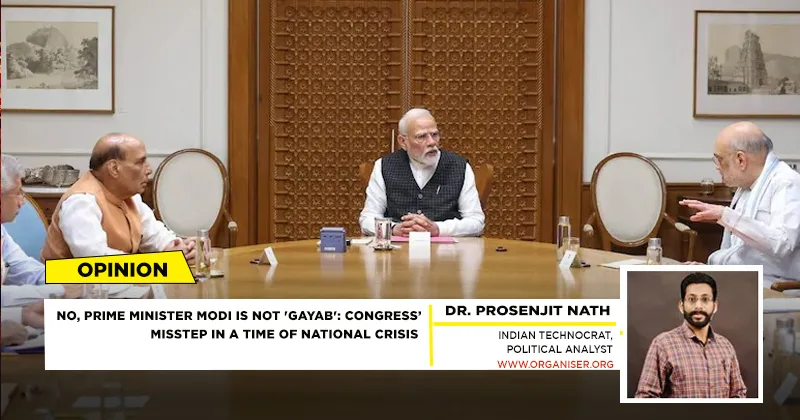
At a time when the country should be standing united against the scourge of terrorism, the Indian National Congress has chosen to indulge in a petty, ill-considered political stunt that not only undermines national unity but also plays into the hands of India’s enemies. The party’s social media team recently posted an image implying that Prime Minister Narendra Modi had gone “gayab” in the aftermath of the horrific Pahalgam terror attack. This insinuation is not only factually incorrect but is also a gross misrepresentation of the Prime Minister’s role and actions during one of the nation’s most trying moments.
https://twitter.com/INCIndia/status/1916817222762221874
The image, circulated widely by official Congress handles, was meant to suggest that the Prime Minister had gone silent and inactive at a critical time. However, the truth could not be more different. Far from being “gayab,” Prime Minister Modi has been deeply engaged in the response to the terror attack from the moment the news broke. He cut short his important diplomatic visit to Saudi Arabia a visit that involved critical discussions on regional security and investment to return to India. Before even landing in the country, he had directed Union Home Minister Amit Shah to travel immediately to Pahalgam. Upon arrival in Delhi, the Prime Minister was briefed by the Foreign Secretary right at the airport, underscoring the urgency and seriousness with which he was treating the situation.
Later that same day, the Prime Minister chaired the high-level Cabinet Committee on Security (CCS) meeting. It was here that major decisions were taken, including pausing the Indus Water Treaty a significant geopolitical move, and sealing the Attari Integrated Check Post, a bold step signaling India’s zero-tolerance stance on cross-border terrorism. These are not the actions of a leader who is disengaged or indifferent. These are the actions of a leader who understands the gravity of the moment and is mobilizing the full machinery of the state to respond with strength and clarity.
Unfortunately, this nuance was lost on the Congress party, or worse, deliberately ignored. What makes the situation even more ironic is that this tone-deaf post came just hours after Congress media head Jairam Ramesh issued a public advisory asking party leaders to refrain from making insensitive or divisive statements about the tragedy. Rahul Gandhi himself, during an all-party meeting convened by the government, struck a surprisingly conciliatory note, saying that the Congress would support any steps taken by the Prime Minister in response to the Pahalgam attack. That spirit of cooperation, however, lasted only a few hours.
The same Congress that assured the nation of its support for the government’s measures then turned around and launched a juvenile attack on the Prime Minister’s supposed “disappearance.” Even more troubling is the fact that Pakistani social media users quickly seized on the Congress image, using it as propaganda material to mock Indian leadership. In an age where information warfare plays as significant a role as traditional conflict, such political carelessness is not just embarrassing it is dangerous.
The Congress party also questioned why Prime Minister Modi did not attend the all-party meeting, and why he continued with his trip to Bihar soon after. These criticisms, once again, lack substance. By long-standing parliamentary convention, all-party meetings are chaired by the Defence Minister, not the Prime Minister a protocol respected across governments, including those led by the Congress in the past. As for the Bihar visit, it was a pre-scheduled engagement announced before even the Saudi Arabia trip. Far from being callous, the PM canceled the Kanpur leg of the tour as a mark of respect to one of the Pahalgam victims, Shubham Dwivedi, who was from Kanpur.
The Prime Minister has also addressed the nation twice since the attack once in Bihar and again during his monthly radio address Mann Ki Baat. In both addresses, he expressed grief for the victims, reassured the nation of justice, and reiterated the government’s determination to punish the perpetrators and their enablers. His speeches reflected empathy, urgency, and resolve the very qualities one expects from a leader at such a time.
In contrast, the Congress party, by stooping to clickbait-style imagery and shallow political attacks, appears to have lost both the moral high ground and strategic sensibility. This is not the first time the party has mishandled its role as the opposition in matters of national security. Following the Balakot airstrikes in 2019, senior Congress leaders openly questioned the authenticity and impact of the strikes a move that backfired and alienated many voters. Once again, by casting doubt and creating a false perception of inaction, the party is repeating a costly mistake.
Now, the Congress is demanding a Special Session of Parliament to discuss the Pahalgam attack a legitimate request in a functioning democracy. But having undermined its seriousness with a tasteless meme, the party will find it difficult to project itself as a responsible voice in that session. It has diluted the gravitas of its demand by engaging in gimmickry that trivializes both the tragedy and the national response.
National tragedies demand national unity. They demand a mature opposition that holds the government accountable without weakening the nation’s resolve or image. The Congress had an opportunity to rise to the occasion and present itself as a serious and constructive force. Instead, it chose to weaponize a meme, play to social media theatrics, and in the process, offer comfort to India’s enemies and confusion to its citizens.
There is a time for politics, and there is a time for solidarity. The Congress party must learn to tell the difference not just for its credibility, but for the nation it claims to serve.











Comments