





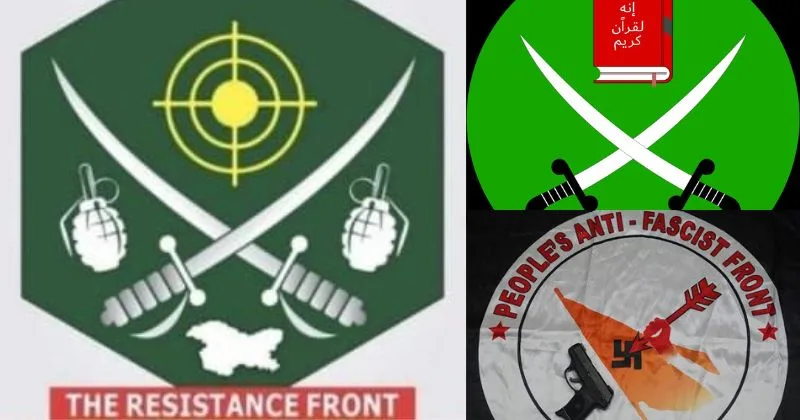
Recent incidents in Kashmir reveal that terrorists have adopted a new strategy, branding their attacks under the label of “resistance.” The group behind the Pahalgam attack was named “The Resistance Front” (TRF), a departure from the Arabic names used historically. New groups with English names, such as the People’s Anti-Fascist Front (PAFF), founded in 2019, and the Kashmir Tigers and United Liberation Front (ULF-K), founded in 2020, have emerged in Kashmir. However, these groups are not genuinely new. TRF and ULF-K, supported by the Pakistani army, are mere offshoots of Lashkar-e-Taiba, while PAFF and the Kashmir Tigers are rooted in Jaish-e-Muhammad. What has changed is not the groups themselves but their narrative and leadership. The English branding and the emphasis on “resistance” mirror strategies long used elsewhere.
The ‘Resistance’ Narrative and Four Projects in Kashmir
This “resistance” narrative is backed by none other than the Muslim Brotherhood. Their expansion into Bharat alongside Pakistan’s Jamaat-e-Islami is evident. The Brotherhood’s influence is apparent in adopting English names and idioms that appeal to Western sensibilities. This shift reflects a conscious strategy seen before in the Brotherhood’s support for Hamas in Palestine, where the word “resistance” was used to frame terrorist activities as ‘struggles for freedom’. Now, Kashmiri separatism is being rebranded under the Brotherhood’s leadership, with Hamas-like methods and alliances.
The Brotherhood launched four key projects to reshape the Kashmiri separatist movement. First, they set out to portray India as a fascist state committing genocide. Second, they created several human rights groups to promote this narrative. Third, they rebranded Pakistan-backed terrorist groups in English. Fourth, they linked Kashmir’s situation to Palestine’s struggle.
Painting Bharat as a Fascist State
Since 2016, a steady narrative of Bharat as a “fascist” state has been built, initially spearheaded by Pakistan under Prime Minister Imran Khan. Using fake news and the support of Brotherhood-friendly media, Pakistan launched a global campaign against Bharat. Figures like former Pakistani President Arif Alvi and PTI leaders amplified these accusations. By 2019, after the abrogation of Article 370, the narrative grew stronger, finding a place in social media trends and international discourse. Several Western “experts,” including Audrey Truschke, CJ Werleman, Halee Dushinsky, and Peter Friedrich, were enlisted to support this project, further spreading the narrative of Indian fascism.
New activist organisations like Stand with Kashmir, Americans for Kashmir, and Friends of Kashmir sprang up in the US, primarily led by Pakistani Jamaat-e-Islami networks. These groups worked to internationalise the Kashmir issue, making it more accessible to Western audiences through English narratives and activist structures. The Brotherhood thus shifted Kashmiri separatism’s leadership from the traditional Jamaat to its global Islamist network.
The Kashmir Genocide Narrative
Simultaneously, the theory of “imminent genocide” was introduced by Gregory Stanton, a “genocide expert” known for predicting the Rwandan genocide. His 2019 warning about Kashmir gave fuel to the narrative. Following this, Imran Khan also launched the “genocide” campaign. However, facing credibility issues, the campaign relied increasingly on Western figures like Gregory Stanton. His participation in Congressional briefings organized by the Indian American Muslim Council (IAMC), Hindus for Human Rights (HFHR), and Engage Action gave the genocide narrative a stamp of Western legitimacy. Media interviews, including a key one with Karan Thapar in The Wire, further circulated Stanton’s warnings.
Despite significant tourism and economic growth in Kashmir post-Article 370, with 2.36 crore visitors in 2024 alone, cross-border terrorism resurged from 2020 onwards. Interestingly, the previously vocal activists and experts became silent, strategically withholding outrage to focus instead on manipulating India’s responses to terror incidents. Their goal remains to provoke India into military actions that could be portrayed internationally as human rights violations in Kashmir.
Strategy linking Kashmir with Palestine
The Brotherhood’s fourth major move was linking the Kashmir issue to Palestine. Using tactics honed in the Palestinian struggle, including the Boycott, Divestment, and Sanctions (BDS) movement, they set about creating an anti-India movement modelled on the anti-Israel campaigns.
The Russell Tribunal for Palestine had long served to frame Israel as a human rights violator; similarly, a Russell Tribunal for Kashmir was launched in Sarajevo in December 2021. Veterans of ISI-backed propaganda like Ghulam Nabi Fai and Nazir Ahmed handed over their networks to the Brotherhood’s new generation. Three months later, a detailed 32-page “toolkit” was prepared outlining BDS-style strategies against India: boycotting Indian cultural and academic events, pressuring companies to divest, lobbying governments to impose sanctions, and even attempting to revoke India’s memberships in global bodies. The Brotherhood’s media allies, particularly Al-Jazeera, were active in these efforts. Early signs of a BDS movement against India appeared in 2018, but it has gained serious traction since 2021.
Building Kashmir- Palestine Narratives
Mimicking strategies used elsewhere, organisations like Hindus for Human Rights were formed, modelled on Jewish Voices for Peace, to give terrorist activities a veneer of legitimacy. Sunita Vishwanath, wife of Stephen Shah, was central to this effort. These “resistance” fronts cry foul when terrorists are eliminated but remain conspicuously silent about civilians killed by terror attacks. After the recent Pahalgam attack that killed 29 innocents, not a word was heard from such activists. Activist couples like Azad Essa and Hafsa Kanjwal have worked tirelessly to draw parallels between Kashmir and Palestine through books and public events. Academic voices, often linked to the same Brotherhood-Jamaat networks, bolster their claims through articles and studies. The pattern is clear: a carefully coordinated propaganda alliance involving Soros-linked groups, Brotherhood media like Al-Jazeera, and Pakistan’s intelligence ecosystem.
Rutgers Law School in the US even organised programs drawing explicit comparisons between India and Israel as “occupiers.” Hafsa Kanjwal, who was associated with Stand with Kashmir and tied to the Pakistani Embassy in the US, played a leading role. Though Rutgers University rejected some demands concerning Israel, it accepted the Kashmir-related demands, underlining India’s weaker international narrative influence compared to Israel. Thus, the Brotherhood succeeded a little in framing India within the Palestine model, which created a few challenges for India’s diplomatic efforts.
From Palestine to Kashmir: Exporting the Terror Industry
The recent Pahalgam attack and others like it are designed to provoke Indian security forces into retaliation. When India acts, international human rights organisations and activists loudly decry Indian actions, portraying terrorists as “freedom fighters” and their killings as “defensive.” The global media, often sympathetic, amplifies this narrative, creating a vicious propaganda cycle.
The violence industry, perfected over decades in Palestine, is now being exported to Kashmir. Millions of dollars are collected annually by Brotherhood-linked groups through donations, extortion, and BDS-related threats. However, the money rarely benefits the ordinary people in whose name it is raised. Instead, it fuels lavish lifestyles for activists, supports propaganda operations, and arms terrorists to sustain violence.
Kashmir, like Palestine, has been transformed into a business model of endless conflict. With each terror attack, from Pulwama to Pahalgam, the Brotherhood strengthens its grip, ensuring the violence and its profit, which continues. To break this cycle, India must respond with intense military and diplomatic action against Pakistan and the broader network behind this global industry of terror.










Comments