





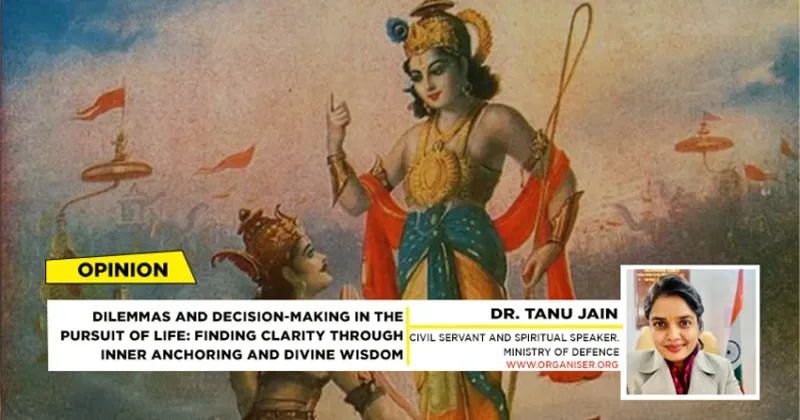
How often do we find ourselves at the crossroads of decision-making—hesitant, confused, or gripped by the fear of making the wrong choice? The mind echoes with questions: Am I doing the right thing? What if this backfires? Would life have been better if I had chosen the other path?
These are not rare thoughts. Many of us revisit decisions, wishing we had taken more time or acted differently. But then again, is the course of our life truly in our hands? Or are we being gently steered by the unseen currents of divine will?
While destiny may chart the broad course, confusion is often a creation of our own minds. In one of my encounters, I met a respected justice, a spiritually inclined man with decades of experience in law. I asked him earnestly, “Sir, how do you make such critical decisions about others’ lives without hesitation or emotional burden?”
He smiled and replied, “I have never had a problem making decisions. My mind is clear, and I have no biases. I serve my duty with sincerity, and that anchors me.”
That statement lingered with me for days. How could someone remain untouched by the emotional weight of decision-making? I eventually understood—clarity is not external; it’s the power of one’s inner being. His spiritual grounding and absence of personal attachment gave him freedom from confusion. He had transcended personal likes, dislikes, and ambitions. His work was not a job, it was his dharma—his sacred duty.
The spiritual texts speak deeply about this inner clarity:
“Yada te moha-kalilam buddhir vyatitarishyati, tada gantasi nirvedam shrotavyasya shrutasya cha.”
— Bhagavad Gita 2.52
“When your intelligence has passed out of the dense forest of delusion, you shall become indifferent to all that has been heard and all that is to be heard.”
This verse emphasises that clarity comes when the fog of delusion lifts—when ego, attachment, and fear no longer influence your thoughts. So, what really brings that clarity?
Clear Priorities is the key Confusion creeps in when we are torn between our personal attachments and our responsibilities. When your priorities are aligned with your higher purpose—not temporary pleasures or emotional biases—decisions become smooth.
“Na karmaṇām anārambhān naiṣkarmyaṁ puruṣo’śnute”
— Bhagavad Gita 3.4
“One does not attain freedom from action by abstaining from work; nor does one reach perfection merely by renunciation.” The key lies in understanding your role and walking it without ego or expectation.
Second is Mental Clarity Through Devotion ,When the mind is purified through sadhana—dedicated spiritual practice, service, and sincerity—clarity arises naturally. Decisions are no longer a burden; they become expressions of your inner purpose.
No Favourites, No Bias is a blessing , When you stop playing favourites—be it people, outcomes, or even ambitions—you rise above confusion. Attachment clouds judgment. Detachment liberates it.
“Udaasina-vadaaseeno gunair yo na vichaalyate”
— Bhagavad Gita 14.23
“He who remains like one unconcerned, unshaken by the modes of nature—such a person gains peace.”
Seeing Work as Worship finally leads to liberation .When your office, your duty, your contribution to the world becomes your tapasya (austerity), then your entire being aligns with it. Work stops being a burden. It becomes seva—sacred service.
In the end Life will always present us with choices. The roads may diverge, dilemmas may arise, and uncertainty may knock on our doors time and again. But when we are anchored in purpose, detached from outcome, and aligned with our inner truth, the fog clears.
True clarity is not about always knowing the right answer—it’s about being so rooted in your dharma that even the toughest choices feel light. It is the silence of the soul, not the noise of the world, that guides the wisest decisions.
As the Upanishads remind us:
“Dharmam chara, satyam vada”
— Taittiriya Upanishad
“Walk the path of righteousness; speak the truth.”
When decisions come from a place of truth, integrity, and surrender, even the unknown becomes sacred. You may not always control the path, but you can choose to walk it with clarity, devotion, and grace. And in doing so, you don’t just make decisions—you shape your destiny.
















Comments