




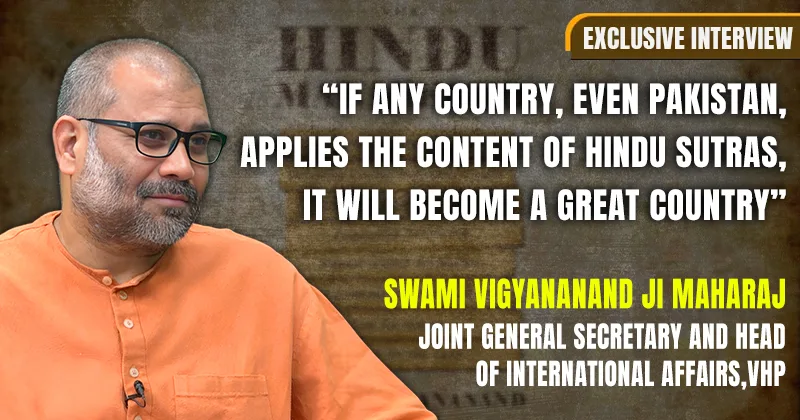
Revered Swami Vigyananand Ji Maharaj, Joint General Secretary and Head of International Affairs, Vishva Hindu Parishad has authored a book ‘The Hindu Manifesto’. Prafulla Ketkar, Editor of Organiser Weekly had a conversation with the IITian turned monk Swami ji about the book, its significance, and how it can impact Hindus and Bharat, if applied in its entirety. Excerpts:
What is the idea behind this book? Why Hindu manifesto?
I am a Bal Swayamsevak of Rashtriya Swayamsevak Sangh (RSS). When I went to Gurukul for studying, I felt that there is a lot of knowledge in our scriptures which is very relevant and contemporary. Principally, it can be applied as it is even today! Since then, I had in mind to write a book on this. It took some time; I read all the scriptures and extracted sutras (aphorisms) from them. Sutra is the tradition of our sages. Even if everyone is not able to read the entire book, they can just read the sutras, and the content and context will remain in the memory. I extracted eight sutras – the first four are ‘Foundational sutras’ and the last four are ‘Civilisational sutras’. If any society wants to advance itself in the world individually, socially or country as a whole, some principles will have to be applied. We have distilled those principles from the scriptures. That is why, it is different from other books. I also say that if any country, even Pakistan, applies the content inside these Hindu sutras, Pakistan will become a great country.
You have very interestingly translated and interpreted the eight sutras. The first is ‘Dharmasya Moolam Artha’
Long ago when I started the World Hindu Economic Forum, an international journalist asked me about the Hindu economic model in comparison to the communist and capitalist models. I told him, “The capitalist model talks about the accumulation of wealth, but never about the sharing of wealth. The socialist or communist model talks about distribution of wealth, but never about its creation. Our Veda mantra states, Shatahast Samahaar, Sahasrahast Sankeer, create wealth with 100 hands and share with thousand hands. First create, generate, only then will you be able to share. This is the Hindu model.
As for the Hindu growth rate, fact is, the Hindu society had an entrepreneurial spirit for thousands of years. This is the reason why Bharat was the economic powerhouse of the world
The second principle is ‘Shatrunjaya Praja Raksha.’ Are you, in a way, Hinduising the definition of the entire international politics?
‘Shatrunjay’ means your military should be strong to defeat the enemy and protect the people. Victory is very important for any country. A lot of factors contribute to achieve victory. A military with quality soldiers, commanders, armament, its technology, storage, fortification, intelligence, and finally it says that you should know the weak points of the enemy at all times. If the enemy uses cunningness or deceit, then you should become even more cunning and deceitful than him. Hindu civilisation has suffered so much because we treated the enemy like a tournament. We defeated them and let them go. But this Sutra says that the enemy should be completely destroyed so that he does not rise again. The details of military structure of Mahabharata have been given in the appendix.
The third principle is “Naasti Vidya Samam Chakshu”. How was ‘quality education for all’ seen in the traditional Hindu knowledge tradition of Bharat?
In the Hindu knowledge tradition of Bharat, it is the responsibility of both the society and the state to educate their people, subjects, whoever they are. This will achieve two things. They develop critical, creative thinking so that they can contribute to the society and get rid of addictions. There are 64 arts, I have described 32 Vidyas. The role of the state given is to educate its people. Therefore, education should be affordable and accessible to everyone. After educating them, they should be made well employable and given employment. Those who are well qualified should be rewarded. I have only explained the things in the book in the form of commentary; the source is scriptures.
The fourth foundational sutra is AvishramoSyam Loktantraadhikaarah. People say that there is no connection between democracy and Hinduism.
These are words from Abhigyan Shakuntalam. The background is, Gautami is the wife of sage Kanva. Gautami and some brahmacharis take Shakuntala to Dushyant’s court. By the time they reach, their court is over. There Kanchuki, the receptionist, says that you have come at a time when the king has gone to rest. But then she herself says AvishramoSyam Loktantraadhikaarah. It is democracy, not republic. In democracy you have the right, the king will not take any rest in public work. This is responsible democracy.
Let us now come to the Civilisational Sutras.
Agra Eti Yuvati is a hymn from Rig Veda. It means highest respect for women – not just verbal but in action through participatory role in the decision making. Then there is Sutra Eka Varnastadaloko! There is a dialogue between Nahush and Yudhishthir in Mahabharat. They say that in the beginning, there was only one Varna. At present, there are many Varnas, but in the future, there will be only one Varna. Then, there is a third Sutra Sarva Shantih” which means Care for Nature. The last sutra is, Mata Bhoomi. This principle is for the whole world. That is why when we Hindus go to America, we contribute to its economy.
You have mentioned that civilisational values and foundational sutras are not exclusionary, but harmonious.
That is why we have given respect for the land in the end, as empty patriotism has no meaning. We talk about Sarve Bhavantu Sukhinah, it will happen only when economy, defence, education, politics, women, society all will flourish in that way, with care for nature. Hindus were abused so much for the last 100 years. When people will believe that we also have contemporary thought, we can apply everything and then only we will be able to take forward other persecuted countries and communities.














Comments