





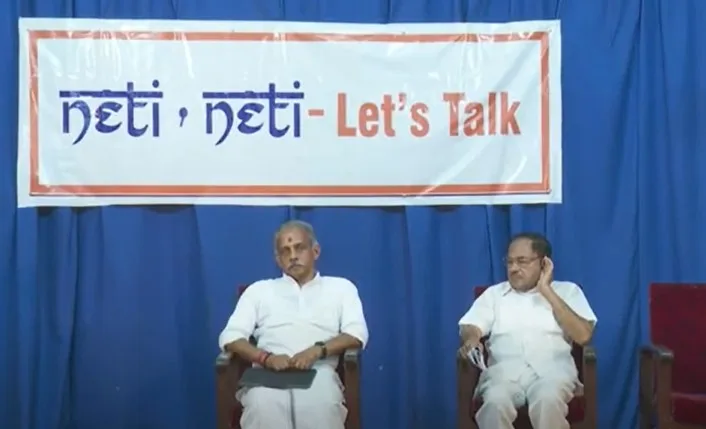
Those who uphold the importance of freedom of expression must also uphold fundamental responsibilities, asserted Prajna Pravah National Convenor J. Nandakumar in Thiruvananthapuram with strong emphasis. He pointed out that Kerala is witnessing a peculiar and selective kind of freedom of expression. He was delivering the keynote address in connection with the ‘Drawing The Line’ debate organised by the Nethi Nethi Debate Forum on April 16.
Nandakumar strongly criticised the media for following a deliberate policy of insulting Union Minister Kiran Rijiju when he addressed a press conference in Kochi regarding the Munambam Waqf issue. He condemned this as a clear misuse of the so-called “duty of the press.”
Citing a blatant example of selective outrage, Nandakumar drew attention to a Palakkad MLA who insulted RSS founder Doctorji over the naming of a skill development institute for differently abled children—yet it was shamelessly justified as freedom of expression.
He asserted that if critics truly understood history, they would recognise Dr Hedgewar’s sacrifice—his jail terms and active involvement in India’s freedom struggle. Instead, they choose to ignore these facts.
The present-day defenders of “free speech” are blindly following Jawaharlal Nehru, who himself set a precedent of intolerance by banning a film and biography that criticised him.
He reminded the audience of how Nehru attempted to curtail press freedom, citing the example of the Organiser weekly case in post-Independence India in 1950. When Organiser won a legal battle defending press freedom, Nehru refused to accept the verdict—instead, he manipulated the system by resorting to law-making to suppress dissent. Yet today, his ideological followers have the audacity to deliver sermons on free speech.
As Nandakumar highlighted, the film Empuraan took full liberty to ridicule constitutional authorities and investigative agencies—despite the Supreme Court having laid bare the truth behind the Gujarat riots. Yet, no cinema hall faced any disruption. Silence was the response. In stark contrast, The Kashmir Files and The Kerala Story—films grounded in factual accounts and true events—faced fierce resistance in Kerala. So much for free expression in a state that claims to defend it.
The Prajna Pravah leader added that slogans were raised by an ‘organised’ community against Duravastha, a great poetic work by Mahakavi Kumaran Asan, authored after visiting the Malabar area where Hindus were massacred during the 1921 Khilafat–Mappila Riot. Yet, the bold and courageous Asan did not yield, but chose to stand by his poetic work and his right to expression.
J Nandakumar felicitated A Kasturi, who resigned from the CPM and joined the Sangh-inspired Hindu Aikyavedi as its Thiruvananthapuram district president. His late father Anirudhan was a senior CPM leader and an MLA in the Kerala Assembly. Kasturi’s brother is a prominent CPM leader in Kerala, a former Lok Sabha MP, and a former emissary of the Government of Kerala to Delhi.
Dr M Abdul Salam, former Vice Chancellor of Calicut University, delivered the introductory speech. A S Gopinath IPS, former Inspector General of Police and president of the Nethi Nethi Debate Forum, chaired the event. Adv. Manju was the moderator.













Comments